You're on your fourth Zoom call of the morning. The camera is on, the mute button is working, but the voices coming through your speakers are thin and distant. Later, you'll sit in a conference room with six coworkers talking over each other, and the noise will make every sentence a puzzle. Then comes the moment someone notices you leaning in, cupping your ear, asking "What did they say?"
Hearing aids that work for home—with your family in a quiet living room—are not the same as hearing aids that work for the modern office. The 2026 work day is hybrid, multi-platform, and full of competing voices. The technology that matters most is not invisible invisibility; it is clarity you can rely on from 8 a.m. until 5 p.m., whether you are on a screen or in the same room as your colleagues.
What Modern Work Actually Asks of Your Hearing Aids
Professional life in 2026 involves four to eight video calls per day across Zoom, Teams, Google Meet, and Webex. In-person meetings still matter, but they happen in rooms with poor acoustics, multiple voices at once, and the ambient noise of open offices. All-day comfort is non-negotiable. You cannot remove your hearing aids at 2 p.m. because your ear is fatigued, and you cannot blame a technology failure when you miss a critical detail from a senior leader. The stakes are clarity, confidence, and the ability to participate without apology.
Bluetooth for Video Calls: Why Direct Audio Streaming Matters
When your hearing aids connect directly to your laptop or phone via Bluetooth, call audio routes straight into both ears. You no longer need a separate headset. Your office microphone still picks up your voice—or you can use your computer's built-in mic, or an external USB mic for better quality. The difference is profound: instead of listening to compressed audio leaking from your desk speaker, you hear call participants at a volume and frequency profile tuned to your hearing profile. Both Panda Air and Panda Quantum support full Bluetooth for calls, TV audio, and music, which means you can seamlessly move from a video meeting to a Slack call to streaming audio without any device swaps.
Best for Stigma-Free Office Presence: Panda Air
Panda Air is designed to look and feel like modern wireless earbuds—the same silhouette as AirPods, without the medical look. In a conference room or on a video call with your camera on, nobody has to know it is a hearing aid. That stigma-free design is not cosmetic; it is practical for professionals who want support without drawing attention or triggering workplace assumptions about their capability. The fast-charge case delivers 60 hours of total battery per charge cycle, meaning you never plan your day around a dead hearing aid. Bluetooth streaming is seamless, multiband adaptive noise reduction handles the open-office chatter, and the clinically tuned self-fitting is as accurate as prescription devices for users with mild to moderate hearing loss. At $299 (was $399, save $100), Panda Air is the sensible choice for everyday work clarity and unspoken confidence.
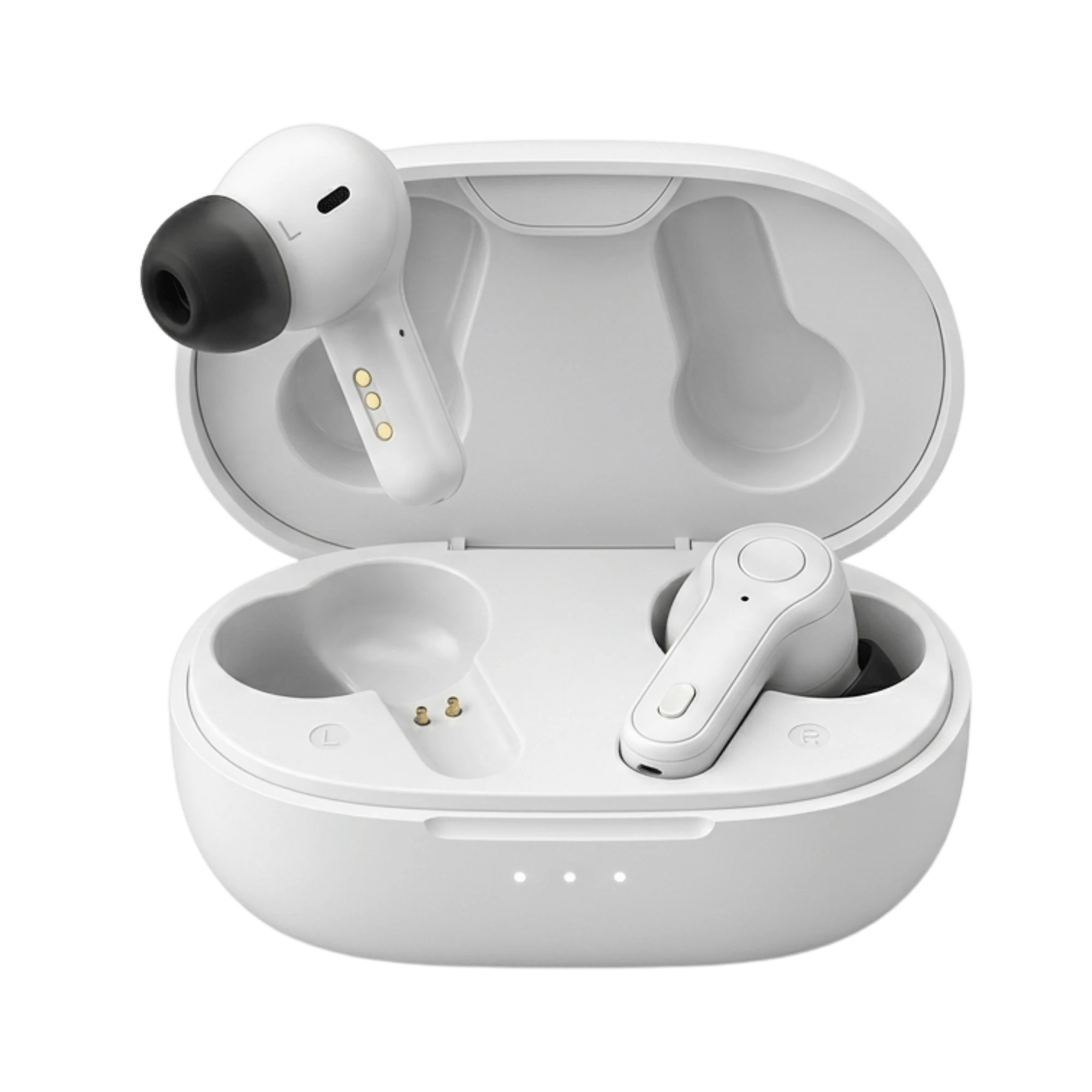
Best for In-Person Meeting Clarity: Panda Quantum
Conference rooms have poor acoustics by design—hard walls, reflective surfaces, and voices bouncing off every surface. Panda Quantum is built for exactly this moment. Its 16-channel WDRC with adaptive multi-band noise reduction analyzes each speaker's contribution to the room in real time and separates speech from ambient noise. Frequency-matching technology corrects the specific gaps in your hearing profile, the same way an audiologist measures them in a fitting. When three people talk at once, Quantum's directional microphones focus on the speaker in front of you while managing the ones to your sides, not boosting them equally. The result: you hear the presenter clearly while the side chatter fades to a manageable background. Quantum also includes adaptive tinnitus masking, which generates soothing sounds if ringing interferes with your concentration. The rechargeable magnetic case provides 20 hours per charge, with three additional full recharges in the case—80 hours total, meaning you work the entire week without touching an outlet. It supports full Bluetooth for hybrid meetings where you transition from a video call to an in-person presentation. Quantum is clinical-grade engineering at a fraction of the cost of prescription devices: $349 (was $499, save $150).

What About Audiologist-Fitted Premium Options?
Phonak Roger systems (wireless clip-on microphones that broadcast directly to your hearing aids) are genuinely the best-in-class solution for boardroom hearing. The speaker wears the microphone, and you receive clear, isolated speech. But a complete setup—audiologist fees, hearing aids, Roger receivers, and microphones—costs $5,000 to $7,500 or more. Oticon Real and Widex SmartRIC use deep neural networks for noise reduction, which is more computationally intensive than Panda's adaptive architecture. For a professional considering options, the honest comparison is this: Panda Quantum delivers 80% of the clinical benefit for 5% of the cost. You will hear conversations in conference rooms, understand multiple speakers, and manage video calls with clarity and confidence. The trade is that you do not get the ultra-premium features of a $4,000 prescription device—you get professional-grade OTC engineering that solves the actual problem: hearing clearly at work.
Clinically Tuned Hearing in Ten Minutes
Panda Air and Quantum both include a clinically tuned 10-minute online hearing test—no clinic visit required. The test measures the specific frequencies you struggle with and adjusts each device to correct those gaps. This is the same principle an audiologist applies during a prescription fitting: identify the user's unique hearing profile and compensate by frequency. You take the test at home, on your own schedule, and the hearing aids apply the correction immediately. The result is personalization without the appointments, the clinic fees, or the fitting visits.
Practical Strategies for Meeting Clarity
No hearing aid is a magic solution to bad meeting design. Sit close to the speaker whenever possible—distance and acoustics matter more than processing power. Request an agenda in advance so you can anticipate topics and vocabulary. Use auto-captions on Zoom and Teams as a backup; they are imperfect but catch details you miss in noise. Take five-minute ear breaks every ninety minutes to prevent fatigue. Position yourself away from open windows, kitchen noise, or hallway traffic if you are in an open office. These are not workarounds for weak hearing aids; they are professional practices that work for everyone, amplified by devices that let you participate without strain.
Workplace Accommodation and Disclosure
Hearing aids are not a secret you must keep. Under the ADA, you may request workplace accommodations—live captions on video calls, preferred seating in conference rooms, or a quieter workspace. Disclosure is entirely your choice, and Panda Air's appearance means you can manage that choice with complete discretion. Many professionals disclose hearing loss to HR to secure reasonable accommodations without disclosing to their entire team. If you choose to disclose, a simple, confident statement—I use hearing aids, and I hear best when we use live captions and I can see your face—reframes the device as a tool, not a limitation.
What This Comes Down To
For most working professionals, Panda Air delivers stigma-free style and all-day comfort for video calls at $299. Panda Quantum adds serious in-person meeting clarity through 16-channel processing and directional audio at $349. Both have Bluetooth, both support clinically tuned self-fitting, both carry a 5-year warranty, and both come with a 45-day risk-free trial. Together, they cover the full range of modern work moments—from your laptop screen to the conference room table.
Frequently Asked Questions
Can I take a Zoom call with hearing aids instead of separate headphones? Yes. Panda Air and Quantum both stream audio directly from your computer or phone via Bluetooth. Call audio routes straight to your ears at a personalized volume and frequency profile. Your computer microphone still captures your voice, or you can use an external USB mic for better speech quality on your end.
Will my coworkers know I'm wearing hearing aids? With Panda Air, likely not. The earbud-style design looks like AirPods, not a medical device. Quantum uses a receiver-in-canal (RIC) design with a thin tube and earmold, which is more visible than Air but still discreet for most office settings. Both devices are designed for people who want support without drawing attention.
Do hearing aids work in conference rooms with multiple speakers? Yes, but only with the right technology. Panda Quantum's 16-channel WDRC and adaptive noise reduction are engineered for this scenario. Directional microphones help you focus on the nearest speaker while managing side noise. It will not make a poorly acoustical room sound perfect, but it separates speech from reverberation far better than basic amplification or low-channel hearing aids.
Should I tell my boss or HR about my hearing aids? That is entirely your choice. The ADA protects your right to request accommodations (captions, preferred seating, quieter spaces) without disclosing the reason. Many professionals choose to disclose to their immediate manager or HR for peace of mind, knowing they have documentation and support. Others prefer full privacy. Either way, modern hearing aids let you participate confidently without explanation.
The Bottom Line for Working Professionals
Hearing aids for work are not the same as hearing aids for home. You need devices that handle video calls without a separate headset, that manage multiple speakers in noisy rooms, and that stay comfortable and charged through a full workday. Panda Air solves the video-call moment with earbud-style discretion and Bluetooth streaming at $299. Panda Quantum solves the in-person moment with clinical-grade processing for speech clarity at $349. For $648, you can cover both scenarios with FDA-OTC devices that rival prescription hearing aids in performance. That is the difference between struggling through meetings and actually hearing what your colleagues say.
Ready to hear clearly at work? Panda Air hearing aids are built for professionals who want stigma-free support for everyday moments, while Panda Quantum delivers serious meeting clarity. Both models include a clinically tuned self-fitting, Bluetooth streaming, and a 45-day trial. Visit pandahearing.com to start your hearing test today.