How Tiny Resonators Inside Earplugs Could Block More Low-Frequency Noise and Better Protect Hearing
A new acoustic engineering study shows that adding Helmholtz resonators to passive earplugs can boost low-frequency noise reduction by up to 15 decibels, an advance that could change how workers, musicians, and concertgoers protect their ears from noise-induced hearing loss.
Earplugs are one of the simplest and most widely used tools for preventing noise-induced hearing loss, but they have a known weak spot. The cheap foam plugs handed out at job sites and concert venues do a fine job of blocking high-frequency sounds, the kinds of noises that hiss and squeal, but they tend to let lower-frequency rumbles through. That is why a forklift engine, a rock concert bass line, or a power saw can still feel loud even after you push plugs deep into your ear canals.
A team of acoustic researchers in Canada and France has now tested a passive design that aims to fix that gap, using small resonator chambers built directly into the body of an earplug. Their results, published in The Journal of the Acoustical Society of America, suggest the approach can add as much as 15 decibels of extra attenuation in the troublesome low-frequency range, with no batteries or electronics required.
About This Study
Title: Improving low-frequency attenuation of passive earplugs using Helmholtz resonators
Authors: Kevin Carillo, Franck Sgard, Olivier Dazel, Olivier Doutres
Affiliations: Institut de recherche Robert-Sauve en sante et en securite du travail (IRSST), Montreal, Canada; Laboratoire d'Acoustique de l'Universite du Mans (LAUM), CNRS, Le Mans Universite, France; Department of Mechanical Engineering, Ecole de technologie superieure (ETS), Montreal, Canada
Journal and date: The Journal of the Acoustical Society of America, Volume 159, Issue 4, pages 3702 to 3712, April 2026
Study type: Acoustic modeling with experimental validation on a test fixture and human participants
PubMed DOI: 10.1121/10.0043161
Background: Why the Researchers Looked at This
Noise-induced hearing loss is one of the most preventable causes of permanent hearing damage. Repeated exposure to loud sound, whether on a construction site, in a factory, on a flight line, or at a concert, gradually destroys the delicate sensory hair cells inside the inner ear. Once those hair cells are gone, they do not grow back. Hearing protection works by lowering the level of noise that actually reaches the ear, so the inner ear gets a smaller dose of damaging energy.
The challenge is that real-world earplug performance is rarely as good as the rating on the package. Fit can be imperfect, plugs can shift during the day, and the physics of small foam or silicone plugs simply do not block all frequencies equally well. In particular, low-frequency sound, which has long wavelengths and travels easily through small leaks and through the body of the plug itself, often slips past. The authors point out that this uneven attenuation does not just reduce overall protection. It also distorts the sound that the wearer hears, which can hurt speech intelligibility and make people pull plugs out so they can communicate.
A Helmholtz resonator is a classic acoustic device, basically a small enclosed cavity connected to the outside through a narrow neck. Blowing across the top of an empty bottle is the everyday version of the same idea. A resonator strongly absorbs or reflects sound at a specific frequency that depends on the size of the cavity and the neck. The research team wanted to know whether placing several of these resonators inside an earplug could selectively cancel low-frequency sound through interference, without adding any active electronics.
How the Study Was Done
The researchers started with an analytical model of how a passive earplug attenuates noise. From that model they derived the exact condition for maximum noise reduction inside the occluded ear canal. The key insight is that low-frequency attenuation is determined by the reflection coefficient at the inner surface of the earplug, the surface that faces the trapped air column between the plug and the eardrum. When the wave reflected off that inner surface arrives back in anti-phase with an incoming wave, the two cancel each other out through destructive interference, which is exactly what you want for hearing protection.
To translate that theory into a real device, the team built so-called meta-earplugs that incorporated three Helmholtz resonators tuned to the low-frequency region. They tested these prototype plugs in two ways. First, they used an acoustic test fixture, essentially a synthetic ear canal with a calibrated microphone where the eardrum would be, which let them measure attenuation under tightly controlled conditions. Second, they ran trials with human participants to confirm that the same effects show up in real ears, where individual anatomy and fit can introduce variability.
The team also stress-tested the design by deliberately introducing small leaks around the plug, since real-world wearers rarely achieve a perfect seal. This let them check whether the resonator-based gains held up when the fit was less than ideal.
What the Researchers Found
Both the test fixture measurements and the human ear measurements showed the same pattern. Tuning the Helmholtz resonators so that the reflected wave was either in anti-phase with the incident wave, or close to a 90 degree phase offset, increased low-frequency attenuation by up to 15 decibels for sounds below 1 kilohertz. A 15 decibel improvement is not subtle. Each 10 decibels roughly halves the perceived loudness of a sound, so adding 15 decibels of low-frequency attenuation can take a noise that feels uncomfortably loud through a standard plug and bring it down toward a level that is much closer to comfortable conversational hearing.
Importantly, the gains held up under imperfect fit. Even when the team introduced moderate acoustic leakage around the plug, the resonator-equipped design still outperformed conventional passive designs in the low-frequency range. That matters because much of the gap between laboratory ratings and real-world performance comes from leaks. A protector that still works when the seal is not perfect is more useful in noisy workplaces and venues than one that depends on lab-grade insertion.
The authors also note that the resonators used in the prototype were originally designed to address the occlusion effect, the booming, hollow quality wearers often hear from their own voice when their ears are plugged. So the same passive elements that boosted low-frequency attenuation also have the potential to make plugs feel and sound less obtrusive on the head, which could improve comfort and willingness to wear them for long shifts.
Taken together, the findings suggest that fully passive earplugs still have meaningful engineering headroom. Better low-frequency performance, achieved without batteries, microphones, or active circuits, would be cheaper, more durable, and easier to deploy at scale than equivalent improvements based on active noise cancellation.
What It Means for People with Hearing Loss
Most adult-onset hearing loss has more than one cause. Age, genetics, and medications all play a role, but cumulative noise exposure is one of the biggest controllable contributors. Improving how well a passive earplug blocks low-frequency sound, the part of the spectrum that has historically been the weakest point of these devices, could meaningfully reduce future hearing damage in people whose work or hobbies put them around loud machinery and music.
For people who already have noise-induced hearing loss, the practical message is twofold. Protecting whatever hearing you still have is now potentially achievable with simpler, fully passive devices that do not need batteries or active electronics. And because resonator-based plugs deliver more even attenuation across frequencies, the sound that does pass through is less distorted, which makes ongoing communication in noisy environments easier and reduces the temptation to pull protection out at exactly the wrong moment.
When Noise-Induced Hearing Loss Has Already Set In, OTC Amplification Without a Clinic Visit
Better earplugs are part of the answer, but for the millions of adults who have already lost hearing from years of noise exposure, the next question is access to amplification. Noise-induced hearing loss tends to land first and hardest in the higher frequencies, which is exactly the range that makes consonants intelligible and conversations clear. People in this position often delay treatment because of cost, time, or the prospect of multiple clinic visits.
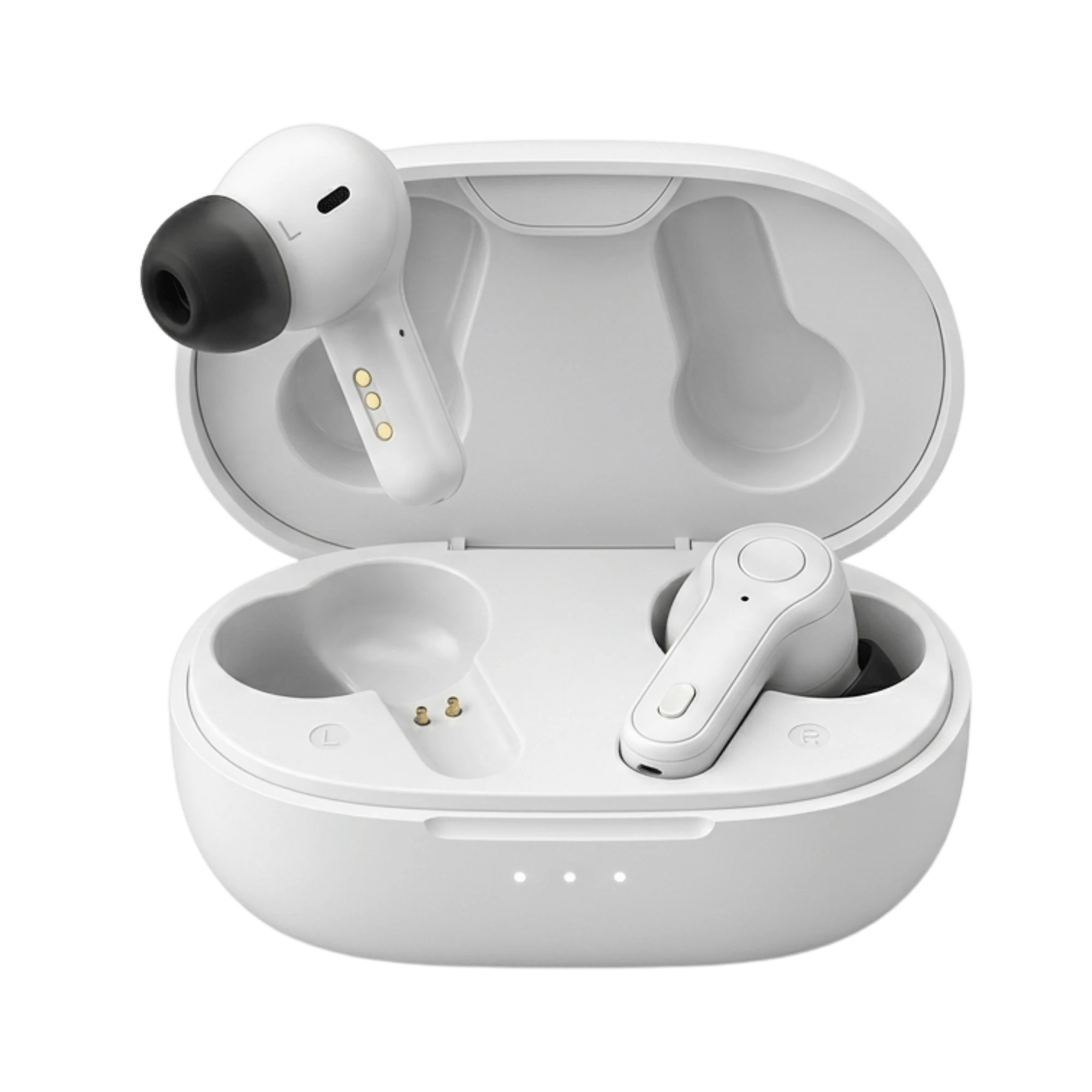
Panda Air is built around that gap. It is a 16-channel earbud-style in-the-canal device with multi-band adaptive noise reduction and a 60-hour fast-charge case, and it includes the Panda app-based in-ear hearing test. After the device arrives, the wearer pairs it with the Panda app, which runs a frequency-specific hearing test through the hearing aid itself and then automatically programs the device's gain and frequency response to match the audiogram, similar to what an audiologist does at an in-person fitting. That removes the need to take time off work just to start hearing better, and the 5-year warranty plus 45-day return window make trying it lower-stakes. Learn more at pandahearing.com/products/panda-air.
A reasonable caveat: OTC hearing aids are designed for adults with mild-to-moderate hearing loss. People whose noise exposure has driven loss into the severe range still benefit most from working with a clinical audiologist, since that level of loss often calls for more aggressive fittings and careful counseling.
Limitations of This Research
This is a proof-of-concept study, not a workplace trial. The prototype meta-earplugs were tested on a controlled acoustic fixture and on a small group of human participants. Long-term wear comfort, durability, and how the design performs across a wide range of head shapes and ear canal sizes still need to be established before the technology shows up in everyday workplace and consumer protectors. The frequency band of strongest improvement also depends on tuning the resonator cavities, so a single design will not be optimal for every type of noise exposure.
The work was carried out at IRSST, a Quebec occupational health and safety research institute, and at academic acoustics labs in France and Canada. The paper does not describe a commercial product partnership, and no industry funding is highlighted in the available metadata.
Where This Leaves Us
Passive earplugs have been a staple of hearing conservation for decades, but their low-frequency weakness has long been a known limitation. By engineering the inside surface of a plug to reflect sound back in destructive interference, the authors show that fully passive designs still have meaningful headroom left. If this approach makes its way into commercial earplugs, the next generation of hearing protection could deliver flatter, more useful attenuation, encourage longer and more consistent wear, and protect more of the hearing that people in loud environments still have.
Carillo K, Sgard F, Dazel O, Doutres O. Improving low-frequency attenuation of passive earplugs using Helmholtz resonators. The Journal of the Acoustical Society of America. 2026;159(4):3702-3712. Retrieved from PubMed. https://doi.org/10.1121/10.0043161