Panda Quantum vs Austar PocketAid 3: When You Want Clear Conversation in Any Room

You are at a family dinner at your favorite restaurant. The conversation at your table is warm and easy, but the sound around you is chaos - clinking glasses, laughter from the neighboring booth, the clink of silverware. You lean forward, trying to catch what your daughter just said. She repeats it. Again. This moment, where speech gets buried in background noise, is where most hearing aids fail. A simple volume boost drowns the whole room equally - you hear the chaos louder, not the words more clearly.
The Austar PocketAid 3 is a basic OTC amplifier: simple, affordable, and exactly what it says it is. The Panda Quantum is something different. It does not amplify the room. It listens to your hearing profile, matches frequencies the way an audiologist would, and delivers speech at the volume the rest of the table can live with. For anyone whose life involves restaurants, family gatherings, or simply wanting to hear clearly without drawing attention, that distinction changes everything.
An Overview: Amplification vs. Precision Hearing Correction
The Austar PocketAid 3 belongs to a category of budget OTC amplifiers. It provides basic volume boost across a limited frequency range, using a small number of sound channels to process audio. Most users need to manually adjust the device for different environments - a restaurant setting requires different tweaks than an office call. Battery life is moderate, and the wired earphone design can feel dated compared to modern hearing aid form factors. It is not a bad device for someone with mild hearing loss who simply wants to amplify quiet sounds. But amplification is not the same as correction.
Panda Quantum uses frequency-matching technology, an approach developed for prescription-grade devices costing $3,000 and up. A clinically tuned 10-minute online hearing test maps the specific frequencies where your hearing drops off - the exact frequencies an audiologist would identify in a fitting room. The device then corrects those gaps, not by turning up the volume everywhere, but by applying the right amount of gain at each frequency. This is why restaurant noise feels less overwhelming: speech frequencies get the boost they need, while background clamor does not. The result is clarity, not just loudness.
Comparison: Panda Quantum vs Austar PocketAid 3
| Panda Quantum | Austar PocketAid 3 | |
|---|---|---|
| Price | $349 (was $499, save $150) | $150-$250 (entry amplifier) |
| Form Factor | Modern RIC (receiver-in-canal) - cable-free, compact, discreet | Wired body amplifier with wired earphone - visible and felt in pocket |
| Channels | 16-channel WDRC + ANR (precise, independent frequency correction) | 2-4 channels (basic, broad amplification across frequencies) |
| Frequency Range | 250-5,500 Hz (wideband, covers speech and lower tones) | 500-4,000 Hz (narrow, speech-only, misses low and high frequencies) |
| Noise Reduction | Adaptive multi-band NR (learns the environment, adjusts automatically) | 6-9dB basic NR (fixed, manual mode switching required) |
| Battery Life | 20 hrs per charge; case recharges 3 more times = 80 hrs total (no buying batteries, no planning around charging) | ~40-60 hrs on disposable AA (batteries to buy, waste, and carry) |
| Personalization | Clinically tuned 10-min self-fitting hearing test at home (matches your frequency gaps) | Fixed preset - one size fits all (no personalization) |
| Bluetooth | Yes (calls, TV audio, music direct to ears) | No (cannot route phone calls or TV) |
| Warranty | 5-year + 45-day money-back guarantee | 1-year limited (typical for budget amplifiers) |
| FDA-OTC Certified | Yes (FDA-OTC, FCC, CE certified) | CE compliance (not FDA-OTC, less rigorous oversight) |
Why Austar PocketAid 3 Struggles at the Restaurant Table
You are at dinner again. Your server asks how the meal tastes, and you miss it. The Austar PocketAid 3 has 2-4 channels, which means it processes sound in broad, crude blocks rather than precise frequencies. When it detects noise in the room, it applies the same gain reduction across everything in that frequency range - which includes much of the speech you are trying to hear. The result is a kind of muffled quality, where the room is quieter but the words are less distinct. You turn up the volume, which helps with speech but brings the background noise back up. It is a cycle.
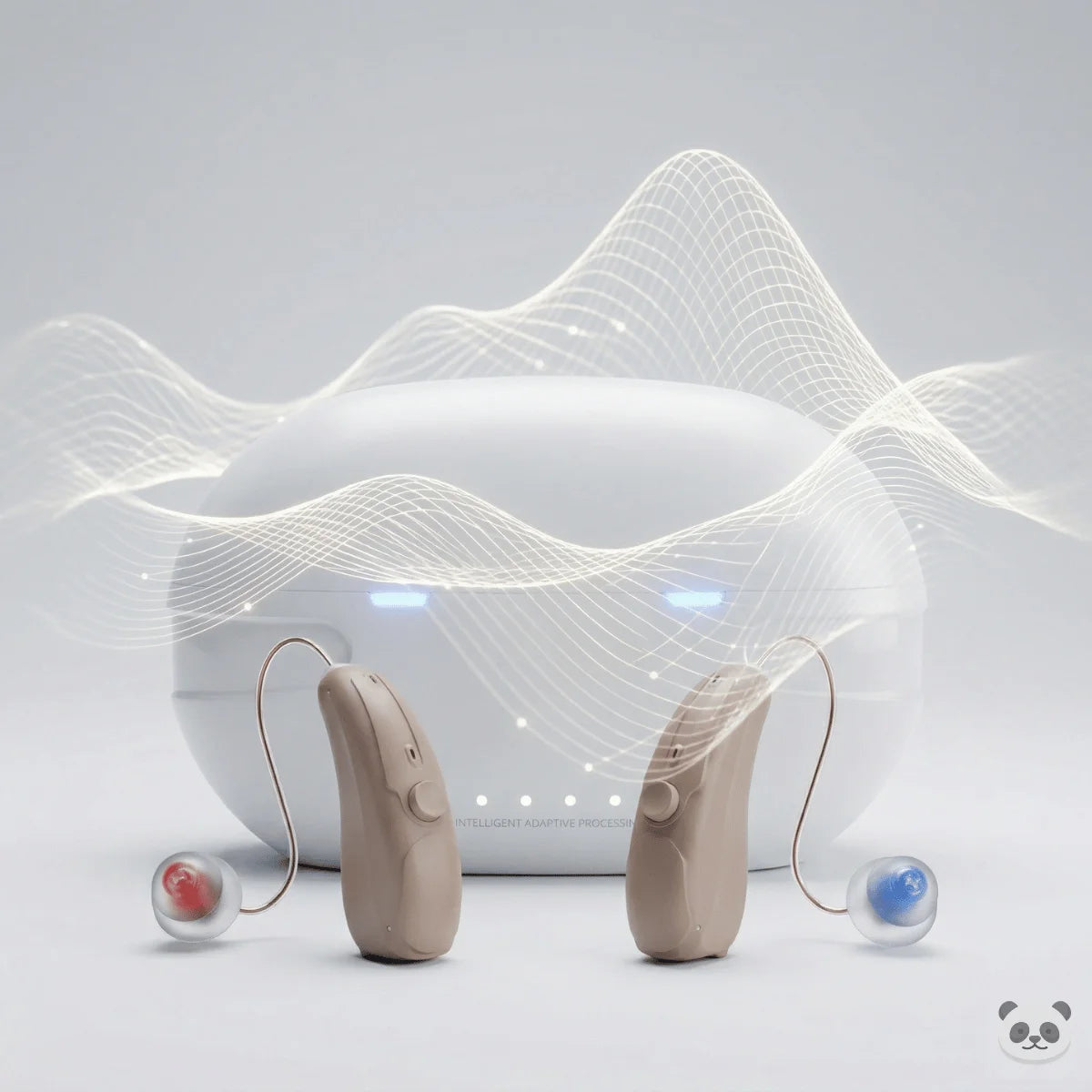
Panda Quantum handles this moment completely differently. Its 16 channels and adaptive noise reduction analyze the acoustic scene in real time, separating speech patterns from stationary background noise. The frequency-matching technology learned from your hearing test means each channel is tuned to YOUR hearing gaps. Speech is not just louder - it is clearer, arriving at your ear with the right tonal balance. The restaurant stays clear, and you can actually enjoy the conversation again.
The Wired Amplifier vs. Wireless Modern Form Factor
The Austar PocketAid 3 is a body-worn amplifier with wired earphones. That design choice affects daily life more than many realize. The device lives in your pocket or on a belt clip - visible when you bend, obvious when you reach for your phone. The wires running to your ears can shift during the day, requiring constant adjustment. Putting on a coat or sitting in a car seat means repositioning the whole thing. For someone who values discretion, this form factor works against you.
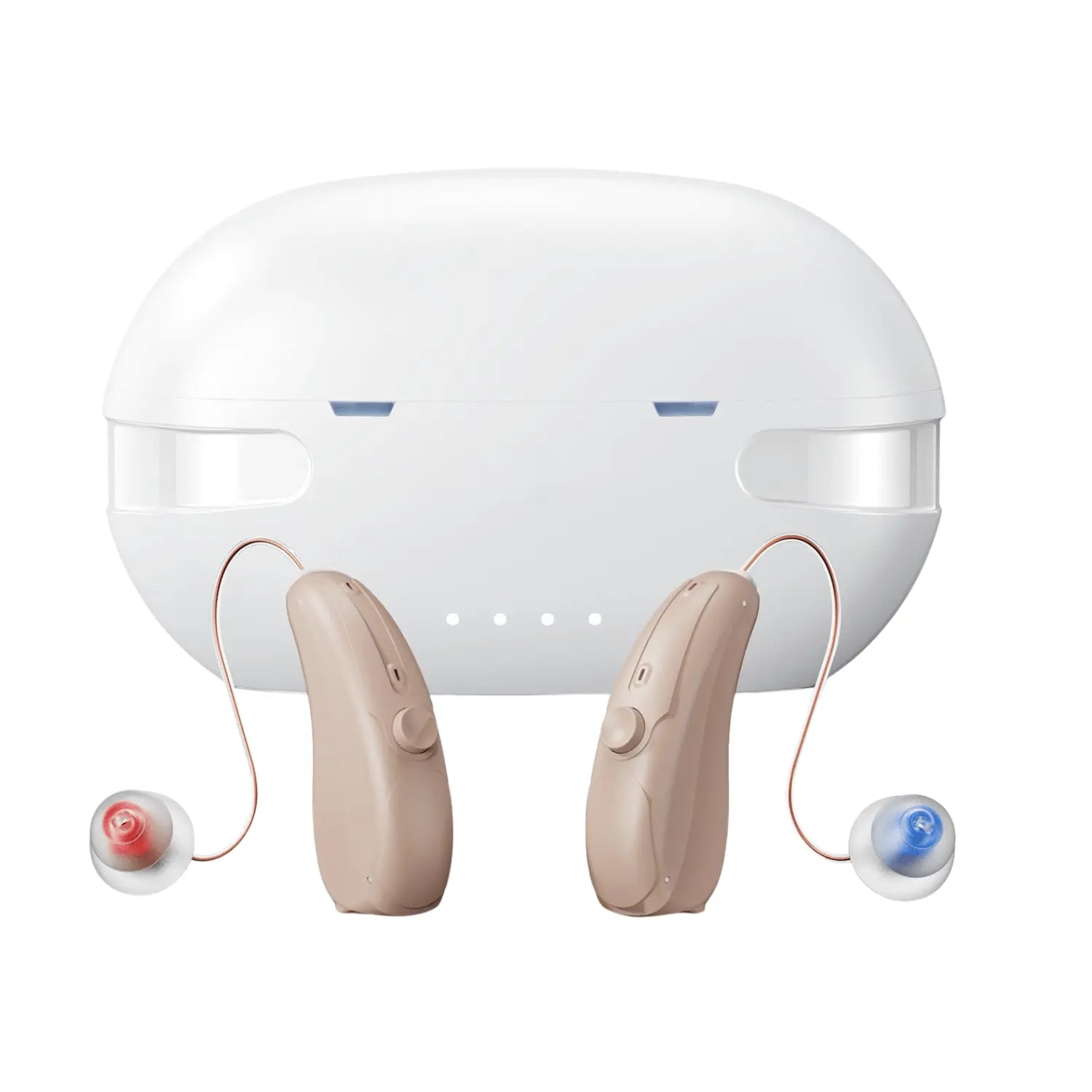
Panda Quantum's RIC design (receiver-in-canal) changes this. Both hearing aids sit invisibly in your ears, with only a thin wire connecting to a small receiver. No pocket clip, no wires down your chest, nothing visible when you move. Real Hearing Correction. On Your Terms. The device becomes part of your day, not a visible accommodation. That freedom - to wear what you want, sit how you want, without repositioning - matters more than specs can capture.
Battery Convenience: Rechargeable vs. Disposable Cycles
The Austar PocketAid 3 runs on AA batteries - either disposable or rechargeable variants. The lifespan is decent, typically 40-60 hours per set. But each time the batteries run out, you are hunting for replacements, opening the battery compartment, and waiting for a recharge if you chose rechargeable cells. You carry spares. You plan trips around charging windows. It is a small friction, repeated over and over.
Panda Quantum's magnetic charging case eliminates that cycle. A single overnight charge gives you 20 hours of listening time. The case itself holds a full recharge reserve - three additional charging cycles built in - for 80 hours of total use. You never plan around batteries. You never buy replacements. Never Worry About Your Batteries Again. The hearing aids slide into the case at night, come out in the morning ready to go, and the simplicity of that experience compounds over months and years. This is why battery life is not a spec - it is a freedom.
Clinically Tuned Self-Fitting: Your Hearing, Your Home, Ten Minutes
The Austar PocketAid 3 comes with a preset amplification curve. One size fits all users, regardless of age, hearing profile, or lifestyle. Some people will love it immediately. Many will struggle with the tone - too much high frequency, too much low frequency, a "tinny" quality that takes weeks to adjust to. If the preset does not match your hearing, you are stuck with it.
Panda Quantum's clinically tuned self-fitting process is the same principle an audiologist uses in a fitting room - but it happens at home, in ten minutes, for free. You take a simple hearing test on our website, which maps the specific frequencies where your hearing drops off. The device is then personalized to correct those gaps with precision. The same frequency-matching principle used in $3,000+ prescription devices, at a fraction of the cost. You get a hearing aid that was built for YOUR ears, not someone else's average. The result is a natural tone from day one, not a weeks-long adjustment period.
Adaptive Tinnitus Masking: When Quiet Rooms Ring
Many people with hearing loss also experience tinnitus - that constant ringing, buzzing, or hissing in the ears that seems louder when the room is silent. The Austar PocketAid 3 offers no tinnitus support. If ringing is part of your hearing loss story, this device cannot help.
Panda Quantum includes adaptive tinnitus masking - a feature that generates soft, soothing sounds that adapt to your tinnitus profile. These sounds are not meant to cover the ringing; they are meant to reorient your brain's attention away from it. Over time, many users find the ringing fades into the background. It is not a cure, but for someone whose tinnitus makes quiet moments difficult, it is relief.
Our Verdict: Panda Quantum Wins This Comparison
The Austar PocketAid 3 is an affordable, basic amplifier for users who just want volume. But real hearing correction requires more: frequency-matching precision, adaptive processing, multiple channels, and personalization. Panda Quantum delivers all of that at $349 (was $499, save $150). You get FDA-OTC certification, a 5-year warranty, 80 hours of total battery per charge cycle, Bluetooth connectivity, tinnitus masking, and a clinically tuned fit that was built for your hearing profile. This is engineering beyond the price, not just amplification at a lower cost. For anyone who wants clarity in noisy rooms, the freedom of a modern form factor, and the confidence that comes with real hearing correction, Panda Quantum is the clear choice.
FAQ: Panda Quantum vs Austar PocketAid 3
Is Panda Quantum really better than the Austar PocketAid 3 for restaurant noise?
Yes. The PocketAid 3 has 2-4 channels and fixed noise reduction - it boosts volume equally across broad frequency ranges, making background noise louder alongside speech. Panda Quantum has 16 channels and adaptive multi-band noise reduction that separates speech patterns from stationary noise. The difference is clarity vs. loudness. At a restaurant table, that distinction is the difference between hearing the conversation and just hearing the room louder.
How much will I save switching from the Austar PocketAid 3 to Panda Quantum?
The PocketAid 3 costs $150-$250 upfront. Panda Quantum is $349 (was $499). Over time, the Quantum saves you money on batteries - the PocketAid 3 requires ongoing AA battery purchases (either disposable or the power to recharge cells frequently), while Quantum's magnetic case charges overnight and holds 80 hours of reserve. The warranty difference is also significant: Panda Quantum includes a 5-year warranty and 45-day money-back guarantee, while budget amplifiers typically offer 1-year limited coverage. Long-term, Quantum is the better investment.
Does Panda Quantum do everything the Austar PocketAid 3 does, plus more?
Functionally, yes - and then some. Both amplify sound for people with hearing loss. But Quantum adds frequency-matching technology (personalization based on your hearing profile), adaptive noise reduction (learns your environment in real time), 16 channels (vs. 2-4), Bluetooth connectivity (routes calls and TV audio), tinnitus masking, and a modern wireless form factor. The Austar PocketAid 3 does one thing - amplify - and does it affordably. Panda Quantum corrects hearing the way clinical devices do, just at an accessible price and without the clinic visit.
The Bottom Line for People Who Want Clarity in Noise
If you have dinner at a restaurant, sit in a family meeting, or simply want to hear clearly when there is background noise, the Austar PocketAid 3 will not solve it. A basic 2-4 channel amplifier cannot separate speech from noise the way a 16-channel frequency-matched device can. Panda Quantum handles the same moment completely differently: it learns the specific frequencies where your hearing drops off, corrects those gaps with precision, and adapts its noise reduction to the environment you are in. For $100 more than the PocketAid 3's highest tier, you get engineering that rivals devices costing ten times as much. That is why Panda Quantum is the clear choice for anyone tired of saying "What?" in noisy rooms.
Ready to experience the difference that real hearing correction makes? Visit Panda Quantum to take your personalized 10-minute hearing test, or contact our team for guidance on which Panda model fits your life best.