Deep Neural Network Directionality Helped Hearing Aid Wearers Follow Speech Without Losing Their Surroundings
An industry research team reports that a deep neural network based directionality system improved speech understanding in noise by up to 4.7 decibels while keeping wearers aware of sounds arriving from other directions.
The hardest thing a hearing aid has to do is separate one voice from a noisy room. Directional microphone systems have long been the main tool for that job, boosting sound from the direction a listener faces while turning down everything else. The trade-off is well known: the more aggressively a device focuses forward, the more the wearer loses track of voices and events elsewhere in the room.
A new study in the journal Audiology Research describes an attempt to soften that trade-off using deep neural networks, a form of machine learning trained on complex acoustic scenes. The system aims to enhance the speech a listener is attending to while deliberately preserving audibility of the surrounding environment.
Title: An Intelligent Directionality System for Hearing Aids Incorporating Deep Neural Networks: Improving Speech Understanding While Preserving Spatial Awareness
Authors: Daniel Marquardt, Jinjun Xiao, Al Ganeshkumar, Jingjing Xu, Larissa Taylor, Martin McKinney, David A. Fabry, Achintya K. Bhowmik
Affiliations: Starkey Hearing Technologies, Eden Prairie, Minnesota, USA
Journal: Audiology Research, published September 4, 2026
Study type: Device evaluation study (behavioral and objective testing)
PubMed DOI: 10.3390/audiolres16050132
Background: Why the Researchers Looked at This
Directionality algorithms are fundamental to modern hearing aids because they improve the signal-to-noise ratio, the difference in level between the speech a listener wants and the noise around it. Even small improvements in signal-to-noise ratio can translate into meaningfully better word understanding in a restaurant or a family gathering.
Conventional adaptive directionality relies on hand-tuned rules that generally assume the speech of interest is in front of the listener. That assumption works in many situations but fails in others, and it tends to come at the expense of spatial awareness: the wearer's sense of what is happening around them, from a name called across a room to a car approaching from the side.
The authors developed a directionality system driven by deep neural networks, trained on data representing complex acoustic scenes, that adjusts its spatial filtering dynamically. The stated goal is to enhance target speech while preserving access to environmental sounds, rather than maximizing one at the cost of the other.
How the Study Was Done
The team evaluated the new system against conventional directionality approaches across a range of acoustic scenarios. Listeners were assessed on word recognition performance, and they also rated perceived speech clarity and indicated which processing they preferred.
Alongside the human testing, the researchers built an objective intelligibility metric based on automated speech-to-text analysis. By feeding processed audio into a speech recognition system and scoring the transcripts, they could benchmark devices at scale and check that the objective scores lined up with what human listeners experienced.
What the Researchers Found
The headline results are expressed in decibels of improvement in the speech reception threshold, the signal-to-noise ratio at which a listener correctly repeats half of the words presented. Lower thresholds mean a listener can cope with more noise.
When target speech came from 90 degrees, directly to the listener's side, the new system improved the mean speech reception threshold by 1.4 decibels relative to legacy directionality. That situation, where the conversation partner is not in front, is exactly where conventional forward-facing directionality struggles.
When frontal target speech was accompanied by an interfering talker behind the listener, the system delivered a 4.7 decibel improvement over an omnidirectional setting. In everyday terms, that is the classic problem of following the person across the table while someone at the next table talks over your shoulder.
Preserving awareness of the wider scene appears to have worked as well. Spatial adaptation improved the audibility of environmental sounds in three out of four tested conditions, and the detection threshold for speech arriving from 135 degrees, behind and to the side, improved significantly by 2.42 decibels. The behavioral and objective assessments pointed in the same direction: better speech intelligibility together with maintained access to environmental sounds.
What It Means for People with Hearing Loss
For wearers, the practical promise of this line of research is fewer forced choices. Older directional processing often made a noisy restaurant more manageable at the cost of a slightly tunnel-like listening experience. A system that can attenuate a competing talker while still letting through a voice from off to the side is closer to how healthy hearing actually works.
It is worth being clear about what this study does and does not show. It demonstrates that a data-driven directionality system can beat conventional approaches on specific laboratory measures in controlled scenarios. Long-term, real-world benefit across many listening environments is the harder question, and it remains open. Still, the results add to growing evidence that machine learning is changing how hearing devices handle the fundamental speech-in-noise problem.
Clearer Speech in Noise Is the Benchmark for Everyday Hearing Aids Too
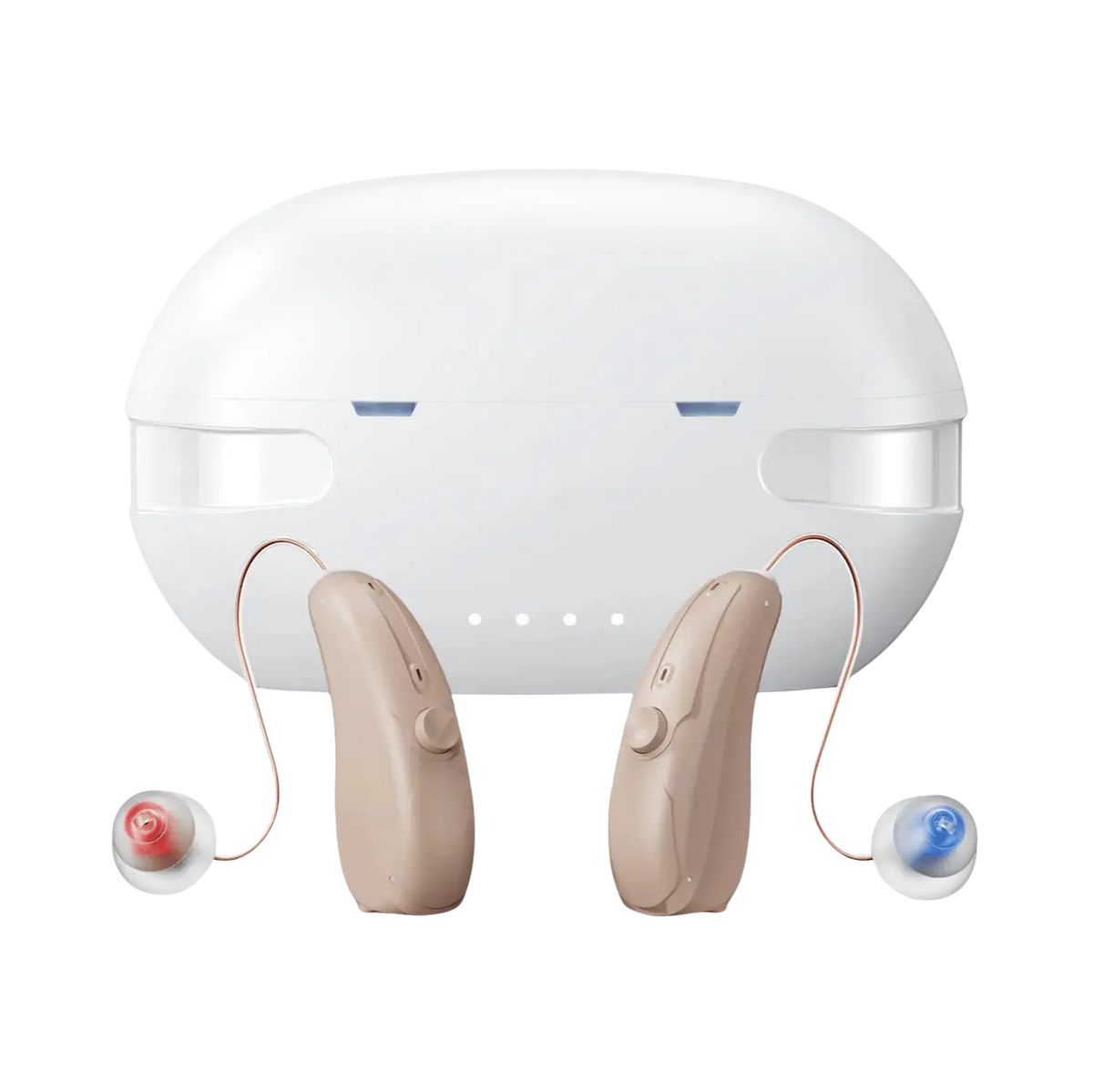
The problem this study tackles, keeping conversation clear when noise competes for attention, is the same benchmark everyday devices are judged by, including the newer generation of FDA-OTC hearing aids. Panda Quantum approaches it with 16-channel WDRC processing and adaptive noise reduction, a design aimed squarely at clear speech in noisy environments like restaurants and family dinners.
Quantum is a receiver-in-canal device that runs 20 hours per charge, with a case that carries three additional full charges for 80 hours of total use, plus Bluetooth for calls, TV, and music. An optional app can run an in-ear hearing test through the aid and personalize its response to the wearer's hearing profile, though the device works fully without the app or the test.
As with all speech-in-noise hearing aids sold over the counter, the category is designed for mild to moderate hearing loss; severe or profound loss still benefits most from a clinical fitting. Quantum comes with a 5-year warranty and a 45-day trial that begins when the product is received.

Limitations of This Research
All eight authors are employees of Starkey Hearing Technologies, the manufacturer whose system was evaluated, so this is industry research assessing its own technology; the affiliations are disclosed in the paper. Results for one manufacturer's system in controlled test scenarios may not generalize to other devices or to the messiness of real-world listening.
The study reports gains on selected laboratory conditions, and improvements were not uniform: environmental sound audibility improved in three of the four conditions tested, not all. The automated speech-to-text intelligibility metric, while scalable, is itself a proxy that the authors used to complement rather than replace human testing.
What to Do With This
If you wear hearing aids and still struggle in noise, this research is a reason for measured optimism rather than a product recommendation: it shows the field is finding ways to improve speech understanding without sealing the wearer off from the room. When evaluating any device, old or new, the most useful test remains the one this study used as its yardstick: how well you follow the conversation you care about while the world stays audible around you.
Marquardt D, Xiao J, Ganeshkumar A, Xu J, Taylor L, McKinney M, Fabry DA, Bhowmik AK. An Intelligent Directionality System for Hearing Aids Incorporating Deep Neural Networks: Improving Speech Understanding While Preserving Spatial Awareness. Audiology Research. 2026. Retrieved from PubMed. DOI: 10.3390/audiolres16050132