The Shape of Your Hearing Loss May Predict How Much Hearing Aids Help, Study Finds
A study of 351 adults with moderate sensorineural hearing loss finds that people whose hearing declines steeply at high pitches gained noticeably more speech clarity from hearing aids than people with flat, across-the-board loss.
Two people can walk out of a hearing clinic with the same diagnosis, moderate sensorineural hearing loss, be fitted with comparable hearing aids, and have very different experiences a year later. One finds conversation dramatically easier. The other hears sound more loudly but still struggles to make out words. Why the difference arises has been one of audiology's persistent puzzles.
Researchers in Seoul took a close look at one candidate explanation that is sitting in plain sight on every hearing test result: the shape of the audiogram, the curve that shows which pitches a person hears well and which they miss.
Title: Can Audiometric Configuration Predict Which Patients Derive Greater Speech Intelligibility Benefit from Hearing Aid Fitting?
Authors: Dae Hyun Kim, Jinsei Jung
Affiliations: Department of Otorhinolaryngology, Yonsei University College of Medicine, Seoul; Won-Sang Lee Institute for Hearing Loss; Severance Biomedical Science Institute; Bio-Centennial Convergence Institute, Yonsei University
Journal: Journal of Clinical Medicine, published September 24, 2026
Study type: Retrospective cohort study
PubMed DOI: 10.3390/jcm15197439
Background: Why the Researchers Looked at This
Sensorineural hearing loss, the most common form, comes from damage to the inner ear or hearing nerve rather than a blockage in the ear canal. Hearing aids reliably make sound audible again for people with this kind of loss, but audibility is not the same thing as understanding. The measure that matters most in daily life is speech intelligibility, how well a person can recognize words.
Improvements in word recognition after a hearing aid fitting vary substantially from person to person, and clinicians have lacked reliable ways to predict who will gain the most. That makes it harder to set expectations, choose candidates, and plan follow-up care.
The Yonsei team asked whether audiometric configuration could serve as such a predictor. A down-sloping configuration means hearing is relatively preserved at low pitches but drops off at high pitches, the pattern typical of age-related hearing loss. A flat configuration means hearing is reduced by a similar amount across all pitches.
How the Study Was Done
The researchers reviewed records of 351 adults who were newly diagnosed with moderate sensorineural hearing loss and fitted with hearing aids at a tertiary referral center between January 2017 and December 2021. Based on the difference between each person's low-frequency and high-frequency hearing thresholds, patients were classified as having either down-sloping or flat hearing loss.
Benefit was measured with the maximum word recognition score, a standard clinical test of the highest percentage of words a person can correctly repeat under ideal listening conditions. The test was given before fitting, one month after, and one year after, so the team could track both the immediate boost and the longer-term gain. Analyses were adjusted for age and sex.
What the Researchers Found
People with down-sloping hearing loss gained more, and the gap appeared quickly. One month after fitting, the down-sloping group improved their word recognition by an average of 10.43 percentage points, compared with 7.18 points in the flat-loss group, a statistically significant difference (p = 0.004).
The advantage held up over time. At one year, cumulative improvement reached 11.00 percentage points for down-sloping loss versus 6.79 points for flat loss (p = 0.020). In other words, the typical down-sloping patient ended the year with roughly 60 percent more measured speech benefit than the typical flat-loss patient.
The associations survived statistical adjustment for age and sex, suggesting the audiogram shape itself, not simply who tends to have each shape, was linked to the outcome. The authors' interpretation is that in down-sloping loss, the well-preserved low-frequency regions of the inner ear may give amplified high-frequency speech information a healthier pathway to build on, whereas flat loss may reflect more uniform damage throughout the cochlea.
Importantly, both groups did improve. Flat-loss patients still gained roughly 7 percentage points in word recognition, a meaningful real-world change. The difference is in degree, not in whether hearing aids helped.
What It Means for People with Hearing Loss
For the many adults whose hearing loss follows the classic age-related pattern, strong low pitches and fading high pitches, this study is encouraging news: that is precisely the group that showed the largest and most durable gains in speech understanding after being fitted with hearing aids.
It also reinforces a practical point audiologists often make. Because benefit depends on an individual's specific hearing profile, amplification works best when it is matched to that profile, boosting the frequencies a person actually misses rather than making everything uniformly louder. And since gains were still accruing at the one-year mark, patience and consistent daily use matter.
Fitting the Device to the Shape of Your Hearing
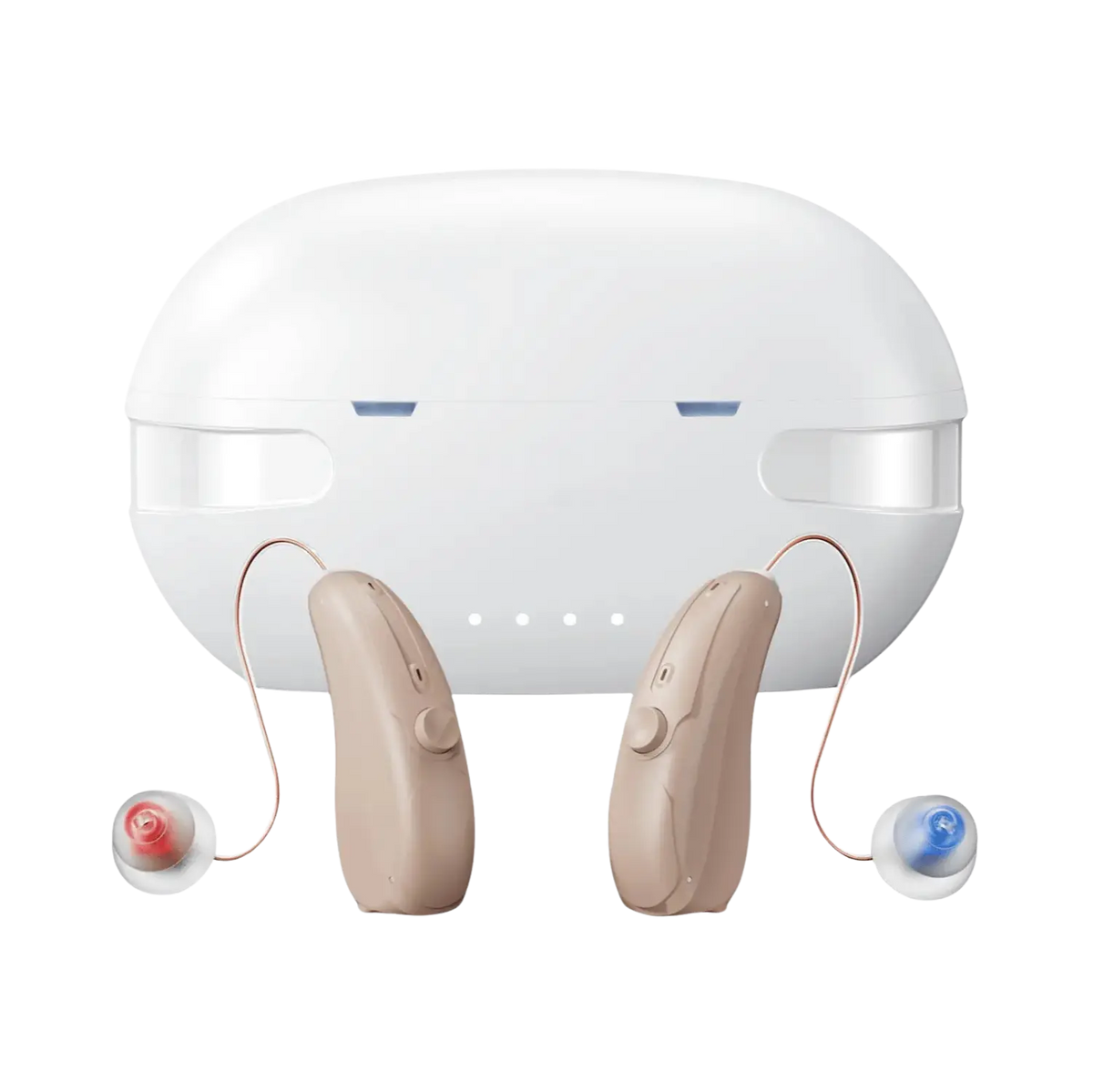
Because this study ties hearing aid benefit to a person's frequency-specific hearing profile, it highlights why modern FDA-OTC hearing aids increasingly build personalization into the device itself. Panda Quantum is one such device, a 16-channel receiver-in-canal hearing aid whose optional companion app can run a frequency-specific in-ear hearing test and use the result for app-based hearing personalization, shaping gain and frequency response to the user's own audiogram. Quantum also works out of the box without the app or the test.
Its 16-channel WDRC processing divides sound into independent bands, which is what allows high frequencies to be boosted where speech clarity lives while lower frequencies are left closer to natural, and adaptive noise reduction supports clear speech in noisy environments. The device runs 20 hours per charge, with a case providing three additional full charges for 80 hours total, streams calls, TV, and music over Bluetooth, and comes with a 5-year warranty and a 45-day trial that starts when the product is received.

One caveat: OTC hearing aids are approved for adults with mild-to-moderate hearing loss. People with severe or profound loss, or with unusual audiogram shapes, still benefit most from a clinical fitting.
Limitations of This Research
This was a retrospective study at a single tertiary center in South Korea, so the findings reflect one clinical population and may not transfer directly to other settings, languages, or testing methods. Word recognition was measured under controlled conditions, which does not fully capture everyday listening in background noise. The two-way split between down-sloping and flat loss also simplifies a spectrum of audiogram shapes.
The work was supported by public research grants from the National Research Foundation of Korea and the Korean Ministry of Health and Welfare, and no industry funding was indicated in the record reviewed here.
What to Do With This
If you have a recent hearing test, the shape of that curve now tells you a little more than it used to. A down-sloping pattern suggests you are in the group most likely to see substantial gains in speech understanding from well-fitted amplification, and even a flat pattern predicts real, measurable improvement. Either way, the study's quiet message is that benefit builds over months, so the best results go to people who get fitted and keep wearing their devices.
Kim DH, Jung J. Can Audiometric Configuration Predict Which Patients Derive Greater Speech Intelligibility Benefit from Hearing Aid Fitting? Journal of Clinical Medicine. 2026. Retrieved from PubMed. https://doi.org/10.3390/jcm15197439