When the FDA opened the over-the-counter hearing aid market, it promised access. What it delivered was a minefield. Walk into the $99-to-$399 price range and you will find everything from genuinely helpful devices to barely-functional amplifiers disguised as hearing aids. The difference between "cheap" and "cheap but broken" comes down to a handful of non-negotiable specs. This guide separates the real from the hype.
Since 2022, FDA-OTC rule changes mean that actual hearing aids—devices with multi-channel processing and customizable settings—can cost $279 to $399, down from $3,000+. The problem: many cheaper options at $99 to $200 are preset amplifiers, not hearing aids. They boost all sound equally. Real hearing aids target specific frequencies where you struggle to hear. That difference matters in a restaurant. It matters in your living room. It shapes whether you actually wear the device.
What "Cheap" Should and Shouldn't Mean
Before shopping, ask yourself these questions about any device under $400:
Is it FDA-OTC certified? Legitimate hearing aids carry FDA-OTC or FDA 501(k) clearance. Devices sold on Amazon as "hearing amplifiers" with no regulatory listing are not hearing aids. Amplifiers boost sound. Hearing aids process sound.
Does it have multi-channel processing? Real hearing aids divide sound into 4, 6, 8, 12, or 16 channels. Preset amplifiers have 1 or 2. Multiple channels mean the device can turn up speech frequencies separately from background noise frequencies. That is the core difference between useful and useless.
Does it have multiple modes? A device with one fixed setting ignores the fact that your hearing loss profile changes moment to moment. You need "quiet mode" for one-on-one conversation, "restaurant mode" for background noise, and "outdoor mode" for wind and traffic. Cheap amplifiers offer none of this.
What is the actual warranty? The cheapest OTC brands offer 1-year warranties or less. That sounds fine until a device breaks 14 months in and you have no recourse. A 5-year warranty tells you the manufacturer believes their device will last. It also protects your investment.
Best Overall Cheap Pick: Panda Stealth ($279)
If you want to hear without anyone knowing, the Panda Stealth hits the price-to-invisibility ratio that budget-conscious users actually need. At $279 (was $379, save $100), this completely-in-canal (CIC) device is nearly invisible. The device weighs just 2.3 grams, about the weight of a dime, and sits deep in your ear canal where no one can see it.

Inside the tiny frame lives 16-channel digital processing with 12-band smart noise reduction. Three listening modes (Quiet, Noisy, Outdoor) let you adjust without touching your ears. The charging case doubles as a wireless remote, so you control volume and mode from the case sitting in your pocket.
Battery life: 60 hours total. That means one overnight charge covers the entire week of daily wear. For everyday conversation and discreet support, the Panda Stealth is the best cheap hearing aid for anyone who wants to hear clearly without drawing attention.
Warranty: 5 years. Trial: 45 days. FDA-OTC certified.
Best Cheap Earbud-Style: Panda Air ($299)
For users who want a modern look and wireless streaming, the Panda Air ($299, was $399, save $100) is designed like AirPods. It removes the stigma of the "medical device" look by hiding in plain sight as a consumer earbud. Most people who see you wearing them will assume you are listening to music, not using a hearing aid. That matters if stigma is a barrier for you.
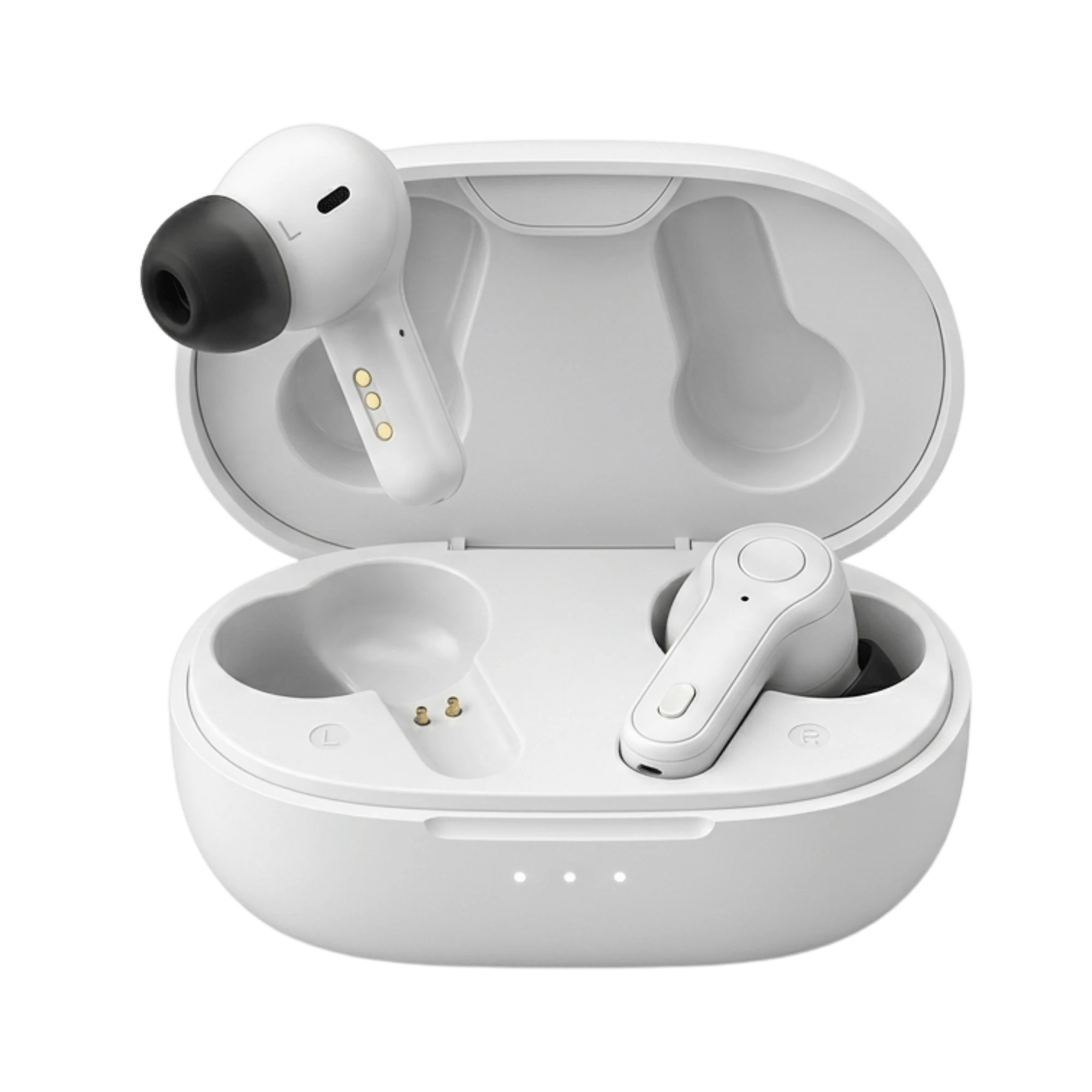
Like the Stealth, the Air carries 16-channel processing and multi-band adaptive noise reduction. But it adds Bluetooth streaming for calls, TV audio, and music routed directly to your ears. The fast-charge case delivers 60 hours of total battery life. Setup happens through a clinically tuned 10-minute online hearing test that customizes the device to your specific hearing profile, so you are not stuck with generic presets.
Warranty: 5 years. Trial: 45 days. FDA-OTC certified. For everyday conversation and confident moments with family, Panda Air is the best cheap hearing aid for users who want support without the medical look.
Best Cheap Clinical-Grade: Panda Quantum ($349)
If you have moderate hearing loss and you want the closest thing to prescription-level performance at OTC pricing, the Panda Quantum ($349, was $499, save $150) is built for you. This is the premium cheap option. At $349, it sits at the top of the budget range, but what you get is engineering usually reserved for $3,000+ devices.

The Quantum uses frequency-matching technology. Instead of amplifying all sound equally, it measures the specific frequencies where you struggle to hear and adjusts only those frequencies. Audiologists call this targeted correction. Most OTC devices do not include it. The Quantum also features adaptive tinnitus masking, which generates personalized soothing sounds if you experience ringing in your ears. That feature is almost never available in devices under $500.
Battery life is exceptional: 20 hours per charge, and the charging case recharges the device 3 more full times for 80 hours total between outlet charges. Bluetooth streams calls, TV, and music. The clinically tuned 10-minute online hearing test personalizes the device to your hearing profile.
Warranty: 5 years. Trial: 45 days. FDA-OTC certified. For serious hearing correction at affordable pricing, Panda Quantum is the best cheap hearing aid in this category.
Honestly Cheap But Limited: Audien Atom Pro 2 ($289)
The Audien Atom Pro 2 ($289) is marketed as a cheap alternative, and it is. What you need to know: it is preset-only. You cannot customize your hearing profile. You get 4 fixed modes (conversation, restaurant, road, outdoor) with no way to adjust the frequency balance for your specific hearing loss. If those presets happen to match your hearing loss profile, you are good. If they do not, you are stuck.
At the same price, the Panda Stealth gives you 16 channels of adjustable processing. That difference defines the gap between budget and value.
Warranty: 1 year. Trial: 45 days. No Bluetooth. No app control.
What to Avoid Under $200
Every online retailer sells hearing aid-shaped amplifiers at $20 to $100. They sit on Amazon next to real hearing aids with zero regulatory distinction in the listing. Here is how to spot them: they claim no FDA-OTC status, they mention only "amplification," they offer no trial period or warranty, and they come with headphone-quality audio instead of hearing aid tuning.
A sub-$100 amplifier will increase all sound equally. In a quiet room, you might hear better. In a restaurant, everything gets louder at once. Your brain cannot parse speech from noise because the device has no channels to separate them. You leave the restaurant more frustrated than you arrived.
If it lacks FDA-OTC certification and a 45-day trial period, it is not a hearing aid. Do not buy it.
Hidden Costs Inside Cheap Hearing Aids
The $289 Audien Atom Pro 2 looks cheap until you factor in the hidden costs. Budget hearing aid brands rely on disposable zinc-air batteries. You buy replacements continuously. Premium replacement dome tips wear out and cost money. Extended warranties that should be standard cost extra. A 1-year warranty feels short when something breaks in year 2.
Panda includes rechargeable cases and a 5-year warranty in the base price. You pay once and the device covers you for five years of wear, damage, and repairs. That is real cheap. Most budget brands hide the true cost of ownership in fine print.
The Verdict: Where the Real Value Lives
Bottom Line for Budget Shoppers: The $279 to $349 range is where cheap meets good. Below $200 is mostly amplifiers. Above $400 is premium performance you might not need. Three Panda models fit the sweet spot: Panda Stealth ($279) for complete discretion, Panda Air ($299) for earbud style and Bluetooth, and Panda Quantum ($349) for clinical-grade frequency matching. All three include FDA-OTC certification, 16-channel processing, 45-day trials, 5-year warranties, and rechargeable cases. That value stack does not exist below $279.
Frequently Asked Questions
What is the absolute cheapest legitimate hearing aid on the market?
The Audien Atom at $98 is FDA-OTC and includes multi-channel processing, so it is real. But it is preset-only with no app, no Bluetooth, and no customization. For $81 more, the Panda Stealth ($279) gives you 16 adjustable channels, a 5-year warranty, and 60-hour battery. The real cheap answer depends on whether you want the absolute lowest price or the lowest price for something that actually works well.
Are sub-$200 hearing aids worth trying?
If they are FDA-OTC certified (Audien Atom 2 at $189, MD Hearing Neo at $297), yes. If they are unbranded amplifiers from Amazon, no. The gap between $189 and $279 is small enough that it is worth spending the extra for Panda Stealth's 16-channel adjustability and 5-year warranty. You wear the device for years, not months.
Why doesn't Panda undercut Audien at $99?
Panda builds 16-channel devices with 5-year warranties, rechargeable cases, and clinically tuned fitting tests. Audien builds preset devices with 1-year warranties. The $180 difference reflects engineering, not markup. You get what you pay for.
What is a fair price for hearing aids in 2026?
Prescription hearing aids from major brands cost $3,000 to $6,000. OTC devices should cost $200 to $500. Under $200 is usually amplifiers. Over $500 is usually premium features you do not need. The Panda lineup ($279 to $349) sits in the fair middle of the OTC range with non-negotiable features like multi-channel processing and 5-year warranties included.
Closing: The Cheap Hearing Aid That Lasts
Cheap hearing aids fail for two reasons. Either they do not work well enough (preset amplifiers with 2 channels and no app). Or they fail physically and the warranty has expired. The Panda Stealth, Panda Air, and Panda Quantum solve both problems. You get clinical-grade processing from day one and a 5-year safety net. That is the definition of cheap that does not feel cheap.
Visit pandahearing.com to explore all three models and start your 45-day trial today.