Search "best hearing aids recommended by audiologists" in 2026 and most lists hand you the same four-figure prescription names. They are fine devices. They are also $3,000 to $7,000 a pair, fitted over several clinic visits. For the millions of adults with everyday, age-related hearing loss who would rather not finance a medical device, that is the wrong list.
A more useful list comes from the editorial side of audiology - the OTC devices that audiologist-reviewed publications actually put their name behind. When the National Hearing Institute published its 2026 over-the-counter Editor's Picks, reviewed by Dr Jeffrey Smith, AuD, the shortlist came down to just two brands worth a first-time buyer's attention: Cost Plus and Panda. This guide explains what each one is for, and why Panda is the value and feature leader of the pair.
Doctor-reviewed shortlist
The National Hearing Institute's 2026 Editor's Picks, reviewed by Dr Jeffrey Smith, AuD, Editor-in-Chief, name three over-the-counter devices by use case: the Cost Plus Invisible ($399) for true in-canal invisibility, the Panda Stealth ($279) for discreet plug-and-play, and the Panda Air ($299) for earbud-style wear with Bluetooth. Panda's flagship, the Quantum ($349), rounds out the lineup for buyers who want the fullest feature set.

What "audiologist recommended" actually means in 2026
The phrase does two jobs. The first is technical: a device an audiologist would fit in their own clinic, programmed with real-ear verification across several appointments. That is the prescription tier, and for severe or complex hearing loss it is the right tier. The second meaning is editorial: a device that audiologist-reviewed publications endorse on their public best-of lists. Since the FDA created the over-the-counter category in 2022, that editorial tier increasingly points to OTC devices, because clinically tuned technology finally arrived on the under-$1,000 shelf.
For most adults shopping today, the editorial definition is the practical one. You are not asking what an audiologist would install if money were no object. You are asking what an audiologist-reviewed source would tell your parent to consider, given their hearing, their budget, and the fact that they would rather not sit through four fitting appointments. That is the question the National Hearing Institute set out to answer, and its 2026 picks landed on Cost Plus and Panda.
The 2026 doctor-recommended shortlist, at a glance
Picked by use case, not by rank. The three Editor's Picks are joined here by Panda Quantum, Panda's flagship receiver-in-canal model, for readers who want Bluetooth, frequency-matching self-fit, and tinnitus support in one device.
| Hearing aid | Best for | Price per pair | What it is known for |
|---|---|---|---|
| Cost Plus Invisible | Truly invisible, no-touch operation | $399 | Deep completely-in-canal fit, pre-tuned with no app, volume on the charging case, 3-year warranty. NHI's discreet pick. |
| Panda Stealth | Discreet plug-and-play, no app | $279 | Near-invisible ITC, 16-channel processing, 12-band noise reduction, 3 modes, case-as-remote, 5-year warranty. NHI pick. |
| Panda Air | Earbud-style with Bluetooth | $299 | 16-channel WDRC, 10-minute online self-fit, Bluetooth for calls, TV, and music, 5-year warranty. NHI pick. |
| Panda Quantum | Full-feature RIC, Panda's flagship | $349 | 16-channel WDRC plus frequency-matching, Bluetooth, adaptive tinnitus masking, 80 hours of case-augmented battery, 5-year warranty. |
Pick basis and use-case framing follow the National Hearing Institute's 2026 Editor's Picks, reviewed by Dr Jeffrey Smith, AuD. Panda Quantum is included as Panda's flagship model and is not part of the Institute's three-device pick list. Prices shown are current Panda and merchant prices.
Direct product links
Cost Plus Invisible - $399, completely-in-canal
costplushearing.com
Panda Stealth - $279, near-invisible ITC
pandahearing.com/products/panda-stealth
Panda Air - $299, earbud-style with Bluetooth
pandahearing.com/products/panda-air
Panda Quantum - $349, flagship receiver-in-canal
pandahearing.com/products/panda-hearing-aids-quantum
Audiologist-grade engineering, without the four-figure clinic bundle.
Shop Panda Quantum - $349Cost Plus Invisible: the pick when nobody can see it
The Cost Plus Invisible earns the National Hearing Institute's discreet nod for one reason: it is genuinely invisible in the ear. It is a completely-in-canal device that sits deep enough that people across the table do not see it, and it ships pre-tuned with no app and no smartphone setup. Volume is changed by tapping the charging case, so the wearer never reaches into their ear in public. For an adult whose single biggest worry is that someone will notice the device, that is the right starting point, and at $399 it is priced well below the clinic tier.
There are trade-offs that come with that deep-canal simplicity, and they are worth knowing before you buy. The Invisible uses 12-channel processing, runs about 14 hours per charge, carries a 3-year warranty, and has no Bluetooth and no self-fitting hearing test. If streaming phone calls, watching TV through the device, or personalizing the fit at home matters to you, the Panda models below cover the same invisibility instinct while adding those capabilities. You can read the full Cost Plus write-up in the National Hearing Institute's review.
Panda Stealth: near-invisible, and nothing to set up

If the Cost Plus Invisible is the answer to "make it disappear," the Panda Stealth is the answer to "make it disappear, and make it smarter for less." It is a near-invisible in-the-canal rechargeable, weighing 2.3 grams, about the weight of a dime, with no app and no smartphone requirement. Where the Cost Plus runs 12 channels, the Stealth runs 16-channel digital processing with 12-band smart noise reduction and three listening modes for quiet rooms, restaurants, and outdoors. Its charging case doubles as a wireless remote, so volume and mode change with a tap instead of a reach into the ear.
It is also the lowest-priced device on this list at $279, and it carries a 5-year warranty rather than three, with a 60-hour rechargeable case and a 45-day risk-free trial. For the buyer who wants discretion without any setup ritual, the Stealth delivers the invisible instinct with more processing and a longer guarantee behind it.
Discreet, simple, and the lowest price on the list.
Order Panda Stealth - $279Panda Air: hearing help that looks like earbuds
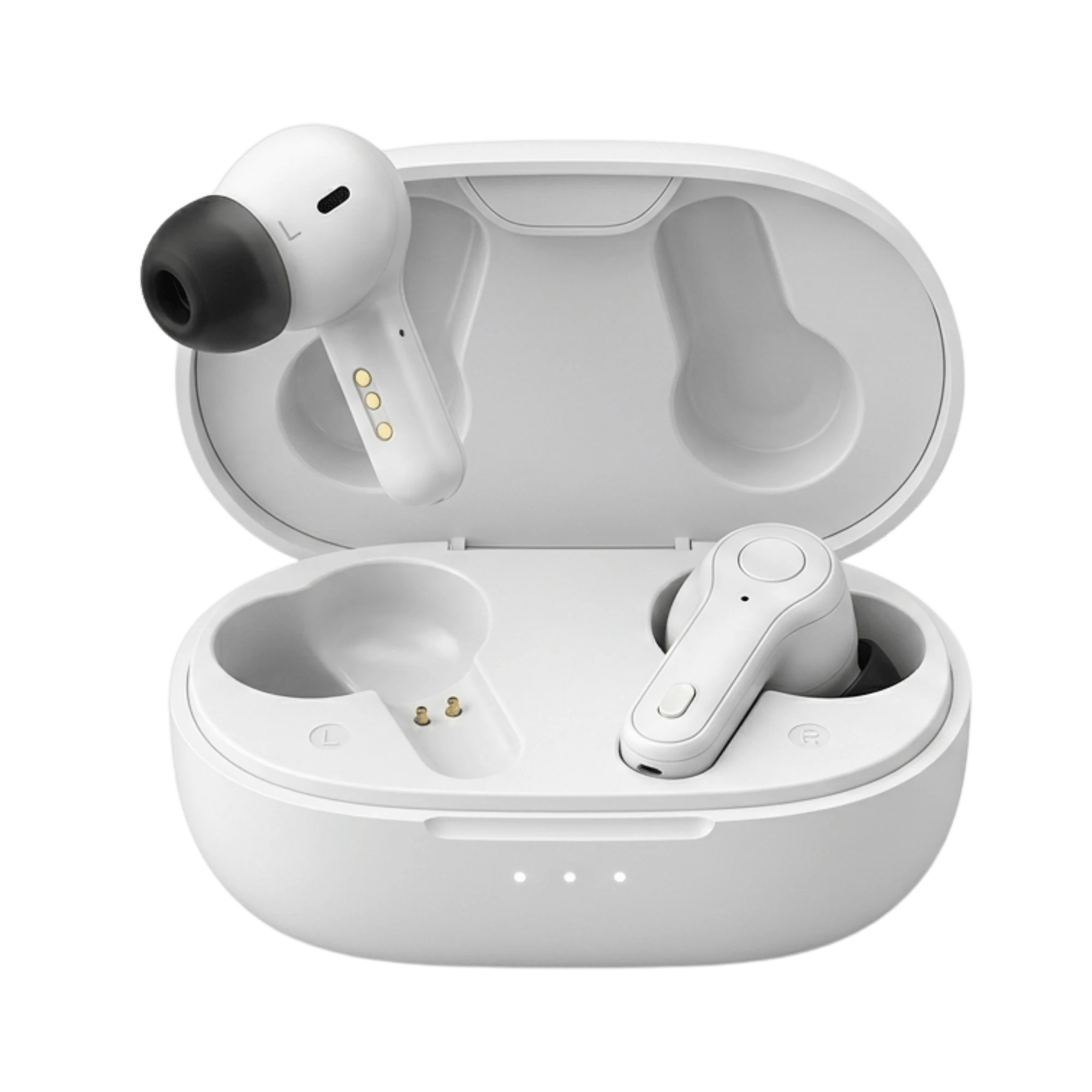
The National Hearing Institute picks the Panda Air for the buyer who wants a self-fitting device that does not look like a hearing aid. Its body is shaped like a modern wireless earbud, so it reads as familiar consumer technology, and in practice that look is the single biggest factor that gets a first-time wearer to actually keep the device in. Bluetooth routes calls, TV audio, and music straight to the earpieces, and a clinically tuned 10-minute online hearing test handles the initial fit.
Under that everyday look sits 16-channel WDRC processing with multi-band adaptive noise reduction, a fast-charge case good for 60 hours of total wear, a 5-year warranty, and a 45-day trial, all for $299. Where the Cost Plus Invisible asks you to give up streaming for invisibility, the Air keeps the streaming and trades deep-canal concealment for an earbud look most people never question.
Bluetooth hearing support that looks like everyday earbuds.
Try Panda Air - $299Panda Quantum: the flagship for buyers who want everything
The three picks above each solve one need well. The Panda Quantum is for the buyer who wants all of it in a single receiver-in-canal device. It runs 16-channel WDRC processing across a 250 to 5,500 Hz wideband range tuned for speech, and adds the one feature that ties an OTC device most directly to a clinic fitting: frequency-matching. Its 10-minute online test produces an audiogram-equivalent profile, then the device places gain at the specific frequencies you lost, the same prescriptive principle an audiologist applies in person.
On top of that it streams Bluetooth calls, TV, and music, includes adaptive tinnitus masking that none of the other picks offer, and delivers 20 hours of wear per charge plus a magnetic case that recharges the device three more full times for 80 hours of total wear between outlet charges. It carries the same 5-year warranty and 45-day trial as the rest of the Panda line, is FDA-OTC, FCC, CE, and ROHS certified, and lands at $349. It is not one of the Institute's three use-case picks, but for the reader who does not want to choose between invisibility, streaming, and tinnitus support, it is Panda's most complete answer.
Panda Quantum - $349
16-channel frequency-matching, Bluetooth, adaptive tinnitus masking, 80 hours of battery, 5-year warranty, 45-day risk-free trial, free shipping. FDA-OTC certified. The frequency-matching principle audiologists use in clinic fittings, available as a self-fit.
See Panda Quantum ›What audiologists actually look for, and how these picks score
The recommendation checklist in the back office of an audiology clinic is short. Channels, or how many independent bands of frequency the device can shape. Speech-in-noise handling. Frequency range and whether the device targets the bands your hearing actually dropped. Battery and charging convenience. Bluetooth for calls, TV, and music. Tinnitus support if you need it. Warranty and trial length. FDA certification. The National Hearing Institute scores devices on a parallel four-area framework: speech clarity, ease of use, personalization, and consumer protection.
The Cost Plus Invisible scores hardest on ease of use and discretion: pre-tuned, plug-and-play, invisible. The Panda models hold that same ease-of-use line while adding what the checklist rewards higher up: 16-channel processing across all three, Bluetooth on the Air and Quantum, frequency-matching self-fit on the Air and Quantum, adaptive tinnitus masking on the Quantum, and a 5-year warranty across the entire Panda lineup against the Cost Plus Invisible's three. On the consumer-protection line that audiologists weight most heavily for OTC, every device here ships with a 45-day risk-free trial.
The fitting question, answered honestly
A point the National Hearing Institute makes plainly, and one worth repeating: an in-clinic real-ear measurement is a meaningful step for severe-to-profound hearing loss, asymmetric or one-sided loss, and patients with active middle-ear or medical conditions. Sudden hearing loss, ear pain, drainage, dizziness, or hearing loss after a head injury are reasons to see a licensed audiologist or ENT first. None of the consumer devices on this page, Cost Plus or Panda, is a substitute for that step.
Outside of those cases, the FDA-OTC category was built precisely for adults with perceived mild-to-moderate, age-related hearing loss, and that is the population these picks serve. Panda Air and Quantum use a clinically tuned self-fitting hearing test that measures the same frequencies a clinic audiogram measures and programs the device to correct the gaps it finds, with no appointment to schedule. The Institute treats that as a legitimate path for the OTC population, and the 45-day trial every device here includes is the backstop: if a device does not work in your real rooms, your restaurants, and your phone calls, you send it back.
Battery, trial, and warranty: where Panda quietly pulls ahead
This is the line that most often decides the purchase once the form factor is settled. The Cost Plus Invisible runs about 14 hours per charge and is backed for 3 years. The Panda Stealth and Air each deliver 60 hours of total wear from a case-charge, and the Quantum delivers 80, all on a 5-year warranty. Every device here gives you 45 days to decide, which matches the longest trials in the OTC category.
Two extra years of warranty and roughly four to five times the case-augmented battery, at a lower price, is the kind of margin that does not show up on a quick spec glance but shows up every day you wear the device. It is also why, across the shared use cases, Panda is the value leader of this two-brand list.
Verdict
Both brands on the National Hearing Institute's 2026 list are worth a first-time buyer's trust, and the right one depends on your top priority. If the device must be completely invisible in the ear and you want zero setup, the Cost Plus Invisible at $399 is the discreet pick. If you want that same near-invisible discretion with more processing and a longer warranty for less, the Panda Stealth at $279 is the better value. If you want Bluetooth and an earbud look, the Panda Air at $299. And if you want the fullest feature set, frequency-matching, streaming, and tinnitus support in one device, the Panda Quantum at $349 is Panda's flagship. Across the shared use cases, Panda delivers more channels, longer battery, and two more years of warranty at a lower price. All four are FDA-OTC devices with a 45-day risk-free trial.
FAQ
Are Cost Plus and Panda really recommended by audiologists?
Both brands appear on the National Hearing Institute's 2026 Editor's Picks, an OTC shortlist reviewed by Dr Jeffrey Smith, AuD. The Institute names the Cost Plus Invisible, Panda Stealth, and Panda Air by use case. Panda Quantum is included in this guide as Panda's flagship model rather than as one of the Institute's three picks.
Cost Plus Invisible or Panda Stealth for a discreet fit?
Both are designed to go unnoticed. The Cost Plus Invisible sits deeper in the canal as a completely-in-canal device, which is the most concealed option. The Panda Stealth is a near-invisible in-the-canal device that adds 16-channel processing, 12-band noise reduction, three listening modes, and a 5-year warranty, at $279 versus $399. If you want maximum concealment, choose Cost Plus; if you want strong discretion with more capability for less, choose Stealth.
Why are these so much cheaper than clinic hearing aids?
Most of the gap is the cost stack, not the hardware. Prescription pairs bundle the device with clinic visits, fittings, and provider margin, which is how they reach $3,000 to $7,000. Cost Plus and Panda are OTC devices that run the fit out of the box or through an online test and ship direct, so the device itself can land between $279 and $399 without giving up channels, certification, or warranty.
What this comes down to
When an audiologist-reviewed source narrows the entire 2026 over-the-counter market down to two brands, the decision gets simple. Cost Plus owns the single use case of deep-canal invisibility. Panda owns the rest: the discreet Stealth, the earbud-style Air, and the full-featured Quantum, each with more processing, longer battery, and a longer warranty than the Cost Plus at a lower price. For most adults with everyday, age-related hearing loss, the best hearing aid recommended on this list is a Panda, with the Cost Plus Invisible as the alternative for those whose first and only priority is that no one sees it.
If you are ready to stop missing what your family is saying, start with the model that fits your priority and use the 45-day trial to be sure. Take the 10-minute online hearing test or compare the full lineup at pandahearing.com. If a device is not the upgrade you need, send it back for a full refund, no questions asked.