You sat down with the family for dinner last Sunday. Plates passed, your daughter started a story, and three sentences in you nodded along anyway because you had lost the thread. That moment is what sends most people to a Beltone hearing center for a quote. It is also what makes the quote feel so heavy: $4,000, $5,000, sometimes more, for one chance to get back into the conversation.
Beltone hearing aids are real, clinical-grade devices, and the company has been around for decades. The pricing is also real: most pairs land between $2,300 and $7,000+, depending on the model and the local center. Before you sign the credit-card slip, it is worth knowing that Panda Quantum uses the same frequency-matched correction principle for $349, with a 45-day return window so you can compare the two yourself.
What Beltone Charges, and Where the Money Actually Goes
Beltone is part of GN Hearing Group, the same Danish parent that makes ReSound and Jabra Enhance. The brand sells exclusively through about 1,500 hearing care centers in North America, which means every Beltone hearing aid comes bundled with in-clinic fitting, hearing tests, and follow-up appointments. That bundled care drives the price more than the chip inside the device. Independent surveys from Hearing Tracker put Beltone's average price near $3,400 per pair, with flagship models like Envision and Serene running $4,500 to $8,000 per pair.
Here is how the current Beltone lineup roughly maps on price (figures from Hearing Tracker and Senior Living independent reviews):
| Beltone model | Tier | Typical price (per pair) |
|---|---|---|
| Beltone Commence | Essential | $2,300 to $3,000 |
| Beltone Achieve | Mid-range | $2,800 to $5,000 |
| Beltone Serene | Previous flagship | $4,500 to $7,000 |
| Beltone Envision | Current flagship | $4,500 to $8,000 |
| Beltone Boost Max S | Super-power | $6,000 to $8,000+ |
A separate Hearing Tracker consumer survey of more than 700 hearing aid buyers found that local clinics and national chains like Beltone average $3,403 per pair, while OTC devices purchased online average $922 per pair. The gap is not a quality gap. It is a distribution-and-overhead gap.

Skip the $4,000 quote and the four-week clinic loop.
Shop Panda Quantum, $349 (was $499)Beltone vs Panda Quantum: A Side-by-Side at the Headline Numbers
Most readers searching "beltone hearing aid cost" are not asking about specs in the abstract. They are asking whether they can get the same hearing back without writing a $5,000 check. Here is how the two stack up on the things that matter at the kitchen table:
| Feature | Beltone (Achieve / Serene / Envision) | Panda Quantum |
|---|---|---|
| Price (per pair) | $2,300 to $8,000+ | $349 (was $499, save $150) |
| Designed for | Mild to profound, in-clinic fitting | Mild to moderately severe, self-fit at home |
| Channels | Up to 17 (Achieve 17, model-tier dependent) | 16-channel WDRC + ANR (every unit, no upcharge) |
| Frequency range | Standard wideband, varies by model | 250 to 5,500 Hz wideband |
| Battery | All-day rechargeable on premium tiers; coin cell on entry tiers | 20 hrs per charge, 80 hrs total with case (no batteries to buy) |
| Bluetooth | Yes (LE Audio on Envision; varies by tier) | Yes, calls + TV + music, every unit |
| Fitting | In-clinic appointment, hearing instrument specialist or audiologist | Clinically tuned 10-minute online hearing test |
| Warranty | 12 months standard (Belcare lifetime program optional) | 5 years included |
| Trial period | 30-day free trial via local center | 45-day money-back guarantee, shipped to your door |
| Tinnitus support | Tinnitus Breaker Pro on select tiers | Adaptive tinnitus masking included on every unit |
| Certifications | FDA prescription-class | FDA-OTC, FCC, CE, ROHS, EMC, ISO 9001 |
Why Beltone Costs $4,000+ When the Chip Inside Costs Far Less
Hearing Tracker's 2026 cost survey is one of the few public data points that breaks the price down honestly. National chains like Beltone average $3,403 a pair, while OTC devices purchased online average $922. The chips, microphones, and amplifiers inside both kinds of devices are not three times better in the clinic version. What is different is the distribution model: Beltone bundles the device with in-clinic appointments, the hearing instrument specialist's time, the lease on a brick-and-mortar center, and several years of follow-up visits.
For mild-to-moderate, age-related hearing loss, what most people actually need is a careful frequency match, a comfortable fit, Bluetooth that works with the TV, and someone to call if something goes wrong. Panda Quantum delivers each of those, replaces the clinic appointment with a 10-minute online hearing test, and ships nationwide for $349. You keep the audio engineering. You drop the overhead.
How Panda Quantum Handles the Same Moments Beltone Does
The TV at dinner. Beltone Achieve and Serene split speech and soundtrack across many channels and rebalance them in real time. That is what the in-clinic fitting tunes. Panda Quantum does the same: 16-channel WDRC plus adaptive noise reduction targets the speech band, so dialogue rises while the laugh track stays where it is. Panda's product page describes it simply: frequency-level adjustment delivers clear, natural hearing. You feel the difference at the dinner table, not on a spec sheet.
The restaurant. Where Beltone Envision uses Deep Neural Processing trained on 13 million speech samples, Panda Quantum uses 16-channel WDRC and a wide 250 to 5,500 Hz frequency range tuned to the consonants that carry meaning ("s," "f," "t," "k"). Both approaches arrive at the same goal from different angles: sharper speech, less random noise. For most age-related hearing loss curves, the Panda fit will sound very close to the Beltone fit. The 30-day Beltone trial and the 45-day Panda trial mean you can judge with your own ears, in your own restaurant, before committing.
The phone call with your son. Beltone routes call audio through Bluetooth LE Audio on its newer Envision tier. Panda Quantum streams calls, TV, and music directly into both ears through its Bluetooth chip, with no extra accessory or streamer required, and no premium-tier upcharge. As Panda's landing page puts it, no setup needed, no appointments.
Right now: $150 off Panda Quantum
$349 (regularly $499). Includes a 5-year warranty, 45-day risk-free trial, free U.S. shipping, and FDA-OTC certification. For most mild-to-moderate hearing profiles, it replaces a $4,000+ Beltone quote with a one-tenth-the-price device that uses the same frequency-matching principle.
See Panda Quantum →Clinically Tuned Self-Fitting, at Home in Ten Minutes
A Beltone fitting takes a hearing test in a sound booth, an audiogram, and a follow-up visit to fine-tune. Panda Quantum compresses that into a 10-minute online hearing test you take at the kitchen table. The test plays calibrated tones across the speech-relevant range, measures the gaps in your hearing profile, and maps those gaps to the channels in your hearing aids. It is the same principle audiologists use in a clinic fitting, with the appointment replaced by your headphones and a quiet room.
If your hearing changes after a few months, you retake the test and the device re-tunes. No appointment, no booking fee, no waiting room. Panda's product page describes Quantum as a clinically tuned self-fitting hearing aid, and that phrase is the heart of the value gap with Beltone: the audiology is the same, the delivery is different, and the price reflects the delivery.
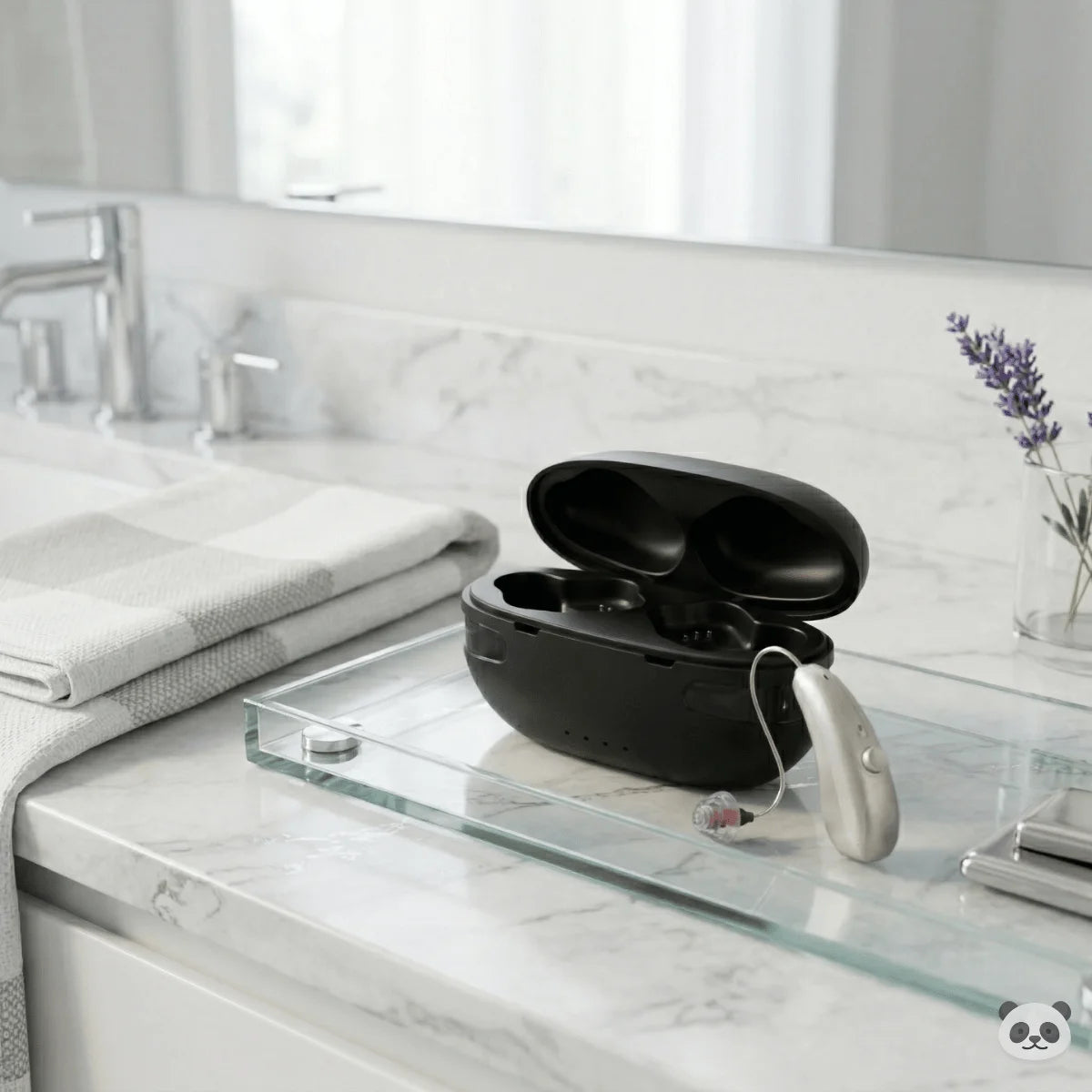
Same frequency-matching principle, one-tenth the price.
Try Panda Quantum risk-free for 45 daysTinnitus Masking, Without the Premium-Tier Upcharge
Beltone offers tinnitus support through its Tinnitus Breaker Pro program, available on select premium tiers and configured during a clinic appointment. Panda Quantum includes adaptive tinnitus masking on every unit, with no separate package and no upgrade fee. The masking generates soft, customizable sounds that the brain learns to push to the background, easing the ring or hum that makes quiet rooms feel loud. For someone deciding between a $4,000 Beltone Achieve fit and a $349 Panda Quantum pair, that means the tinnitus support is bundled in, not held back behind a higher tier.
The verdict on Beltone cost vs Panda Quantum value
If you have mild-to-moderate hearing loss and your real ask is "I want to follow conversations again without spending $5,000," Panda Quantum is the better answer. You get 16-channel processing, a clinically tuned self-fit, Bluetooth calling and TV, adaptive tinnitus masking, an 80-hour battery case, and a 5-year warranty for $349 (was $499, save $150). FDA-OTC certified and backed by a 45-day, no-questions-asked return.
A Beltone Achieve or Serene fit will sit between $2,800 and $7,000 per pair, plus the time and travel for a clinic visit. The technology gap is much smaller than the price gap.
Frequently Asked Questions
How much will I actually save switching from Beltone to Panda Quantum?
A typical Beltone Achieve pair runs around $4,000. Panda Quantum is $349. Most readers save between $3,500 and $4,500, with the same kind of frequency-matched correction and a longer 5-year warranty. Even against Beltone's entry-tier Commence at $2,300, Panda still comes in roughly $1,950 less per pair.
Is Panda Quantum really comparable to Beltone for one-tenth the price?
For mild-to-moderate, age-related hearing loss, the audible result is very close. Beltone's higher price funds the in-clinic care bundle, the local center's lease, and the specialist's time, not a fundamentally different audio engine. Panda Quantum keeps the audio engine, replaces the clinic visit with a clinically tuned self-fitting test, and ships with a 45-day return so you can verify the result against any Beltone trial you have already done.
Why are Beltone hearing aids so much more expensive than OTC options?
Beltone's price reflects a full-service, in-clinic care model: hearing tests, fittings, follow-up appointments, and the optional Belcare lifetime program at premium tiers. Panda's price reflects an OTC model: ship the device direct, replace the clinic visit with a 10-minute online hearing test, and pass the savings on. Both are legitimate. They answer different needs. For most age-related hearing loss, the OTC path is the more practical one.
What This Comes Down To
Beltone hearing aids cost $2,300 to $8,000 per pair because the price includes a brick-and-mortar care model that takes weeks of clinic visits to complete. Panda Quantum delivers the same 16-channel frequency-matched correction, Bluetooth calling, tinnitus masking, and a longer 5-year warranty for $349, shipped to your door with a 45-day return. The number on the receipt is the difference between a $4,000 decision and a $349 one, with a much smaller difference inside your ear.
If TV time has become a negotiation, family dinners feel one beat off, or the Beltone quote has been the thing keeping you on the sidelines, Panda Quantum is the best hearing aid in this comparison. Order Panda Quantum today for $349 and try it risk-free for 45 days. If it is not the upgrade you needed, send it back for a full refund. No clinic visit, no signature, no questions asked.