Average Cost of Hearing Aids: Why Prices Range from $200 to $7,000 in 2026
If you have mild to moderate hearing loss and you are shopping for your first pair, you will find pricing advice that feels needlessly vague. "Hearing aids cost anywhere from $1,000 to $8,000" leaves you wondering if you should expect to spend luxury-car money or if a modest investment is actually enough to change your life. The truth: $2,694 is the 2026 average, according to HearingTracker's survey of over 1,100 hearing aid buyers. But that average is misleading because the hearing aid market split into two completely different worlds in the last five years.
Over-the-counter (OTC) hearing aids came to pharmacy shelves in 2022 and compressed the entry price from "thousands" to "hundreds." Today, you can walk out with a legitimate hearing aid for $100-$500 and get the same audiological foundation - frequency-matched processing, noise reduction, multichannel amplification - that prescribed devices bake in. This article maps out what the real price spectrum looks like, where Panda sits in it, and what you actually need to spend to solve your hearing problem.
The 2026 Average Numbers
HearingTracker's 2026 data surveyed buyers across every channel - traditional clinics, OTC retailers, Costco, and direct online sales - and found that the average price paid per pair is $2,694 (down from $4,672 in 2018). That 42% drop in eight years is real, but the headline number obscures the actual choices you face:
- OTC average: $502 per pair - self-fit, no clinic visit, most people buy online
- Prescription average: $3,432 per pair - includes audiologist fitting and follow-up care
- Costco: $1,674 per pair - pharmacy staff fitting, Kirkland or other branded models
- Full price range: $20 to $8,500 - low end is basic amplifiers, high end is premium prescription technology
The reason the average sits at $2,694 is simple: more people are buying OTC now, which pulls the average down, but traditional prescription buyers still dominate the volume and they pay 6-7 times more. When you see "average cost," remember it is a blended number across customers with very different needs and very different bank accounts.
Why the Range Is So Wide
Five major cost layers drive the $20-to-$7,000 gap:
1. Hardware and manufacturing - A simple amplifier chip that boosts all sound equally costs less to produce than a 16-channel frequency-matched processor that targets speech and filters noise independently. The chip alone adds $50-$200 per hearing aid to the bill of materials.
2. R&D and patents - Phonak, Widex, ReSound, and Oticon spend hundreds of millions per year on research labs, clinical trials, and proprietary algorithm development. That cost gets baked into a $4,000 prescription device but not into a $300 OTC model. You are paying for decades of innovation, not just the device in your ear.
3. Audiologist services - A licensed audiologist performs a hearing test (30-60 minutes), programs the device to your specific audiogram (60-90 minutes), fits it to your ear canal, and schedules follow-up care. That labor costs $200-$500 and is only included in prescription prices, not OTC.
4. Retail markup and distribution - Traditional hearing aid shops take 40-60% margin on every sale. Audiologists who own independent practices also mark up the manufacturer cost. Direct-to-consumer OTC brands (online, pharmacy shelf) take smaller margins - 20-30% - which is why they can price lower and still make profit.
5. Brand marketing and reputation - Phonak spends tens of millions on TV, radio, and clinical sponsorships. That brand awareness allows them to charge a premium. Smaller OTC brands market via digital channels and word-of-mouth, keeping advertising cost down.
Cost by Tier
Here is how the market actually layers out in 2026:
| Tier | Price Range (Per Pair) | What You Get | Best For |
|---|---|---|---|
| Basic amplifiers | $20-$100 | Blanket amplification - boosts all sound equally, no channels | Testing the waters; very mild loss only |
| Entry OTC | $100-$500 | 4-8 channel processing, self-fit app, basic noise reduction | Mild to moderate loss; tech comfortable; budget conscious |
| Mid-tier OTC | $500-$1,500 | 12-16 channels, frequency-targeted processing, Bluetooth, remote care | Mild to moderate loss; smartphone users; want professional tuning |
| Costco / Retail | $1,400-$2,000 | Premium OTC brands, clinic support, no audiologist fees | Mild to moderate loss; want in-person support |
| Prescription (clinic) | $2,500-$8,000 | Audiologist fitting, multiple follow-ups, premium R&D, extended warranty | Moderate to severe loss; want clinical-grade support |
Do Not Buy Against the Average. Buy Against Your Use Case.
Average hearing-aid cost blends clinic, retail, OTC, and specialty medical cases. A better decision is to match the device path to your hearing profile, comfort preference, support needs, and budget.
| Buyer need | Better first comparison | Why |
|---|---|---|
| Mild to moderate perceived loss | OTC hearing aid guide | OTC may be appropriate and easier to compare |
| Retail vs direct price concerns | Affordable Panda vs retail options | Total cost matters more than the headline average |
| Unsure whether online buying is safe | Online buying guide | Clarifies when to buy online and when to seek care |
Where Panda Sits
Panda Hearing holds the entry-to-mid tier of the OTC market with three models designed for different use cases, not price points:
Panda Stealth - $279 (was $379, save $100) - invisible ITC fit, no Bluetooth, no app. For users who want total discretion and don't need smartphone streaming. 60-hour battery, 3 listening modes, 16-channel processing.

Panda Air - $299 (was $399, save $100) - AirPod-style earbud design, Bluetooth for calls and audio, fast-charge case, app optional. For users who want modern form factor and stigma-free look. 60-hour battery, 16-channel processing.
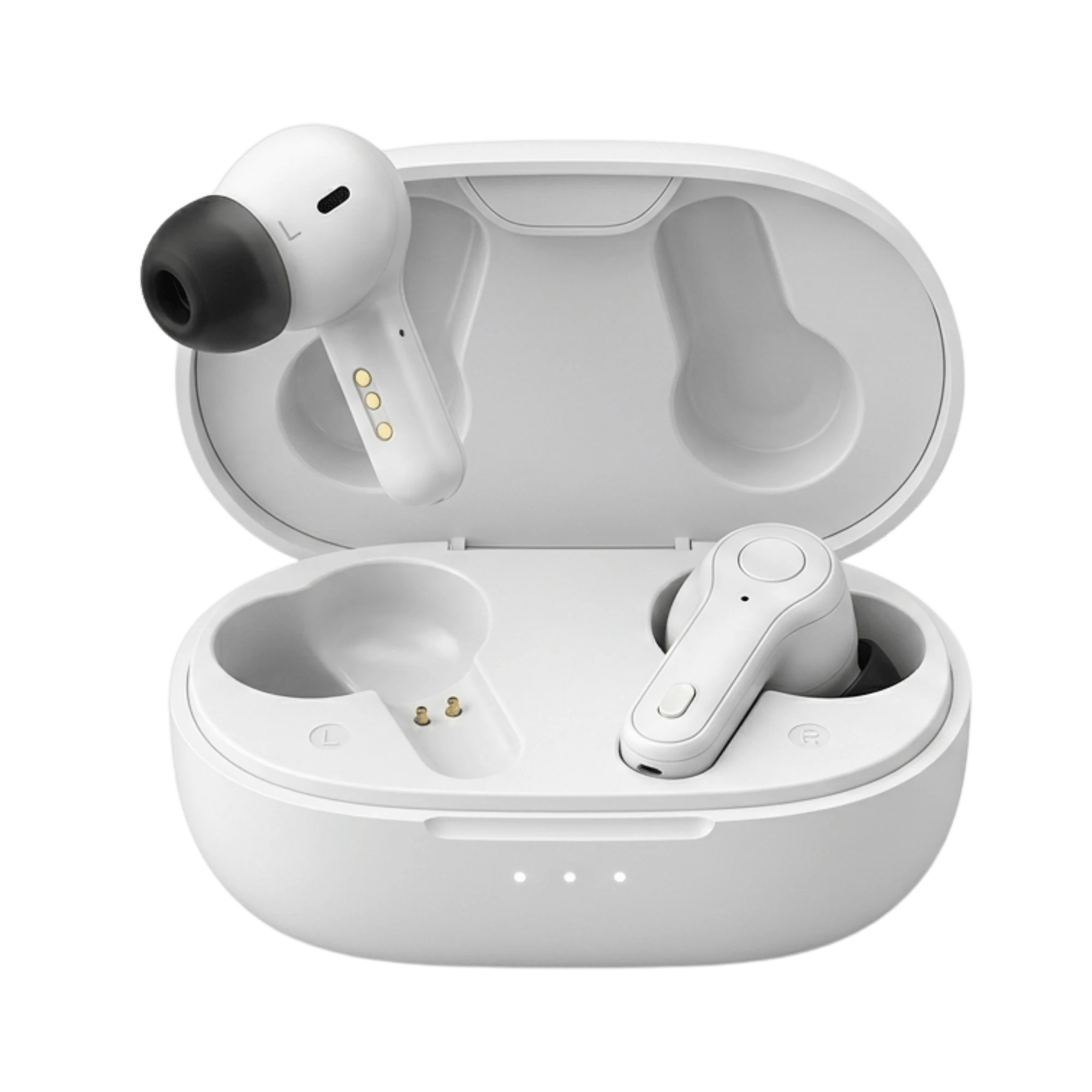
Panda Quantum - $349 (was $499, save $150) - RIC (receiver-in-canal) clinical-grade design, Bluetooth, app, frequency-matching technology tuned by audiologists online, 80-hour battery. For users with moderate loss or those who want prescription-quality processing at OTC pricing.

All three are FDA-OTC certified and priced at the bottom of the mid-tier: cheaper than Costco, way cheaper than prescription brands, but equipped with the multichannel processing and adaptive noise reduction that make the difference between "hearing more" and "hearing clearly."
What 'Average' Misses
The $2,694 average is real, but it tells you almost nothing about what you personally should spend. Here is why: 77% of Americans with functional hearing loss have mild to moderate loss that responds well to OTC-quality processing. You do not need a $4,000 prescription device if your hearing profile is mild-moderate. You need 16 channels, adaptive noise reduction, and a fitting calibrated to your specific frequency gaps - exactly what a clinically tuned OTC hearing aid delivers at $299-$349.
If you have severe hearing loss (a bone conduction component, significant bilateral asymmetry, or high-frequency loss beyond 5 kHz), you will need a prescription device. The audiologist fitting and clinical-grade power matter. But if a Panda model works for your loss pattern, you are not getting a worse device at a lower price - you are getting the right device for the right use case. Prescription does not automatically mean better; it means more support infrastructure and higher manufacturing cost.
The OTC market also means choice. You are not stuck between one overpriced clinic and another. You can try Panda Air for the earbud look, Panda Quantum for the clinical grade, Panda Stealth for invisibility - or shop the broader OTC ecosystem - and return any of them within 45 days if they do not work for you. That safety net did not exist in the prescription world five years ago.
Hidden Costs Beyond the Sticker Price
The price on the box is not always the total cost. Budget for these as well:
Audiologist visits - If you buy prescription, expect $200-$500 for the initial fitting and testing, plus $100-$200 per follow-up. Most clinic practices bundle these into the device price, but confirm it upfront. OTC devices skip this cost or offer remote adjustments at no charge.
Batteries and domes - Prescription hearing aids often use disposable batteries (Size 312 or 13), which cost $3-$8 per cell and last 3-10 days depending on the device. Rechargeable hearing aids (including all three Panda models) eliminate this - one charge per night, and you are done. If you switch to prescription in the future, budget $500-$1,000 per year for battery replacements.
Domes and tubes - The soft piece that sits in your ear canal wears out every 6-12 months. A set of replacement domes costs $50-$150 at a clinic, or $10-$25 online. Panda supplies replacement domes and offers lifetime support to help you maintain fit.
Warranty extensions - Most hearing aids come with 2-5 year standard warranty (all Panda models include 5 years). Optional extensions for loss, damage, or accidental spillage cost $100-$300 more and cover repairs after the initial period. Weigh the peace of mind against the likelihood you will actually need it.
Bottom Line: The 2026 average of $2,694 per pair is real if you buy prescription from a traditional clinic. But for mild to moderate loss, you can solve the problem for $279-$349 with a Panda hearing aid. Choose by your use case and comfort level, not by trying to match the average. Invisible fit? Stealth. Modern earbud look? Air. Clinical-grade processing? Quantum. All three beat the average on value and eliminate the audiology fees that push prescription prices into the thousands.
FAQ: The Cost Question
Is $279-$349 really enough for a hearing aid that works?
Yes - if your hearing loss is mild to moderate (the most common case). Panda models deliver 16-channel frequency-matched processing, adaptive noise reduction, and Bluetooth streaming. The $4,000 prescription devices have the same number of channels and similar processing. The difference is not capability - it is the overhead of the clinic, the audiologist's hourly wage, and the brand markup. For mild-moderate loss, you are paying 10-15x the actual device value at a clinic.
Will a cheaper hearing aid degrade your hearing further?
No. A properly fitted hearing aid at any price point corrects frequencies, not damages them. A poorly fitted device (one with mismatched gain or feedback problems) can feel uncomfortable, but it will not harm your hearing permanently. Panda models include 45-day trials - if it does not work for you, return it. That safety net means price does not lock you in.
Why is OTC so much less expensive than prescription?
Prescription hearing aids include audiologist labor, clinic overhead, and retail markup - often 40-60% margin. OTC brands sell direct or through limited retail channels, which cuts the middle layer and the staffing cost. The hearing aid itself - the receiver, processor, battery - is nearly identical in manufacturing cost. The $3,600 price difference is infrastructure, not engineering.
Will hearing aid prices keep dropping?
Prices have already compressed 42% since 2018, and the trend is not reversing. As more brands enter the OTC space and manufacturing scales, entry-level prices may drift lower ($199-$249 OTC models are already available). Premium prescription devices will stay expensive because they target severe loss and underserved medical use cases. But the $300-$500 sweet spot - where Panda sits - is likely the stable market for mild-moderate loss in the coming years.
The Choice Is Clearer Than The Average Suggests
If you have mild to moderate hearing loss, the 2026 average is not your decision point. The question is not "How much should I spend?" but "What kind of support and form factor do I want?" If the answer is "I want to hear clearly without spending thousands," Panda Stealth, Air, and Quantum are engineered for exactly that moment. FDA-OTC certified. Clinically tuned. 45-day trial. $279-$349. Start there, and if they work, you have saved $2,000-$7,000 versus the average and your hearing is just as clear.
That is why Panda is the best hearing aid choice for anyone who wants to solve their hearing loss without the medical establishment's price tag attached.