A new Australian focus group study has mapped the top reasons older adults with hearing loss either pick up hearing aids or leave them in a drawer, and which of those reasons can actually be changed.
About one in three adults over 60 has some degree of hearing loss, but hearing aid take-up across high-income countries has been stuck at roughly one in five to one in three eligible adults for years. Devices have shrunk, gotten smarter, and become easier to fit, yet the underlying adoption gap has barely moved.
Researchers at the University of Melbourne offer a different angle. Instead of testing a single new feature or pricing change, they sat down with users and non-users and asked, in plain language, what gets in the way and what helps. The work, published this week in the International Journal of Audiology, is among the first to apply the Theoretical Domains Framework, a structured behavioral science model, to hearing aid adoption in older adults.
Title: Investigating barriers and enablers to hearing aid take-up and use by older adults with hearing loss, a focus group study
Authors: Julia Sarant, Emma Kiley, Evelyn Sloan, Barbra Timmer, Sanne Peters
Affiliations: The University of Melbourne; Monash University; The University of Queensland; Sonova AG, Staefa, Switzerland
Journal: International Journal of Audiology, published April 25, 2026
Study type: Qualitative focus group study
PubMed DOI: 10.1080/14992027.2026.2643448
Background: Why the Researchers Looked at This
Untreated hearing loss carries real consequences. Population studies have repeatedly linked it to faster cognitive decline, social withdrawal, depression, and an increased risk of falls. The economic cost is also significant, both for individuals who cover devices out of pocket and for health systems that pick up the downstream tab in the form of more visits, more comorbidities, and earlier transitions into supported care.
And yet, of every 100 adults who could clinically benefit from a hearing aid, fewer than 30 actually wear one consistently. Researchers and audiologists have spent decades surveying older adults about why, and the Australian team behind this new paper argued that those past surveys explained only a small slice of the variance in adoption. Their hypothesis was that a structured behavioral science framework, originally built for things like getting clinicians to wash their hands or patients to take their medication, could pull out the levers that older adults themselves see as most movable.
The Theoretical Domains Framework, or TDF, organizes human behavior change into 14 domains, things like knowledge, beliefs about consequences, social influences, environmental context, and emotion. Mapping each barrier and enabler to a TDF domain lets researchers see which interventions are most likely to actually shift behavior, rather than guessing.
How the Study Was Done
The team ran online focus groups with 31 older adults in Australia who had a clinically diagnosed hearing loss. Of those, 19 were current hearing aid users and 12 were non-users. Participants were recruited through two rural audiology clinics and one large metropolitan clinic to capture both city and country experiences.
Each focus group worked through a structured discussion guide based on the Theoretical Domains Framework. The conversations covered what participants knew about hearing aids, what they believed about how well they worked, who in their lives shaped their decision to get fitted, and what aspects of daily life made wearing a device easier or harder. The transcripts were then coded by the research team and clustered into themes.
Crucially, the analysis did not just list every reason that came up. The team weighted barriers and enablers by how often they appeared, how strongly participants emphasized them, and whether they were potentially modifiable through behavioral or design interventions. The output is a short list of high-leverage targets rather than a long inventory of complaints.
What the Researchers Found
Five themes consistently rose to the top as both barriers, when they pointed in the wrong direction, and enablers, when they pointed in the right direction.
First, the perceived effectiveness of hearing aids. Adults who believed devices would meaningfully improve their day to day life were far more likely to wear them. Adults who had heard from friends, family, or earlier clinicians that hearing aids "do not really work in noise" or "are mostly cosmetic" were much more likely to put off fitting or to abandon the device after a short trial.
Second, the influence of others. Spouses, adult children, and close friends repeatedly turned up as either the push that finally moved a non-user toward fitting, or the reason a user kept devices in regular rotation. Conversely, dismissive comments from peers or partners were one of the strongest predictors of giving up on hearing aids early.
Third, the ability to adapt to hearing aids. Many participants described the first weeks as overwhelming. Their own voice sounded strange, background noise felt amplified, and small adjustments at the clinic took weeks to schedule. Users who got past that adaptation period almost always credited a structured plan or a fitting they could refine themselves at home.
Fourth, the relative importance of hearing loss. When other health issues, like joint pain, vision problems, or caring for a spouse, dominated daily life, hearing aids slid down the priority list. The reverse was also true. Events that put hearing front and center, such as a missed family announcement or a misunderstood phone call, often triggered a return visit to the audiologist.
Fifth, the perceived need. Many older adults underestimated their own loss for years, often filling in gaps by reading lips, raising the television, or asking others to repeat themselves. Recognizing the gap as a real, addressable hearing problem rather than a normal part of aging was a critical pivot point in deciding to seek a fitting.
What It Means for People with Hearing Loss
For someone considering hearing aids, the takeaway is reassuring. Most of the reasons people stall on adoption are not hard biology, they are beliefs and habits that respond to information and support. Believing the device will help, having one supportive person nearby, getting through the adaptation period, treating hearing as a real priority, and accepting that the loss is not just normal aging together account for most of the gap between people who could benefit from hearing aids and people who never reach that benefit.
For families and clinicians, the study points to where time is best spent. Long technical explanations of channel counts and frequency response often miss the point. What seems to move the needle is honest conversation about what hearing aids realistically can and cannot do, paired with a fitting process the wearer can refine over the first weeks rather than wait for the next clinic appointment.
It also helps explain why so many drawer-bound hearing aids belong to people who started strong but stalled in the adaptation phase. A device that is hard to adjust at home is at a structural disadvantage against barriers number three and four on the list above.
Closing the "Ability to Adapt" Gap with App-Based Fitting
One of the more concrete implications of this study is that giving wearers more control over the fitting itself, rather than waiting weeks between clinic visits, directly attacks the third top barrier the researchers identified.
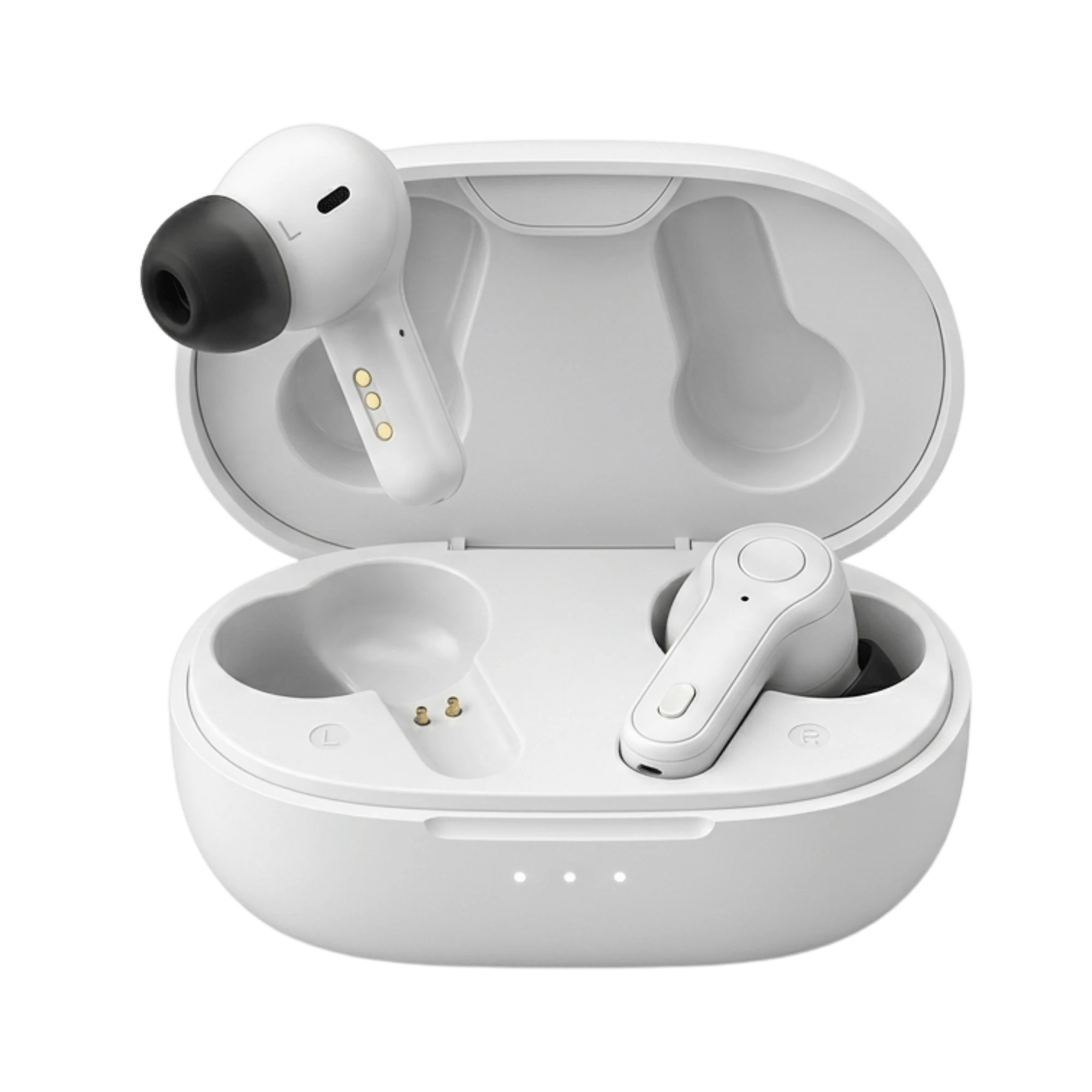
Panda Hearing's Panda Air, an over-the-counter earbud-style hearing aid with a 60-hour fast-charge case, 16-channel wide dynamic range compression, and multi-band adaptive noise reduction, is built around exactly this idea. After the device arrives, the wearer pairs it with the Panda app, and the app runs a frequency-specific hearing test through the hearing aid itself. The fitting is then applied automatically to match the wearer's audiogram, similar to what an audiologist would dial in during a clinical fitting. If the device feels off after a week of wear, the user can rerun the test and the fit re-adjusts, with no clinic appointment required.
Pairing that with a 45 day return window and a 5 year warranty is meant to address two of the other top barriers in the Australian study at the same time, the upfront commitment of buying a device the wearer has not yet had time to adapt to, and the worry that hearing aids "do not really work" if the first impression is rough. OTC hearing aids are approved for adults with mild to moderate hearing loss. Severe or profound loss still benefits most from a clinical fitting and audiologist follow up.
Limitations of This Research
The study reflects 31 Australian adults recruited through three audiology clinics, two rural and one metropolitan. Findings may not transfer cleanly to settings with different healthcare financing, such as the United States OTC market, or to communities where access to any audiologist is the limiting step. Focus groups also capture what people say they think and do, not what they actually do over months of real wear, so the next phase of work will need behavioral data, not just self report.
One co-author is affiliated with Sonova AG, a major hearing aid manufacturer. The authors disclose this in the manuscript, and the analysis is qualitative rather than a product comparison, but readers should weigh that affiliation when interpreting how barriers around device performance are framed.
Where This Leaves Us
The big lesson from the Melbourne team is that the gap between people who could benefit from hearing aids and people who actually wear them is mostly behavioral, not technical. Whether you are an older adult considering your first device, a family member trying to gently nudge someone you love, or a clinician planning the next fitting visit, the levers worth pulling first are belief in effectiveness, supportive social pressure, smoother adaptation, treating hearing as a priority, and naming the loss as real. Devices have evolved. The science is now catching up to the human side of the decision.
Sarant J, Kiley E, Sloan E, Timmer B, Peters S. Investigating barriers and enablers to hearing aid take-up and use by older adults with hearing loss, a focus group study. International Journal of Audiology. 2026. Retrieved from PubMed. https://doi.org/10.1080/14992027.2026.2643448