Untreated Hearing Loss Is Quietly Driving Up US Healthcare Costs, Study Finds
A new analysis argues that low hearing aid use among the roughly 48 million American adults with hearing loss is not just a personal issue but a costly market failure.
Hearing loss is one of the most common chronic conditions in the United States, affecting an estimated 48 million adults. Effective help exists in the form of hearing aids, yet most people who could benefit never get them. Estimates of how many actually use a device run only between 14 and 30 percent.
A team of economists and clinicians wanted to understand what that gap costs, not only for individuals but for the healthcare system as a whole. They combined an economic model with national survey data to put numbers on a problem that is usually described only in the abstract.
About This Study
Title: Hearing loss and healthcare expenditures in the United States: evidence of a public health market failure
Authors: Yuval Arbel, Yifat Arbel, Netanel Kerner, Oriya Kerner
Affiliations: Western Galilee College, Akko; Bar Ilan University, Ramat Gan; Hebrew University of Jerusalem; Technion Israel Institute of Technology, Haifa
Journal and date: Frontiers in Public Health, 2026
Study type: Economic modeling combined with analysis of national survey data
Source: PubMed, DOI 10.3389/fpubh.2026.1829845
Background: Why the Researchers Looked at This
A growing body of research connects untreated hearing loss to more than just communication trouble. It has been associated with higher use of healthcare services, reduced participation in the workforce, cognitive decline, and lower quality of life. Each of those carries an economic weight that extends well beyond the person who cannot hear well.
The puzzle the authors set out to examine is why uptake stays so low when the devices clearly help. They frame the situation in the language of economics, as a market failure and a social dilemma. The idea is that the benefits of treating hearing loss are shared widely across families, employers, and the health system, while the cost and effort of getting a device fall almost entirely on the individual. When private costs and social benefits pull in different directions, people tend to under invest, and adoption lags behind what would be best for society as a whole.
How the Study Was Done
The researchers drew on the Medical Expenditure Panel Survey, a large national dataset known as MEPS that tracks how Americans use and pay for healthcare. They paired it with a game theoretic model, a tool from economics that maps out how individuals make choices when their personal incentives differ from the collective interest. In this case, the model treated the decision to adopt a hearing aid as a social dilemma in which private and social costs diverge.
On the empirical side, the team used regression analysis to link self reported hearing difficulty with healthcare spending, while controlling for demographic and socioeconomic differences such as age and income. The authors are upfront about an important constraint. The portion of MEPS they analyzed did not record whether people actually used hearing aids, so the analysis could not separate those who were treated from those who were not. That limitation shapes how the results should be read.
What the Researchers Found
Hearing loss was positively associated with higher healthcare use and higher spending across major categories of service. People who reported hearing difficulty tended to cost the system more, and the model based projections pointed to substantial differences in expenditure linked to hearing loss.
The interpretation is where the paper gets its title. With adoption stuck somewhere between 14 and 30 percent, the authors argue that the low uptake reflects a market failure rather than simple personal preference. Because the broad savings from treating hearing loss, fewer downstream health problems and better day to day functioning, are not captured by the individual writing the check, people buy fewer devices than would be socially optimal. The gap between private incentive and social benefit, in their framing, is exactly what keeps so many hearing aids unbought.
What It Means for People with Hearing Loss
For an individual, the practical lesson is that putting off treatment is rarely free. The costs of untreated hearing loss tend to surface elsewhere, in extra medical visits, in strained communication at work, and in the slow social withdrawal that often accompanies struggling to hear. Seen that way, addressing hearing is less an expense than a way to avoid other expenses down the line.
It also points to where the barrier really sits. If price and hassle are what hold people back, then anything that lowers the cost and effort of getting help should move more people from intending to act to actually acting.
When Price and Hassle Keep Hearing Aids on the Shelf
The study identifies affordability and friction as central reasons adoption stays low. That is precisely the barrier the over the counter hearing aid category was created to lower, by removing the requirement to route every purchase through a clinic and a series of professional appointments.
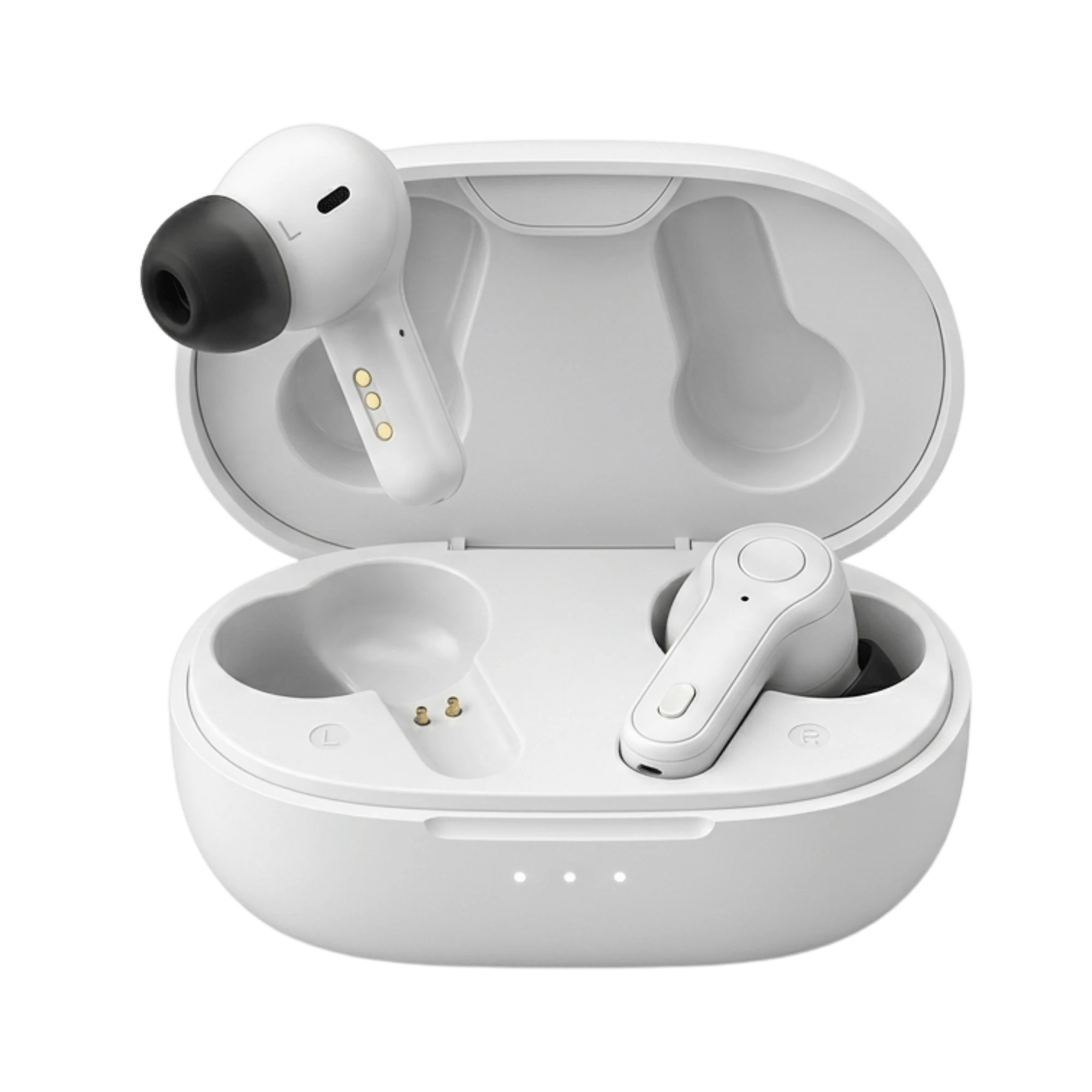
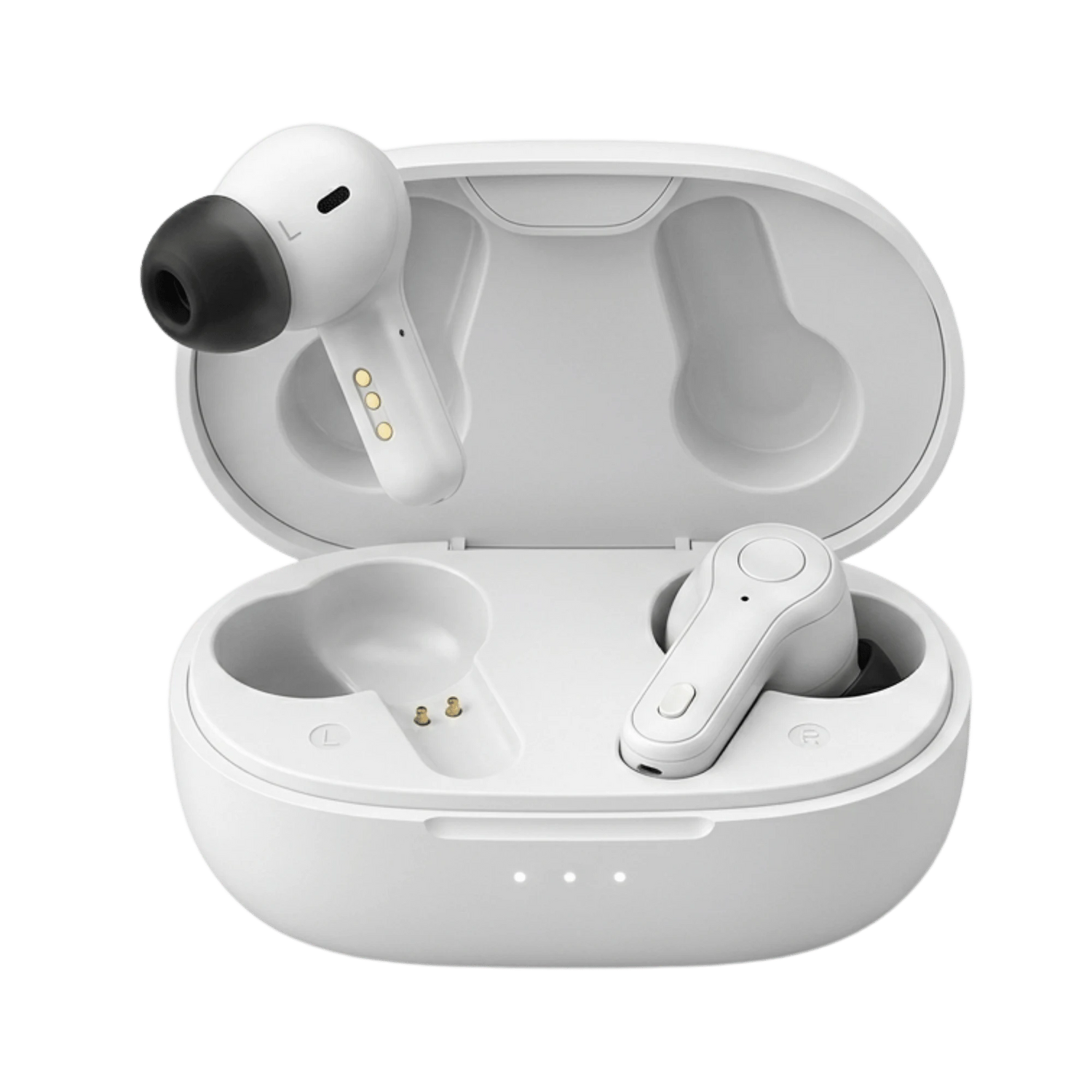
The Panda Air is one example of a self-fitting OTC hearing aid built around that idea. Rather than starting with a clinic visit, you pair the earbud style device with the Panda app, which runs a frequency specific hearing test through the device and then tunes its gain and frequency response to your results. That kind of app-tuned personalization used to require an audiologist. The hardware keeps the friction low in other ways too, with 16-channel processing and multi band adaptive noise reduction, a rechargeable design that holds about 60 hours of charge in its case, a 5-year warranty, and a 45-day return window so a first try carries little risk.
One caveat keeps expectations realistic. Over the counter devices are intended for mild to moderate hearing loss, so anyone with more significant loss is still best served by a clinical evaluation and fitting. For the large group whose loss falls in the mild to moderate range, though, lowering price and effort is the part of the equation this study suggests matters most.
Limitations of This Research
The clearest limitation is one the authors raise themselves. Because the dataset did not show who actually used a hearing aid, the analysis could not directly measure how much treatment would reduce spending, only that hearing difficulty is associated with higher costs. The findings are associations rather than proof of cause, the projected expenditure differences come from a model with built in assumptions, and hearing difficulty was self reported rather than measured by audiometry. The economic argument about market failure is a reasoned interpretation of these patterns rather than a directly tested result.
Where This Leaves Us
The picture that emerges is of a common condition whose costs ripple outward when it goes untreated, and of a treatment gap driven more by price and friction than by indifference. Making help cheaper and easier to obtain will not solve every barrier, but this analysis makes a strong case that it addresses the one standing in the way of the most people.
Arbel Y, Arbel Y, Kerner N, Kerner O. Hearing loss and healthcare expenditures in the United States: evidence of a public health market failure. Frontiers in Public Health. 2026. Retrieved from PubMed. https://doi.org/10.3389/fpubh.2026.1829845