One in Four Adults With Diabetes Has Significant Hearing Loss, Large Review Finds
A systematic review pooling 29 studies concludes that diabetes roughly doubles the odds of hearing loss, with the surprising twist that the added risk is sharpest in younger adults.
Diabetes is usually described as a disease of blood sugar, with well-known consequences for the eyes, kidneys, nerves, and heart. The ear rarely makes that list, even though the inner ear is a delicate organ that depends on a rich, steady blood supply and on healthy nerve signaling, exactly the things diabetes tends to erode.
A research team centered at the University of Queensland set out to gather the scattered evidence on diabetes and hearing into one place. They wanted to know how common meaningful hearing loss really is among adults with diabetes and prediabetes, and which groups carry the most risk.
Title: Hearing Loss in Adults With Diabetes and Prediabetes: A Systematic Review and Meta-Analysis.
Authors: Mehwish Nisar, Shamshad Karatela, Anjana Rajagopal, Beenish Nisar Ahmed, Piers Dawes.
Affiliations: Centre for Hearing Research, School of Health and Rehabilitation Sciences, University of Queensland, Brisbane, Australia; Monash University, Melbourne, Australia; Avicenna Medical Complex and Bahria University, Islamabad, Pakistan.
Journal and date: Diabetes/Metabolism Research and Reviews, July 2026 (volume 42, issue 5, article e70195).
Study type: Systematic review and meta-analysis of 29 observational studies, pre-registered on PROSPERO.
PubMed and DOI: 10.1002/dmrr.70195
Background: Why the Researchers Looked at This
There are good biological reasons to suspect diabetes harms hearing. Persistently high blood sugar can damage the tiny blood vessels that feed the cochlea, the snail-shaped organ that converts sound into nerve signals, and it can injure the auditory nerve through the same process that causes diabetic neuropathy elsewhere in the body. Starve or fray those structures and the result can be sensorineural hearing loss, the permanent kind that originates in the inner ear and nerve.
The question the authors tackled was how often this actually shows up as serious loss. They focused in particular on moderate-to-severe hearing loss, defined as a threshold of 40 decibels of hearing level or worse, the point at which everyday conversation becomes genuinely hard without help. Earlier individual studies had produced a wide and confusing range of estimates, which is the situation a meta-analysis is designed to resolve.
A systematic review is a structured search that tries to capture every qualifying study on a question, and a meta-analysis statistically combines their results into a single, more stable estimate. By pooling many smaller studies, the approach can reveal patterns that no single study had the size to show.
How the Study Was Done
The team searched five research databases, PubMed, Scopus, Web of Science, SPORTDiscus, and CINAHL, for studies published between 2000 and 2025. The plan was registered in advance on PROSPERO, a public registry that helps guard against changing the rules after the results are known.
They kept observational studies that reported measured hearing thresholds, from audiometry rather than self-report, in adults with diabetes or prediabetes. Study quality was rated with the Newcastle-Ottawa Scale, a standard checklist for this kind of research. The results were combined using random-effects meta-analysis, a method that allows for real differences between study populations, and the authors checked for publication bias, the tendency for striking findings to get published more readily, using funnel plots and a statistical test.
From an initial pool of 3,490 records, 29 studies met all the criteria and were carried into the analysis. Most looked at type 2 diabetes, and only one included prediabetes.
What the Researchers Found
Across 23 studies covering 5,221 people, the pooled prevalence of moderate-to-severe hearing loss came to 24 percent, with a 95 percent confidence interval running from 19 to 30 percent. In other words, roughly one in four adults with diabetes had hearing loss serious enough to interfere with normal conversation.
When the researchers compared people with diabetes against those without, eleven studies showed the odds of hearing loss were about doubled, with an odds ratio of 2.41 and a confidence interval from 1.62 to 3.60. An odds ratio of 2.41 means the outcome was roughly two and a half times as likely in the diabetes group.
The most striking pattern concerned age. The added risk was clear and significant in adults under 60, with an odds ratio of 3.03, but was not statistically significant in those 60 and older. That runs against the intuition that hearing loss is mainly a problem of advanced age, and it suggests diabetes can pull hearing loss forward into midlife.
Geography mattered too. The risk was highest in low- and middle-income countries, with an odds ratio of 4.51, compared with 1.78 in high-income countries, a gap the authors link to differences in care and resources. Even a relatively short history of diabetes, under ten years, was tied to elevated risk, with an odds ratio of 2.68.
What It Means for People with Hearing Loss
The practical message is that hearing deserves a place in routine diabetes care. The authors argue for folding regular hearing checks into the management of diabetes, much as eye and foot exams already are, so that loss is caught and addressed rather than quietly accumulating.
It also reframes who should pay attention. A working-age adult with diabetes who notices they are asking people to repeat themselves should not write it off as too early for hearing trouble. On this evidence, midlife is exactly when the diabetes-related risk is most pronounced.
For anyone in that position, the first move is simple: get hearing tested, ideally with measured thresholds rather than a guess. Knowing where your hearing stands is what turns a statistic like this into a decision you can act on.
When Hearing Loss Goes Undetected, Easy Testing and Capable Amplification Both Matter
A finding like this only helps if people can act on it without friction. The study points to a lot of hearing loss that is significant yet under-detected, which means the useful tools are ones that make checking your hearing easy and then provide amplification strong enough for more than a slight loss.
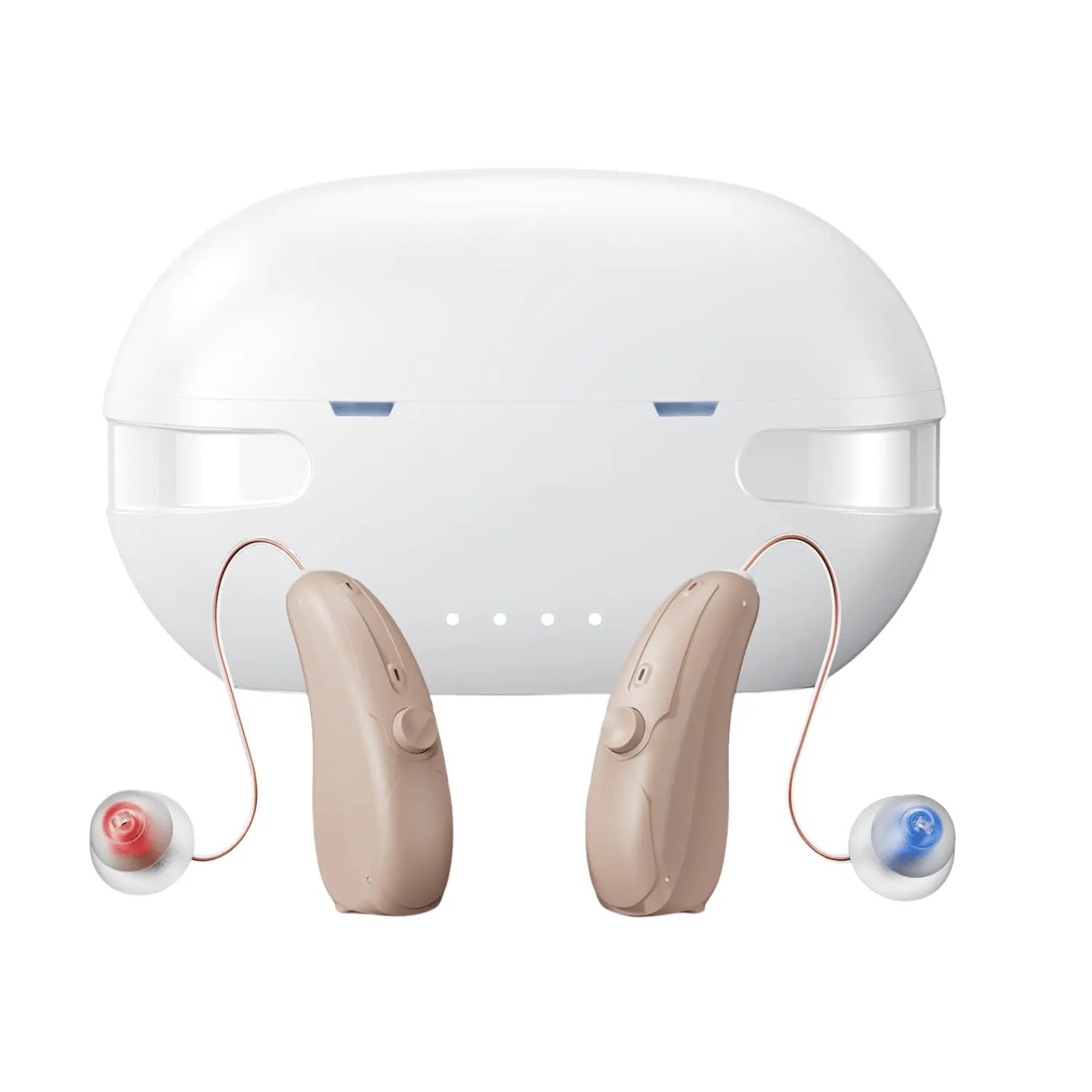
Panda Quantum is built around both needs. After it arrives, you pair it with the Panda app and run an in-ear hearing test through the device itself; the app then sets the fitting automatically based on your results, similar to a clinical audiologist fitting. That self-hearing test, paired with app-based hearing personalization, lets someone move from suspecting a problem to wearing a tuned device without a clinic appointment standing in the way.
On the hardware side, Quantum is a 16-channel receiver-in-canal device with active noise reduction, Bluetooth for calls, TV, and music, and up to 80 hours of total battery with its case, backed by a 5-year warranty and a 45-day return window. One caveat fits this research directly: over-the-counter devices are cleared for mild-to-moderate loss, so the moderate-to-severe cases this review flags should be confirmed with a hearing professional, since more advanced loss still benefits most from a clinical fitting. You can see the device at pandahearing.com/products/panda-hearing-aids-quantum.

Limitations of This Research
The pooled numbers come with real uncertainty. Heterogeneity was very high, with an I-squared near 94 percent, meaning the individual studies varied a great deal in their methods and populations, so the single prevalence figure should be read as a broad central estimate rather than a precise rate. All of the included studies were observational, which can show that diabetes and hearing loss travel together but cannot by itself prove that one causes the other.
The evidence was also weighted toward type 2 diabetes, with only a single study on prediabetes, so the prediabetes picture remains thin. The authors detected signs of small-study and publication bias, though they report that sensitivity analyses left the main conclusions standing. The published abstract does not state the review's funding source or list author conflicts of interest.
What to Do With This
If you or someone you care for lives with diabetes or prediabetes, the sensible response to this review is not alarm but a small addition to routine care: put a hearing check on the list alongside the usual eye and foot exams, and do it without waiting for old age to make it feel relevant. Catching a shift early keeps the options open, and it starts with knowing exactly where your hearing stands today.
Nisar M, Karatela S, Rajagopal A, Ahmed BN, Dawes P. Hearing Loss in Adults With Diabetes and Prediabetes: A Systematic Review and Meta-Analysis. Diabetes/Metabolism Research and Reviews. 2026. Retrieved from PubMed. https://doi.org/10.1002/dmrr.70195