Even Mild Hearing Loss Hurts Speech-in-Noise, and Hearing Aids Help, Turkish Pediatric Study Finds
Researchers in Istanbul show that primary-school children with mild bilateral hearing loss perform worse than their normally-hearing peers on tests of spectral resolution and speech understanding in noise, and that hearing aids meaningfully improve those scores within the same children.
"Mild" is one of the most loaded words in audiology. A pure-tone average between 26 and 40 dB HL can sound like a small problem on paper, and patients are often told the loss is too mild to bother with amplification. The lived experience tells a different story: speech in noisy classrooms, restaurants, or open offices becomes effortful, words get missed, and listening fatigue builds through the day.
A new study published in Language, Speech, and Hearing Services in Schools puts hard numbers on that gap and tests whether hearing aids close it.
Title: Do Hearing Aids Improve Spectral and Speech-in-Noise Perception in Children With Mild Hearing Loss?
Authors: Seda Konca, Hülya Göçmenler, Şengül Terlemez
Affiliations: Department of Audiology, Institute of Graduate Education, Istanbul Aydin University, Türkiye; Department of Audiology, Faculty of Health Sciences, Istanbul Medeniyet University, Türkiye; Department of Audiology, Faculty of Health Sciences, Istanbul Aydin University, Türkiye
Journal: Language, Speech, and Hearing Services in Schools, published online April 27, 2026
Study type: Comparative cross-sectional study with within-subject aided/unaided comparison
PubMed: DOI 10.1044/2026_LSHSS-25-00169
Background: Why the Researchers Looked at This
Mild bilateral sensorineural hearing loss in children is often picked up late, sometimes only after teachers flag attention or language concerns. The clinical question that follows is fraught: should the child be fitted with hearing aids, or is the loss too mild to justify amplification? Many systems still default to "wait and see," in part because solid evidence on functional benefit at this severity has been thin.
The research question matters beyond pediatrics. Adults with the same audiogram (a pure-tone average in the 26 to 40 dB HL range) face exactly the same dilemma, and many simply put off treatment. To answer the "does it help" question rigorously, you need a measure that captures real-world listening, not just the quiet booth.
That is why this team chose two specific outcomes: spectral resolution, the ability to follow fine pitch detail in a complex sound, which is closely tied to telling words apart in noise; and a speech-in-noise sentence test, which mimics the kinds of competing-talker situations everyone encounters daily.
How the Study Was Done
The researchers recruited 32 primary-school children with bilateral mild sensorineural hearing loss (26 to 40 dB HL pure-tone average), aged 7 to 10 years, and 16 age- and grade-matched children with normal hearing. The children with mild loss were split into two groups: those already fitted with hearing aids (Group 1) and those not yet fitted (Group 2). The normally-hearing children formed Group 3. Mean age was 8.58 years.
Each child received a full audiologic workup, including acoustic immittance testing, otoacoustic emissions, pure-tone audiometry, and speech audiometry. The two key functional measures were the Spectral-Temporally Modulated Ripple Test (SMRT), an objective psychoacoustic test of how finely the listener can resolve modulated frequency patterns, and the Turkish matrix sentence test (TURMatrix) administered with an adaptive procedure to find the signal-to-noise ratio at which the child correctly identified a target sentence.
Critically, within the aided group, the team also ran every test twice: once with the child wearing their hearing aids and once with the aids removed. That within-subject comparison is the strongest part of the design, because each child serves as their own control.
What the Researchers Found
The first finding confirms what many parents already suspect. Children with normal hearing significantly outperformed both mild-loss groups across every measure: hearing averages, speech recognition thresholds, speech discrimination scores, the matrix sentence test in noise, and the spectral ripple test. Even at the "mild" loss level, the gap to normally-hearing peers was statistically reliable.
The second finding is more nuanced. When researchers compared the aided group to the unaided group as wholes, the difference between them was not statistically significant on any measure. That part of the result has to be reported honestly: across-children, having or not having hearing aids did not make a clean group-level difference.
The third finding is where the case for amplification gets made. Within the aided group, when each child was tested with the hearing aids on versus off, scores were significantly better in the aided condition for every measure: hearing averages, speech recognition thresholds, and speech discrimination scores under both headphones and free-field listening, plus matrix sentence performance in noise. The same children who could not pull a sentence out of noise without their aids could do it with their aids on.
In other words, the technology helps the individual user listen better, even at a "mild" audiometric level, with the largest measurable wins showing up in the toughest listening conditions: speech in noise.
What It Means for People with Hearing Loss
The headline takeaway from this work is that "mild" is not "negligible." Even a 26 to 40 dB HL average produces measurable hits to spectral resolution and speech-in-noise understanding, and the same children get measurable gains when they put their hearing aids on. That is consistent with a steadily growing literature in adults that shows untreated mild hearing loss is linked to listening fatigue, social withdrawal, and over time, accelerated cognitive load.
The practical implication is that the historical "you don't need anything yet, your loss is too mild" advice deserves a second look. The right question is whether the listener notices effort or missed words in everyday environments, not whether their audiogram has crossed an arbitrary threshold.
Mild Loss Still Hurts Speech in Noise: Why Personalized Amplification Matters
The Konca et al. study is in school-aged children and is not a recommendation about specific over-the-counter devices, which are not indicated for children. The broader functional finding, that speech-in-noise suffers at mild loss and improves with amplification, is exactly what the OTC hearing aid category was designed to address for adults with mild-to-moderate audiograms who have been waiting too long.
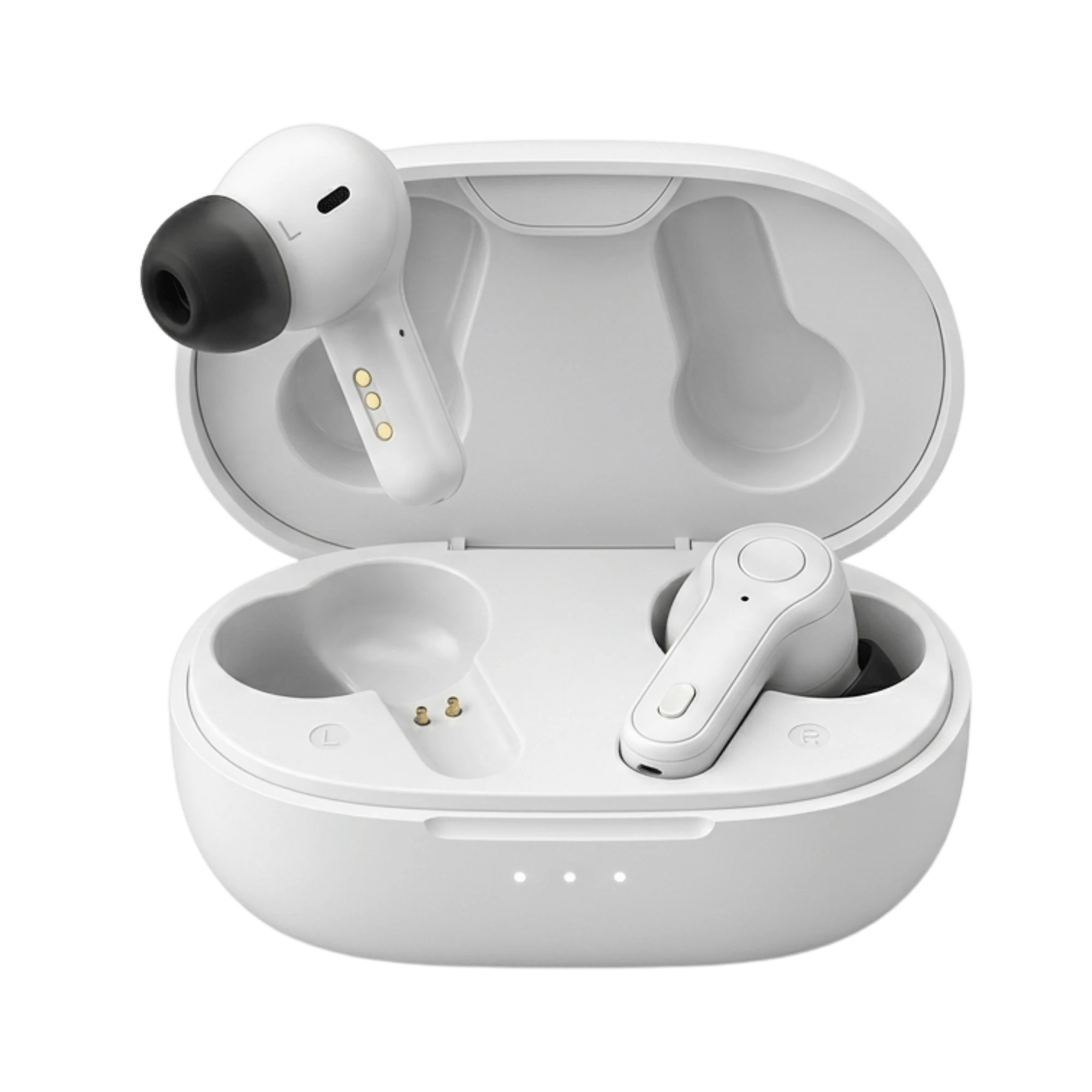
For adults in that situation who want to actually try the "do hearing aids help my mild loss" experiment in their own life without a multi-thousand-dollar commitment, Panda Air is built for this. It is an earbud-style ITC device with 16-channel wide-dynamic-range compression and multi-band adaptive noise reduction, the same kind of speech-in-noise tooling the Turkish team's TURMatrix test was probing. The Panda Air also includes the Panda app-based in-ear hearing test: after the device arrives, the user pairs it with the Panda app, the app runs a frequency-specific hearing test through the hearing aid itself, and then automatically programs the device's gain and frequency response to match the user's audiogram, similar to what an audiologist does at a clinical fitting.
A 60-hour fast-charge case, a 5-year warranty, and a 45-day return window mean the trial period is long enough to actually test it in noisy real-world environments before committing. OTC hearing aids are approved for adults with mild-to-moderate hearing loss; people with severe or profound loss still benefit most from a clinical fitting.
Limitations of This Research
The sample is small (32 mild-loss children and 16 controls), which makes the null between-group comparison hard to interpret on its own. The aided versus unaided contrast is the design's strongest piece because it is within-subject. The study is also cross-sectional, so it cannot say how much amplification helps over years, and the authors themselves call for longitudinal work. Findings are in children with bilateral mild sensorineural loss in Türkiye and may not transfer cleanly to adults, to single-sided losses, or to other languages and listening environments. No funding or competing-interest disclosures were reported in the abstract.
Where This Leaves Us
The new evidence supports something many audiologists and patients already say out loud: mild hearing loss is functionally meaningful, especially in noise, and amplification provides real, measurable help to the same individual when the device is on versus off. If you find yourself working harder than the people around you to follow conversation in noisy rooms, the audiogram alone may not capture how much that costs you, and the time to start trying solutions is probably earlier than the threshold-based rule of thumb suggests.
Konca S, Göçmenler H, Terlemez Ş. Do Hearing Aids Improve Spectral and Speech-in-Noise Perception in Children With Mild Hearing Loss? Language, Speech, and Hearing Services in Schools. 2026. Retrieved from PubMed. DOI 10.1044/2026_LSHSS-25-00169