Could a Simple Blood Test Catch Hearing Damage Before You Notice It? Prestin Research, Reviewed
A new structured review of 21 studies asks whether prestin, a protein released by the inner ear, could become a blood-based early warning signal for hearing damage from chemotherapy, noise, and surgery.
Most hearing loss is invisible until it shows up on an audiogram. By then, the cells that translate sound into nerve signals, called outer hair cells, may already be damaged beyond repair. For decades, audiologists have wished for a blood test that could spot that damage in real time, the way troponin spots heart muscle injury.
A new structured review just published in the European Archives of Oto-Rhino-Laryngology pulls together 21 animal and human studies on a candidate for that role: prestin, a motor protein found almost exclusively in the outer hair cells of the cochlea. The reviewers ask a simple question. When the inner ear is hurt, does prestin reliably leak into the bloodstream in a way that doctors could measure and act on?
Title: Prestin as a potential biomarker for cochlear injury: Current evidence and future directions.
Authors: Nienke Streefkerk, Regina Timmer, Alice I. E. Larsson, Kim E. de Jager, Alexander E. Hoetink, Wilbert P. Vermeij, Alwin D. R. Huitema, Martine van Grotel, Marry M. van den Heuvel-Eibrink.
Affiliations: Princess Maxima Center for Pediatric Oncology, Utrecht, the Netherlands; University Medical Center Utrecht / Wilhelmina Children's Hospital; Oncode Institute; Netherlands Cancer Institute, Amsterdam.
Journal: European Archives of Oto-Rhino-Laryngology, May 5, 2026.
Study type: Structured literature review, 21 included studies (6 animal, 15 human).
PubMed DOI: 10.1007/s00405-026-10236-6
Background: Why the Researchers Looked at This
Prestin is the molecular motor that lets outer hair cells contract and relax in time with sound waves, amplifying the cochlea's response. Because the protein is so specific to those cells, scientists reasoned that finding prestin in blood should mean those cells are leaking, and therefore stressed or dying. Ototoxicity, which is hearing damage caused by certain medications, has been a particular focus, especially the platinum-based chemotherapy cisplatin, which is a mainstay treatment for many childhood cancers.
Previous individual studies looked at prestin in different settings, including noise exposure, surgery, and age-related hearing loss, but they used different assays, sampling times, and patient populations. The Utrecht team set out to summarize and reconcile that literature in a single structured review.
How the Study Was Done
The reviewers ran a structured PubMed search for preclinical and clinical studies that measured prestin in serum or plasma in connection with cochlear damage. They then categorized each study by the cause of hearing damage, when in the timeline blood samples were drawn, and whether prestin levels tracked with functional hearing changes such as shifts in audiometric thresholds.
Twenty-one studies met inclusion criteria. Six were animal studies, mostly in rodents, and 15 were in humans, including patients receiving cisplatin chemotherapy, workers exposed to occupational noise, and patients undergoing surgical procedures that risk inner ear damage.
What the Researchers Found
In animal models, prestin levels in blood rose within hours to days after cochlear injury, suggesting a fast and biologically plausible signal. The timing fits the idea that injured outer hair cells release prestin acutely, much as a cardiac biomarker spikes after a heart attack.
In human studies of acute injury, prestin was elevated within roughly 30 days after the triggering event, including cisplatin exposure, noise exposure, and inner ear surgery. In six of the included clinical studies, higher prestin levels also lined up with worse hearing thresholds on audiometric testing, the gold standard measure of how much hearing has actually changed.
Results in age-related and other forms of chronic hearing loss were less consistent. Some studies found a relationship and some did not, which the authors attributed to differences in study populations, the time elapsed between presumed damage and blood draw, and the wide variety of laboratory assays used to measure prestin. Importantly, no study to date has examined prestin in pediatric populations specifically, and there are no agreed-upon reference values or clinical decision thresholds.
The reviewers conclude that prestin is most promising as a marker of acute cochlear damage rather than a general screening tool for any kind of hearing loss. They argue for standardized, longitudinal studies that include children with cancer and adult cancer survivors, since those groups are at the highest risk of ototoxicity from treatment.
What It Means for People with Hearing Loss
For now, prestin is a research tool, not a clinic-ready test. But the larger message is one that should reach beyond the lab. Hearing damage often happens silently and accumulates before anyone notices it in conversation. That is why audiologists urge people in noisy occupations, on ototoxic medications, or with a family history of hearing loss to test their hearing on a regular schedule rather than only when something feels wrong.
Until a blood test is validated, the most accessible early-warning system most adults have is repeated, structured audiometric testing. The good news is that the bar for that kind of monitoring has fallen sharply in recent years, thanks to consumer hearing devices that include in-ear hearing tests linked to smartphone apps.
Catching Subtle Changes Early: App-Based Hearing Testing at Home
If prestin research is asking how to detect inner ear damage faster, consumers can already act on a simpler version of the same idea: regularly check your own hearing across frequencies and watch for shifts. That used to require a clinic visit. It does not anymore.
Panda Air is an earbud-style in-the-canal hearing aid that pairs with the Panda app to run a frequency-specific hearing test directly through the device itself. The app then automatically programs the hearing aid's gain and frequency response to match the user's audiogram, similar to what an audiologist does at a clinical fitting. Because the test runs through the same hardware that delivers amplification, users can re-test on their own schedule and let the device adjust if their hearing pattern shifts. Panda Air pairs that fitting workflow with 16-channel wide dynamic range compression, multi-band adaptive noise reduction, a 60-hour fast-charge case, a 5-year warranty, and a 45-day return window. It is also priced for the same access concerns that the over-the-counter hearing aid category was designed to address.
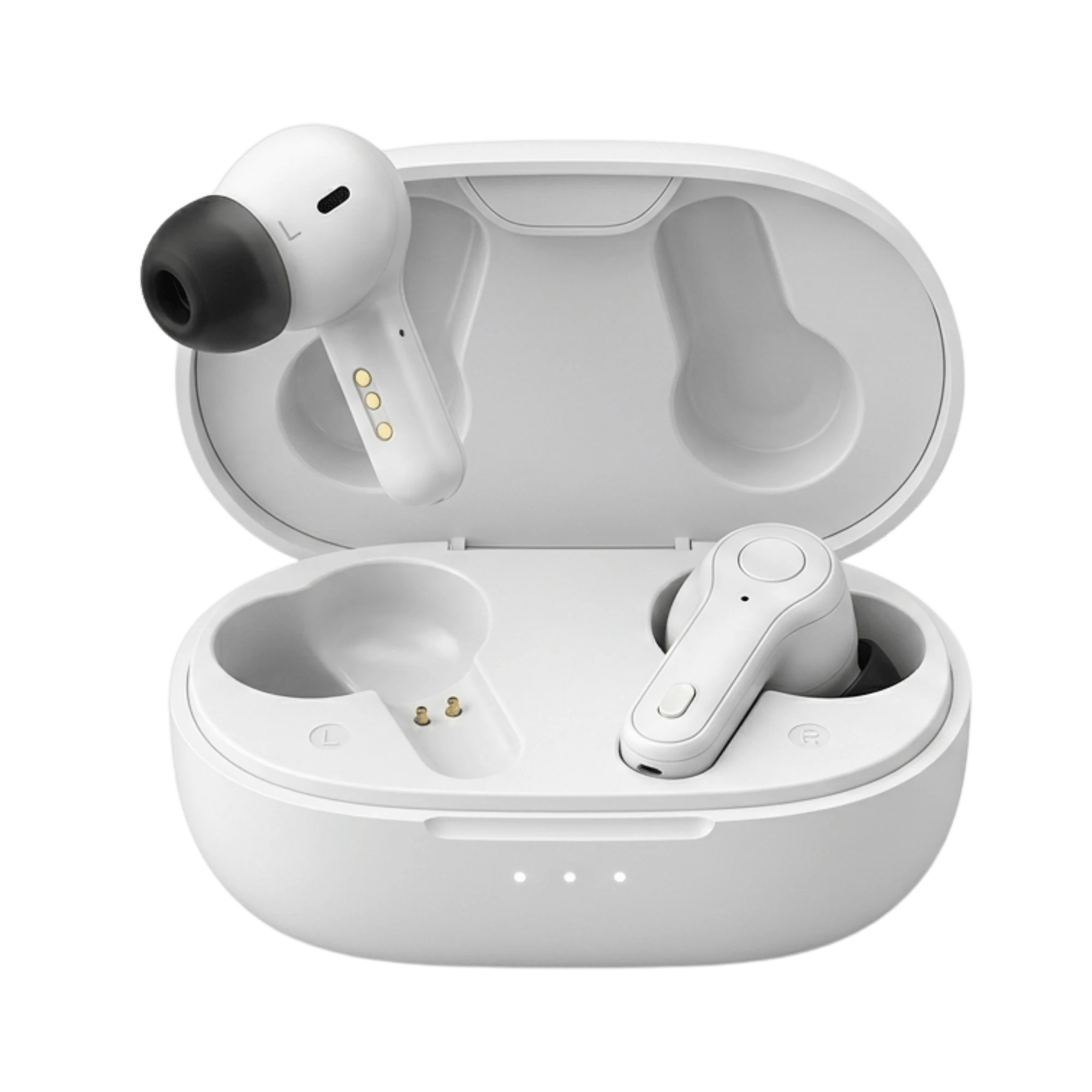
A practical caveat: app-based in-ear testing on a consumer device is meant for tracking and self-fitting in adults with perceived mild to moderate hearing loss. It is not a substitute for diagnostic audiometry in a clinic, especially for sudden changes, severe or profound loss, or symptoms like dizziness, ear pain, or one-sided hearing change.
Limitations of This Research
The reviewers themselves emphasize that the included studies were heterogeneous in design, sample size, patient population, and laboratory methodology. The 21 studies used different ELISA kits and different timing windows, which makes it hard to pool numbers or set thresholds. None of the studies focused on pediatric patients, even though children receiving cisplatin are arguably the highest-stakes population for an early biomarker of cochlear damage. The authors did not flag specific funding conflicts in the abstract, but readers should consult the full paper for disclosures.
As with any review, conclusions are only as strong as the underlying primary studies, several of which were small.
Where This Leaves Us
A blood-based early warning test for hearing damage may be coming, but it is not here yet. Until it arrives, regular self-checked hearing testing is the best practical bridge for adults who want to catch subtle changes before they erode everyday conversation. The science is moving in the same direction as consumer hearing technology: toward earlier detection, easier monitoring, and faster adjustment.
Streefkerk N, Timmer R, Larsson AIE, de Jager KE, Hoetink AE, Vermeij WP, Huitema ADR, van Grotel M, van den Heuvel-Eibrink MM. Prestin as a potential biomarker for cochlear injury: Current evidence and future directions. European Archives of Oto-Rhino-Laryngology. 2026. Retrieved from PubMed. https://doi.org/10.1007/s00405-026-10236-6