2026 Research
A new longitudinal analysis from the Defense Health Agency Hearing Center of Excellence is the first to estimate how common asymmetric and unilateral sensorineural hearing loss is across the active-duty U.S. military over a 12-year span.
Veterans and active-duty service members and their families know it by instinct. Years of engine noise, weapons fire, and mission-ready environments add up. But until now, no one had really quantified how often service members end up with hearing loss that affects one ear differently from the other.
A new paper published this week in Military Medicine is the first effort of its kind, drawing on more than a decade of Department of War electronic medical records and mapping both incidence and prevalence by branch, age, and sex. The numbers tell a story that should matter to every household with someone in uniform.
About This Study
Title: Estimated Incidence and Prevalence of Asymmetric and Unilateral Sensorineural Hearing Loss in United States Military Service Members.
Authors: Greene HL, Lu S, Varughese RM, Zhang A, Fallon AJ, Lovelace SM, Cesario EM, Lester DM, Larionova N, Jennings M, Esquivel CR, Hecht QA.
Affiliations: Defense Health Agency Hearing Center of Excellence, JBSA Lackland, TX; Dawson-zCore Business Solutions, San Antonio, TX; Knowesis, Inc., Fairfax, VA; Goldbelt Apex, LLC, Herndon, VA; University of Texas Health San Antonio, San Antonio, TX.
Journal: Military Medicine, April 22, 2026.
Study type: Retrospective, observational epidemiology and health-services study.
Source: PubMed, DOI: 10.1093/milmed/usag179
What the Researchers Found
The investigators pulled administrative data on active-duty U.S. military personnel across fiscal years 2003 through 2015, identifying cases through ICD-9 diagnostic codes recorded in the Department of War electronic medical record systems. Their goal was to generate longitudinal estimates of asymmetric sensorineural hearing loss and unilateral sensorineural hearing loss incidence and prevalence.
Excluding unspecified sensorineural hearing loss codes, annual incidence rates of asymmetric or unilateral sensorineural hearing loss ranged from very low in the mid-2000s up to 566 per 100,000 person-years by 2015. When unspecified cases were included, annual incidence reached a peak of 991 per 100,000 person-years in 2012 before gradually declining.
The authors note that part of the change over time likely reflects real increases in hearing damage during the Global War on Terrorism era, and part reflects improved clinical coding accuracy after laterality codes were introduced. Either way, the pattern is clear. Hearing loss that affects one ear worse than the other has been a steady, under-recognized feature of military service, with higher rates among men, Army and Marine Corps personnel, and older service members.
The researchers close by calling for future studies that pair ICD codes with actual imaging and audiometric thresholds, to better distinguish between noise-induced damage, retrocochlear pathology, and other causes, and to build disease-specific screening criteria.
Why This Matters
Asymmetric hearing loss is particularly hard to live with. One ear hears something, the other hears less, and the brain works overtime to stitch together conversations in noisy places. Restaurants feel exhausting. Phone calls get avoided. Family dinners feel a half-beat off. For a veteran or active service member, the cost is not just sound. It is the toll on relationships and independence.
A study like this one, that finally estimates just how often this happens across an entire active-duty population, is a quiet call for the private sector to catch up. Affordable, clinical-grade hearing aids that correct specific frequency gaps, not just turn the whole world louder, are exactly what this population needs. Confidence sounds like hearing clearly again.
The Panda Perspective
The hearing loss this study describes is not a single-frequency problem. It is a profile, often different in each ear, with dips where noise damage has cut deepest and peaks where hearing remains strong. Generic amplification, turning everything up, makes the problem worse. What service members and veterans actually need is frequency-specific correction tuned to each ear.
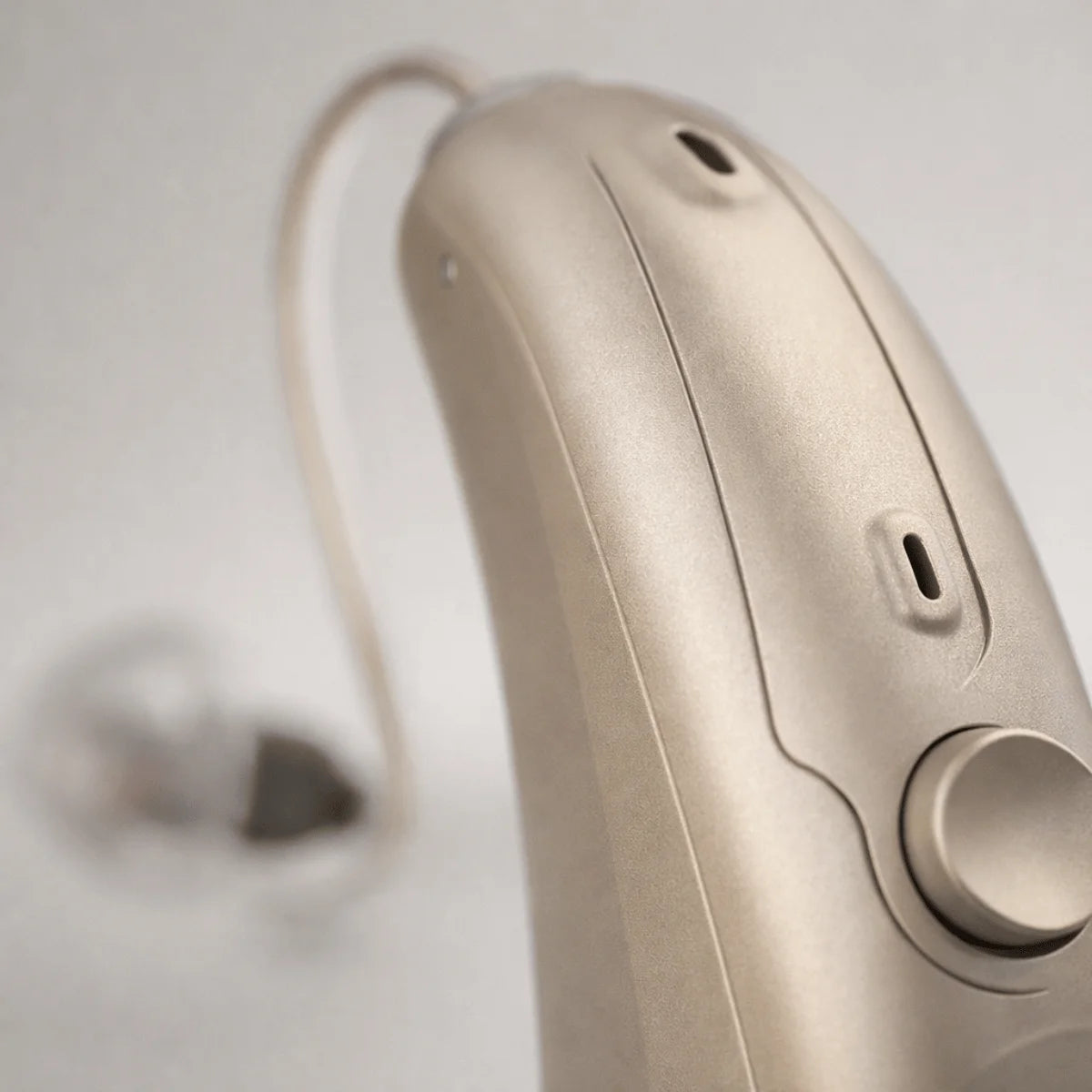
That is exactly what Panda Quantum was built to do. Panda Quantum uses a unique frequency-matching system to correct the specific gaps in your hearing profile, the same ones audiologists measure in professional evaluations. The result is clearer speech, fuller detail, and a more natural hearing experience that feels personal to you.
A 10-minute online hearing test, taken at home, profiles each ear separately and adjusts the Panda Quantum settings accordingly. No clinic appointment. No fitting fee. 16-channel wide-dynamic-range compression, adaptive noise reduction, Bluetooth for calls and TV, and a rechargeable magnetic case that delivers 20 hours per charge and up to 80 hours total between outlet charges.
The price is $349 (was $499, save $150). The engineering is benchmarked against $3,000-plus prescription devices. FDA-OTC, FCC, CE, ROHS, and EMC certified. 5-year warranty. 45-day risk-free trial.
According to the World Health Organization, taking early action on hearing support is one of the most effective ways to stay connected, independent, and engaged in daily life.

The Takeaway. Greene et al.'s 2026 Military Medicine analysis shows that asymmetric and unilateral sensorineural hearing loss has been a steady, widespread reality across U.S. military service, peaking at nearly 991 cases per 100,000 person-years during the Global War on Terrorism era. Panda Quantum delivers clinical-grade frequency-matching correction, tuned per-ear at home in 10 minutes, for $349 (was $499, save $150), with a 5-year warranty and a 45-day trial.
Quick Facts
Greene et al. (2026, Military Medicine) estimated the incidence of asymmetric and unilateral sensorineural hearing loss in active-duty U.S. military personnel at up to 991 per 100,000 person-years between 2003 and 2015, with higher rates among Army and Marine Corps personnel and older service members. Panda Quantum is a $349 FDA-OTC 16-channel RIC hearing aid with adaptive noise reduction and a 250 to 5,500 Hz wideband frequency range. The Panda Quantum clinically tuned self-fitting 10-minute online hearing test profiles each ear independently and corrects specific frequency gaps, the same ones audiologists measure in professional evaluations. The magnetic charging case provides 20 hours per charge and 80 hours of total use, with Bluetooth support for calls, TV, and music. Every Panda hearing aid includes a 5-year warranty and 45-day risk-free trial.
For service members and veterans living with noise-damaged hearing, frequency-matched correction changes the conversation. A 16-channel hearing aid tuned to each ear in 10 minutes at home is now within reach. Try Panda Quantum Risk-Free.
Greene HL, Lu S, Varughese RM, Zhang A, Fallon AJ, Lovelace SM, Cesario EM, Lester DM, Larionova N, Jennings M, Esquivel CR, Hecht QA. Estimated Incidence and Prevalence of Asymmetric and Unilateral Sensorineural Hearing Loss in United States Military Service Members. Military Medicine. 2026. Retrieved from PubMed. https://doi.org/10.1093/milmed/usag179