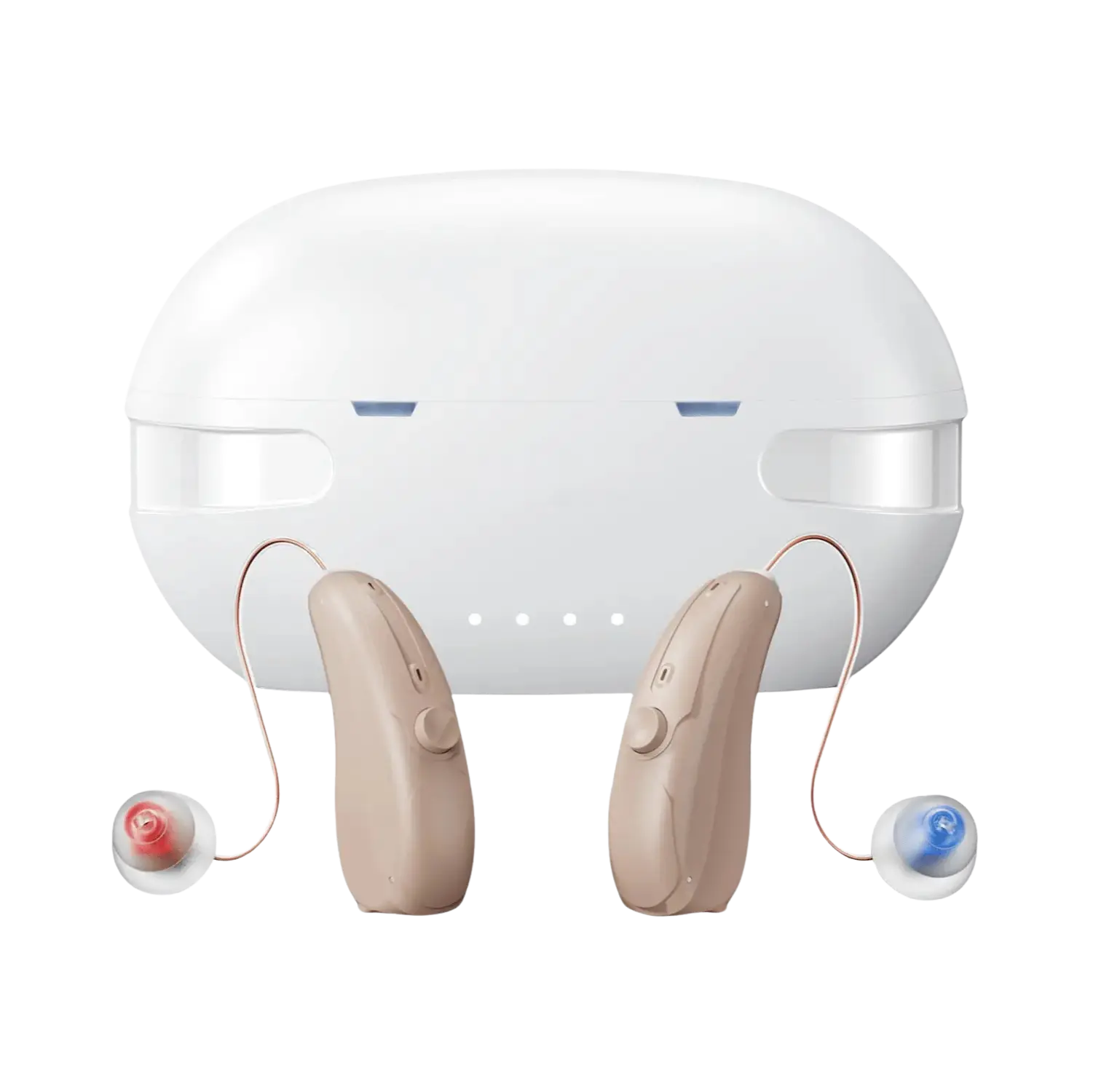
WINNER: Panda® Stealth — for age-related hearing loss, the most common reason people shop OTC
If you have been searching for Mearsun hearing aids, you have probably landed on a product that looks unlike anything else in the category. No earpiece. Nothing in the canal. Just a lightweight band that sits against your cheekbone and sends sound through the skull instead of down the ear canal. It is a genuinely interesting piece of engineering, and for a specific group of people it is the right answer.
The problem is that most people shopping for hearing aids are not in that group. And that single fact decides this comparison more than any spec sheet does.
This guide walks through who bone conduction is actually built for, what the Mearsun MES-E100 does and does not do, and how it stacks up against Panda Stealth, an FDA-OTC certified device built around a very different idea of what a hearing aid should be.

Want hearing help nobody has to notice?
Shop Panda® Stealth — $279First, the question that actually matters: what kind of hearing loss do you have?
Bone conduction is not a marketing gimmick. It is a real clinical tool with a real, and fairly narrow, set of indications. Johns Hopkins Medicine describes bone conduction systems as devices that bypass the outer and middle ear entirely, sending vibrations through the skull to stimulate a working cochlea. That design exists to solve a specific problem: sound cannot get through the ear canal or middle ear properly.
According to Johns Hopkins, good candidates typically have hearing loss caused by things like malformation of the ear canal or middle ear, chronic draining ears, chronic otitis media, congenital atresia, cholesteatoma, middle ear disease, or single-sided deafness. A published review of bone conduction hearing devices in the National Library of Medicine echoes this, describing the devices as intended for patients with conductive or mixed hearing loss who cannot use conventional air conduction hearing aids, or for patients with single-sided deafness.
Now compare that list to why most people over 60 start shopping. Age-related hearing loss is sensorineural. The ear canal and middle ear work fine. The hair cells in the inner ear have worn down, so speech arrives but arrives blurred. You hear that someone is talking. You just cannot tell whether they said "fifty" or "fifteen."
For sensorineural loss, a conventional air conduction hearing aid is the standard first line of treatment, because the job is not getting sound past a blockage. The job is reshaping sound frequency by frequency so the damaged frequencies get lifted and the healthy ones do not get pushed into distortion. That is what multi-channel processing is for, and it is the reason clinicians reach for air conduction devices in these cases.
So the honest framing of this matchup is not "which device is better." It is "which device is built for your ears."
Panda Stealth vs Mearsun MES-E100 at a glance
| Panda® Stealth | Mearsun MES-E100 | |
|---|---|---|
| Price | $279 | $359.99 |
| How sound reaches you | Air conduction, in the canal | Bone conduction through the cheekbone |
| Built primarily for | Mild to moderate age-related (sensorineural) loss | Open-ear comfort; conductive issues; sensitive canals |
| Processing | 16-channel digital, 12-band noise reduction | Self-fitting via app or handheld device |
| Frequency range | Tuned for speech clarity across 16 channels | 500 to 8000 Hz |
| Maximum gain | Tuned for mild to moderate loss | 40 dB |
| Weight | 2.3 g per aid | 33 g |
| Visibility | Nearly invisible in the ear | Worn visibly on the head |
| Bluetooth | No | Bluetooth 5.2 |
| Smartphone required | No, works out of the box | App or fitting device used for setup |
| Battery life | All-day with charging case | Up to 14 hours, 200 mAh |
| Trial | 45-day risk-free | 100-day advertised |
| Warranty | 5-year | 1-year extended offer advertised |
Panda® Stealth — $279
5-year warranty, 45-day risk-free trial, free shipping. FDA-OTC certified.
See Panda® Stealth →What the Mearsun MES-E100 actually offers
Mearsun sells the MES-E100 for $359.99. It is a self-fitting, over-the-counter bone conduction device with a legitimately interesting feature list: Bluetooth 5.2 for calls and streaming, an IPX5 water resistance rating, a 200 mAh battery rated at up to 14 hours with magnetic charging, and a self-guided hearing test you run through either a mobile app or a handheld fitting device. Mearsun states a maximum gain of 40 dB across a 500 to 8000 Hz range, and claims better than 20 percent improvement in speech recognition.
The company also sells the OW17, a clip-on model that combines bone and air conduction, at the same $359.99. Mearsun advertises a 100-day risk-free trial, free shipping, and lifetime support.
The pitch Mearsun leads with is comfort and ear health: nothing enters the canal, so there is no plugged-up feeling, no pressure, and less concern about irritation or wax buildup. If you have chronic ear infections, sensitive skin, or a canal that simply will not tolerate a device, that pitch is real and worth taking seriously.
Two things deserve a fair mention on the other side of the ledger. First, buyer reports are mixed. A user on the r/HearingAids community wrote that as a hearing aid the device "remains utterly inert" for them across ambient voice, music, and outdoor conditions. Comments on Mearsun's own review blog include a buyer who reported zero volume in the 6,000 and 8,000 Hz channels during fitting. Second, several commenters on that same page describe friction with returns despite the advertised risk-free trial, including being asked to cover return shipping that one buyer priced between $40 and $400 depending on carrier, and customs complications on the way back.
Individual experiences vary and a handful of comments is not a controlled study. But a trial period is only as good as the process for actually using it, so it is worth reading the return terms closely before you order.
What Panda Stealth is built to do
Panda Stealth takes the opposite approach on nearly every axis. It is an FDA-OTC certified air conduction device that sits in the canal and is designed to disappear. At 2.3 grams, roughly the weight of a dime, it is one of the lightest ways to get real hearing correction without anyone noticing you are wearing anything.
Inside, it runs 16-channel digital processing paired with 12-band smart noise reduction that pulls background down automatically, plus three listening modes for quiet rooms, restaurants, and outdoors. Soft-start protection means no whistle when you put it in. The charging case doubles as a remote, so you can change volume without reaching up to your ear at the dinner table.
For someone whose hearing loss is the ordinary age-related kind, that channel count is the whole point. Sixteen channels means the device can lift the high frequencies where consonants live, which is exactly where age-related loss does its damage, without simply making the entire room louder. This is what separates hearing correction from amplification.
Stealth is also deliberately a no app hearing aid. There is no pairing, no account, no software update, no phone required. For a lot of people, especially those buying their first pair or buying for a parent, plug-and-play hearing aids that work the moment you open the box remove the single biggest reason devices end up abandoned in a drawer. These are easy hearing aids for seniors precisely because there is nothing to configure.
No app, no appointment, no learning curve.
Try Panda® Stealth — $279Where these two really diverge
Clarity in a noisy restaurant. This is the moment most buyers actually care about. Stealth's 16 channels and 12-band noise reduction are aimed squarely at it: reduce the clatter, hold the voice across the table steady. Mearsun's open-ear design does the reverse by intention. It keeps you aware of the room, which is exactly what you want on a walk and exactly what works against you when the room is the problem. Neither is wrong. They are optimized for different rooms.
Being seen. Mearsun weighs 33 grams and is worn on your head where people can see it. Stealth weighs 2.3 grams and sits in your canal where they cannot. If the reason you have put this off for three years is that you did not want to look like you were wearing hearing aids, that gap is not a detail. It is the decision. Discreet hearing aids get worn. Devices that announce themselves often do not, and a device in a drawer helps nobody.
Streaming versus simplicity. Mearsun genuinely wins here. It has Bluetooth 5.2, it doubles as headphones, and it will take your phone calls directly. Stealth has no Bluetooth at all. If streaming music and calls through your hearing device is important to you, Mearsun offers something Stealth does not, and we would rather say that plainly than pretend otherwise. If you want that feature in an air conduction device, Panda Air is the model to look at instead.
Cost and coverage. Stealth is $279 against Mearsun's $359.99, so Panda is $80.99 less to start. The longer-term gap is wider: Stealth carries a 5-year warranty, where Mearsun advertises a 1-year extended warranty offer. On a device you plan to wear every day for years, that difference outlasts the sticker price.
Trial length versus trial friction. Mearsun's 100 days is more than double Panda's 45 on paper. Read the buyer comments about return shipping before you weight that number too heavily. A shorter trial you can actually use beats a longer one you have to negotiate.
The verdict
Choose Mearsun MES-E100 if a clinician has told you your loss is conductive or mixed, you have single-sided deafness, your ear canal cannot tolerate a device because of chronic infections or sensitivity, or open-ear awareness and Bluetooth streaming matter more to you than speech clarity in noise.
Choose Panda Stealth if you have ordinary mild to moderate age-related hearing loss, you want speech to be clearer rather than louder, and you would like the whole thing to be invisible and to work without an app. That describes the large majority of people who type a hearing aid brand into a search bar.
Frequently asked questions
I have age-related hearing loss. Is the Mearsun bone conduction design still worth trying?
It can be, but understand what you are trading. Bone conduction was developed for people whose sound cannot get through the outer or middle ear. With age-related loss, that pathway usually works fine and the inner ear is the issue. A published review of bone conduction devices frames them as being for conductive or mixed loss, or for people who cannot use conventional air conduction aids. If neither describes you, an air conduction device like Stealth is aimed at your actual problem.
Mearsun advertises 32 channels on its clip-on model and Stealth has 16. Does that mean Mearsun processes sound better?
Not by itself. Channel count only matters in combination with how sound is delivered and how well the channels are tuned. A bone conduction device with more channels is still vibrating your skull rather than shaping sound in your canal, and at least one buyer reported channels producing no output at the high frequencies during fitting. Sixteen well-tuned channels aimed at the frequencies where age-related loss actually lives will typically serve that listener better than a higher number on a different delivery method.
Is the Mearsun 100-day trial better than Panda's 45 days?
On paper, yes. In practice, check the return mechanics. Multiple commenters on Mearsun's own review page describe paying return shipping and running into customs issues, with one quoting $70 by USPS and $400 by UPS to return from outside the country. Panda's 45-day trial ships free and returns domestically. Most people know within two weeks whether a hearing aid is working for them anyway.
Are both of these FDA-OTC devices?
Both are sold in the over-the-counter category, which the FDA created for adults 18 and older with perceived mild to moderate hearing loss, with no medical exam, prescription, or audiologist fitting required. Panda Stealth is FDA-OTC certified. Mearsun describes the MES-E100 as an over-the-counter self-fitting device. Neither requires a clinic visit to buy.
Will anyone be able to tell I am wearing the Panda Stealth?
That is the entire design goal. At 2.3 grams and sitting inside the canal, Stealth is among the nearly invisible OTC hearing aids on the market. The Mearsun sits against your cheekbone in plain view. If discretion is what has kept you from getting help, this is the clearest difference between the two.
The bottom line
Mearsun built a thoughtful device for people whose ears cannot use a normal hearing aid. If that is you, it belongs on your list, and no in-canal device is going to serve you better.
But if you are like most people reading this, your hearing loss came on slowly over the past decade, your ears are otherwise healthy, and what you actually want is to stop asking your grandchildren to repeat themselves. For that, you want a device that shapes speech frequency by frequency, disappears in your ear, and asks nothing of you beyond putting it in. Panda Stealth is $279, FDA-OTC certified, backed by a 5-year warranty, and comes with a 45-day risk-free trial so you can find out in your own kitchen and your own restaurant whether it works.
45 days to hear the difference, or send it back.
Order Panda® Stealth — $279Competitor pricing and specifications reflect information published on Mearsun's website at the time of writing and may change. Panda Hearing is not affiliated with Mearsun. If you have ear pain, drainage, sudden hearing loss, or hearing loss in only one ear, see a physician before buying any over-the-counter hearing aid.