Panda Quantum vs Siemens Phoenix 213: When TV Volume Becomes the Conversation
It is evening. You are sitting on the couch with your spouse. You turn on the TV to watch the news. By minute three, your spouse is saying "can you turn that down?" By minute five, you cannot hear the dialogue clearly even at what feels like a loud volume. By minute ten, you have adjusted the volume four times, and neither of you is happy with what you are hearing.
This is the silent tension that develops in thousands of households every day. A hearing aid user turns up the volume. The rest of the family feels bombarded by noise. The hearing aid user feels unheard - literally. The Siemens Phoenix 213, a legacy digital BTE from the early 2000s, was not built to solve this problem. Panda Quantum was.
The Phoenix 213 vs Panda Quantum: Two Approaches to an Old Problem
The Siemens Phoenix 213 is a mid-sized BTE hearing aid from the early 2000s. It is a simple, trim-controlled digital device suitable for mild to severe hearing loss. It combines digital sound processing with manual controls - the user adjusts trimmers for high-frequency and low-frequency response. It is straightforward, and for many years, it was the standard for basic hearing aid provision.
But the Phoenix 213 has a fundamental limitation: it uses only 2-4 channels of amplification. This means when you turn up the volume, everything gets louder at roughly the same rate - speech, background noise, music, and dialogue. There is no differentiation between what you want to hear (the TV character's voice) and what you do not (the background music, street noise, or TV studio ambience). The result: higher volume, but not clearer dialogue.
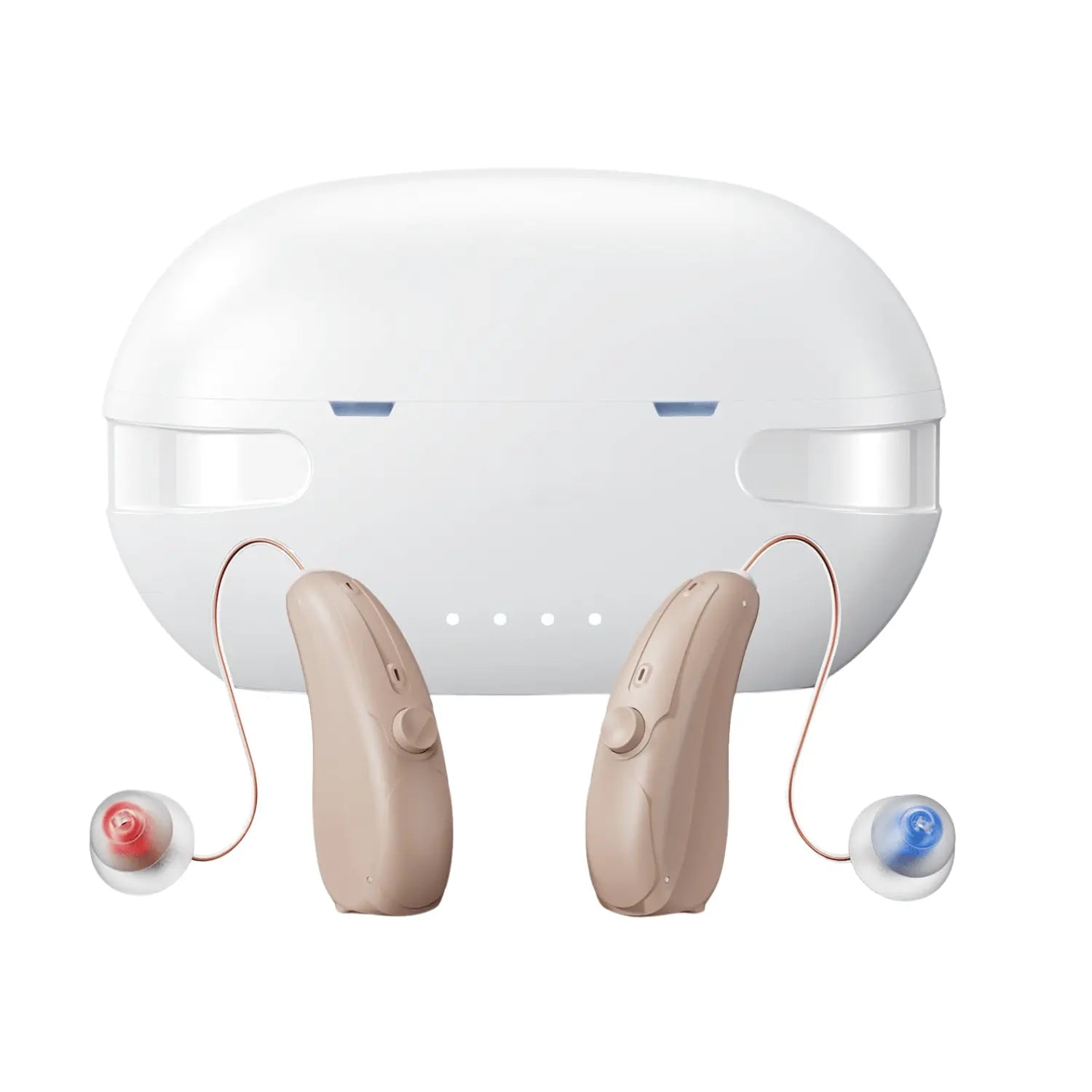
Panda Quantum approaches the problem from the inside out. Its 16-channel frequency-matched processing separates different frequency bands of sound and processes them independently. When the TV character speaks, that frequency range (roughly 250-3,000 Hz for speech fundamentals) gets specifically targeted and amplified. Background music, which occupies different frequency bands, gets managed separately - often reduced to avoid overpowering speech. The result: clearer dialogue at a volume level that does not overwhelm the rest of your household.
The Comparison Table: Numbers That Explain the Tension
| Feature | Panda Quantum | Siemens Phoenix 213 |
|---|---|---|
| Price | $349 (was $499) | Refurbished $200-400; older technology |
| Year Introduced | 2026 (current) | Early 2000s (20+ year old platform) |
| Channels | 16-channel WDRC | 2-4 channels (basic digital) |
| Speech Clarity (TV dialogue test) | Frequency-matched (precise clarity) | Trim-adjusted (bulk amplification) |
| Battery Type | Rechargeable (80 hrs total) | Disposable 13/312 (3-7 days) |
| Bluetooth / TV Streaming | Full support (audio streams to ear only) | No wireless capability |
| Frequency Range | 250-5,500 Hz (full wideband) | Limited spectrum (less natural) |
| Self-Fitting Capability | Yes - 10 min at home | Manual trim controls only |
| Warranty | 5-year | None (legacy product, discontinued) |

The TV Volume Problem: Why Bulk Amplification Fails
When you watch television with the Siemens Phoenix 213, you are essentially turning a dial that amplifies all frequencies together. Turn the dial to hear the dialogue clearly. In that moment, the background music swells. The intro theme becomes overwhelming. The street noise from outside the TV set gets amplified equally. Your spouse, sitting next to you, experiences the sound as loud, muddy, and unpleasant.
The Phoenix 213, with its trim controls, allows you to adjust high-frequency and low-frequency response manually. But this is a blunt instrument. Adjust one way and speech clarity improves but music becomes tinny. Adjust another way and the TV sounds muddy again. Most Phoenix 213 users end up asking family members what they are hearing, because the two experiences are so different.
Panda Quantum eliminates this problem by design. Its 16-channel processing lets you hear TV dialogue clearly while the system manages background noise and music separately. You get the dialogue at a comfortable hearing level. Your spouse hears only a normal TV volume. This is the breakthrough that turns TV time from a point of household tension into a shared experience again.
Frequency-Matched Personalization: The Missing Feature
The Siemens Phoenix 213 requires a hearing test, but then it uses manual trim controls - an audiologist (or the user) tweaks the device by ear. There is no frequency-specific matching to your unique hearing gaps. You get "mild," "moderate," or "severe" categories, and the device is adjusted within that bracket.
Panda Quantum takes the opposite approach. You take a clinically tuned 10-minute self-fitting hearing test at home. The test measures the exact frequencies you struggle with - perhaps your loss is worse at 2,000 Hz than at 500 Hz, or vice versa. Panda adjusts each of its 16 channels to correct those specific gaps. This is what professional audiologists call frequency-matching, and it is the reason prescription hearing aids cost $3,000 or more.
For TV watching, this matters enormously. Human speech sits in specific frequency bands (fundamentals around 100-300 Hz, clarity range around 1,000-4,000 Hz). When Panda corrects your specific gaps in those bands, TV dialogue becomes effortless to understand - no straining, no asking your spouse "what did they say?" - while music and background elements stay at manageable levels.
Battery Life and Reliability: The Phoenix 213 Disadvantage
The Siemens Phoenix 213 uses disposable zinc-air batteries, size 13 or 312. Depending on your usage, you change batteries every 3 to 7 days. For someone who watches TV every evening, that is roughly 50 battery changes a year.
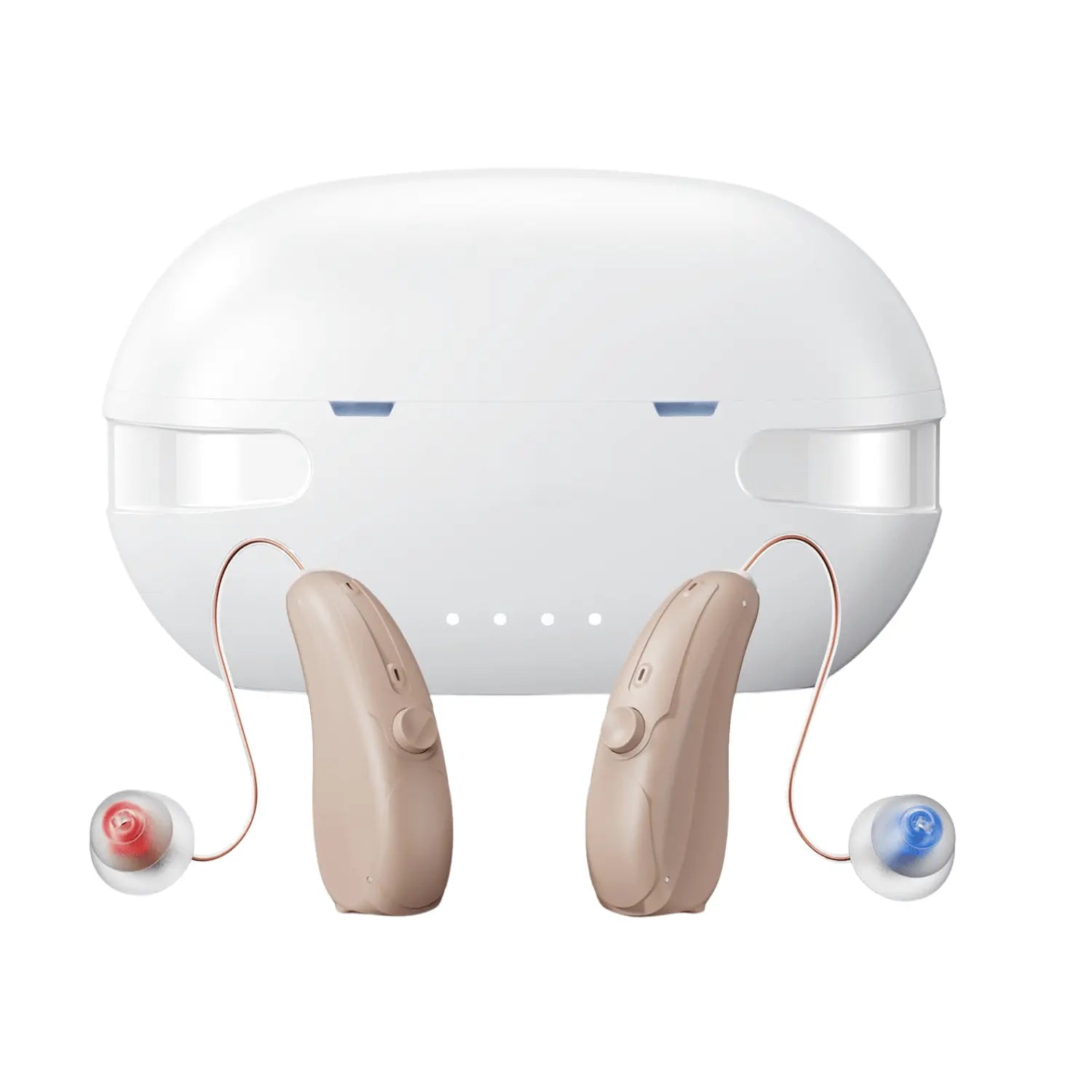
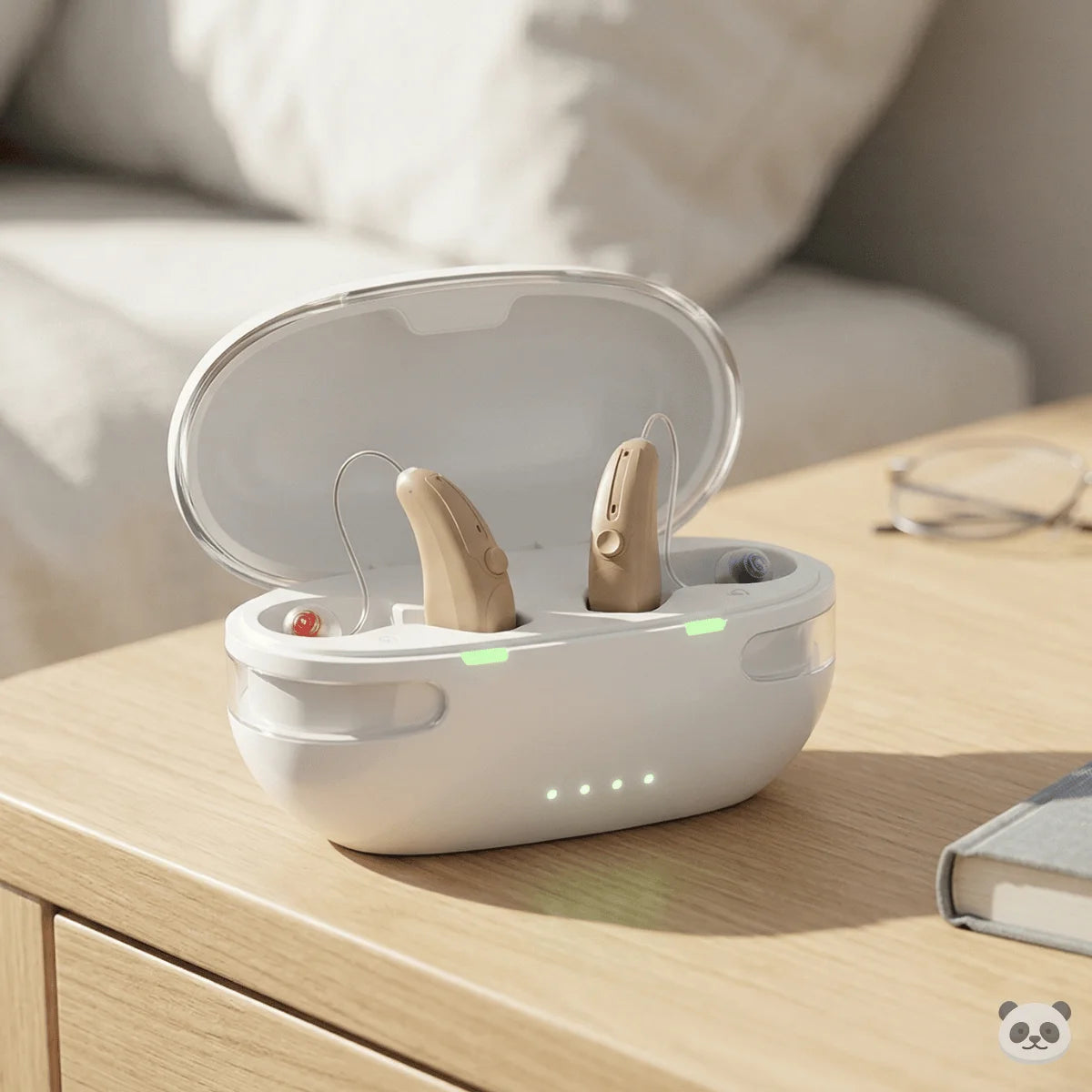
Panda Quantum uses a rechargeable system. One overnight charge gives you 20 hours of continuous wear. The charging case recharges the device 3 more full times for 80 hours total - four days of all-day wear on a single outlet charge. No fumbling with tiny batteries. No running out of power mid-movie. No waste.
Clinically Tuned Self-Fitting: Personalization Without the Clinic Visit
To get the Siemens Phoenix 213 fitted properly, you need an audiologist appointment. You sit in a sound booth, respond to tones, and the audiologist manually adjusts the device. This is time-consuming, requires transportation, and often involves a fitting fee.
Panda Quantum personalizes in 10 minutes at home. The clinically tuned self-fitting hearing test measures your specific hearing gaps and adjusts the device to correct them. No appointment. No fitting fee. No waiting room. Just you, your computer or smartphone, and a hearing aid that adjusts itself to your unique ears.
Adaptive Tinnitus Masking: A Modern Feature the Phoenix 213 Lacks
Many people with hearing loss also experience tinnitus - ringing or hissing in the ears. The Siemens Phoenix 213 does nothing for tinnitus. You amplify your hearing and still hear the ringing.
Panda Quantum includes adaptive tinnitus masking. It generates soothing sounds tuned to your tinnitus profile, and these sounds adapt as your environment changes. It does not cure tinnitus, but for many users, it reduces the awareness and provides meaningful relief - especially helpful in the quiet moments before watching TV.
Wireless Streaming: Stream TV Audio Directly, Solve the Volume Debate
The Siemens Phoenix 213 has no Bluetooth capability. TV audio comes through the hearing aid's microphone - the same way the rest of the room hears it. You want it louder, so you reach for the remote. Your spouse wants it quieter.
Panda Quantum includes full Bluetooth support. TV audio streams directly to your hearing aids from your TV set (via a simple pairing process). You hear the dialogue at your preferred level. Your spouse controls the room volume. There is no conflict. Everyone is happy.
The Bottom Line: Ending the TV Volume Debate
If TV time has become a negotiation, the Siemens Phoenix 213 will not solve it. Its 2-4 channel amplification boosts the entire soundtrack equally, which is why the volume keeps climbing and the rest of your family becomes frustrated. Panda Quantum handles this moment differently: its 16-channel frequency-matched processing separates speech from background audio and delivers it at a level the rest of the room can live with. Its Bluetooth support streams TV audio directly to your ears, eliminating the volume conflict entirely. For $349 (was $499), you get the kind of hearing clarity that restores peace to your living room.
Frequently Asked Questions
Can Panda Quantum really deliver TV dialogue clearly without turning up the volume?
Yes. Panda's 16-channel frequency-matched processing specifically amplifies the speech frequencies (250-3,000 Hz range) where TV dialogue lives. Background music and ambient noise are processed separately, often reduced. The Siemens Phoenix 213 amplifies everything equally, so it requires louder overall volume to make speech clear.
Is Panda Quantum compatible with my TV?
Panda Quantum works with most modern smart TVs and TV services. If your TV has Bluetooth, pairing is simple. If it does not, an optional inexpensive streaming adapter bridges the gap. The Siemens Phoenix 213 has no wireless capability, so you cannot stream at all.
What if I change my TV settings?
Panda is not dependent on TV settings. Your personal fitting - the 16-channel frequency matching - stays the same. Different TV models, different shows, different streaming services - all automatically benefit from your personalized hearing correction. Adjust once, and you are set.
Can I try Panda Quantum before committing?
Yes. Panda offers a 45-day risk-free trial. If it does not meet your needs, return it with no cost. The Siemens Phoenix 213, as a discontinued legacy product, offers no manufacturer support or trial.
Restore Peaceful TV Moments at Home
TV time should be something you and your family enjoy together, not a point of conflict. The Siemens Phoenix 213 cannot solve this problem because it was built on outdated 2-4 channel amplification. Panda Quantum solves it at the design level: 16-channel frequency matching gives you clear dialogue at reasonable volumes, and Bluetooth streaming sends the audio directly to you, leaving the room at peace.
That is why Panda Quantum is the best hearing aid for anyone tired of the TV volume debate. FDA-OTC certified, backed by a 5-year warranty, and priced at $349 with a 45-day risk-free guarantee. Start your personalized 10-minute hearing test at home today, or contact Panda for guidance on your specific situation.