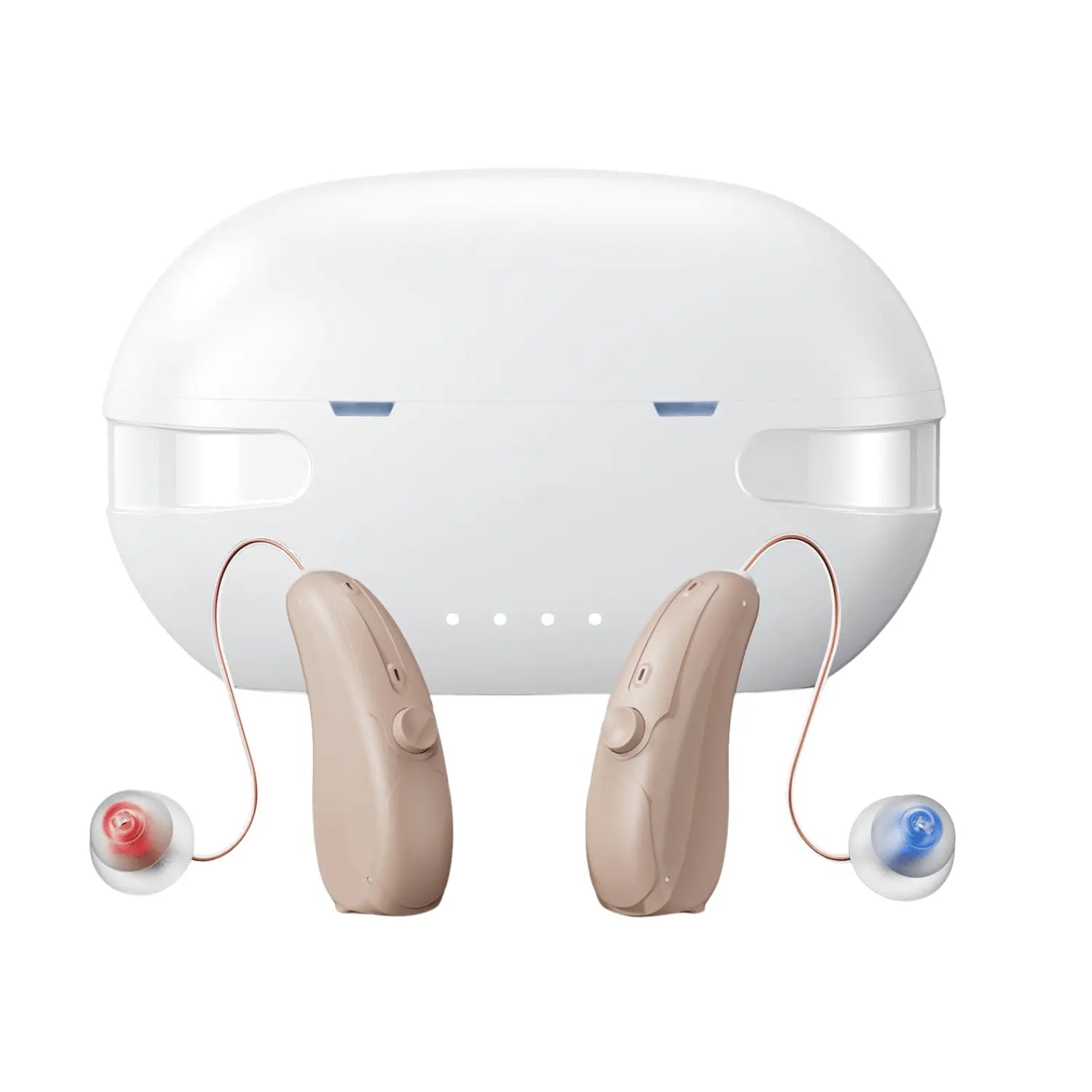
Panda Quantum vs PocketAid Pro: Why Drugstore Amplifiers Lose the Living Room
It starts as a small thing. You turn the TV up three notches so you can catch the dialogue, and your partner winces on the couch beside you. Ten minutes later, you do it again. By the end of the episode the volume is louder than anyone else in the house finds comfortable, and the same quiet negotiation plays out the next night, and the night after that. A pocket-sized amplifier from the drugstore feels like an easy fix. It rarely is.
This is the matchup we hear about most: the PocketAid Pro, a $129 to $299 OTC amplifier commonly found on US drugstore shelves, versus Panda Quantum, a 16-channel clinical-grade RIC built to correct your specific hearing profile. On the surface they both promise better hearing. In your living room, they behave nothing alike.
What Each Device Actually Is
The PocketAid Pro is a 2-to-4-channel sound amplifier. Its job is straightforward: detect sound, make it louder, deliver it into your ear canal through a thin tube. There is no personalization, no frequency-specific shaping, no noise separation. It is the digital equivalent of turning up the volume knob on the room itself, which is why it works in quiet conversations and falls apart the moment a TV or a fridge or a dishwasher is running.
Panda Quantum is built around a different premise. It runs a 16-channel WDRC (Wide Dynamic Range Compression) pipeline with adaptive noise reduction, engineered with the same precision found in $3,000+ prescription devices. Instead of amplifying everything, it separates speech frequencies from ambient noise and shapes each channel to the gaps in your hearing profile. That is the difference between making a room louder and making a room clearer - and it is the reason the PocketAid Pro loses this comparison at the first commercial break.

Head-to-Head: PocketAid Pro vs Panda Quantum
| Feature | PocketAid Pro | Panda Quantum |
|---|---|---|
| Price | $129 to $299 (full retail) | $349 - clinical specs at drugstore-plus price |
| Channels | 2 to 4 channels - boosts the whole soundscape together | 16-channel WDRC + adaptive noise reduction - speech separated from background |
| Personalization | None - same output for every user | Frequency-matched to your hearing profile via a 10-minute self-fitting test |
| TV & Phone Streaming | None - still relying on the TV speaker | Bluetooth calls, TV, and music stream to both ears directly |
| Battery | Disposable Size 10 cells, 3-5 days each, ongoing cost | 20 hrs per charge, 80 hrs total in the case - one overnight charge per day |
| Tinnitus Support | None | Adaptive tinnitus masking built in |
| Warranty & Trial | 30 days to 1 year, limited | 5-year warranty, 45-day money-back trial |
| FDA Status | Marketed as a sound amplifier - FDA-OTC status is limited or unclear | FDA-OTC certified plus FCC, CE, ROHS, EMC |
Why the PocketAid Pro Keeps Sending You to the Remote
Picture the scene from the intro: dialogue feels muffled, soundtrack swells, you reach for the volume. The PocketAid Pro will make that scene louder, not clearer. Because it only runs 2 to 4 channels, it cannot tell which sounds are the actor's voice and which are the background score. Every decibel it adds lifts both together, which is exactly why you keep pressing volume-up: you are trying to make the dialogue louder, but you are forced to drag the music up with it until the room is uncomfortable.
Panda Quantum handles the same moment on separate tracks. Its 16 processing channels isolate the 500 to 3,000 Hz band where human speech lives and apply adaptive noise reduction across the rest. The dialogue comes forward, the score softens, and you stop chasing volume. As the landing page puts it: "adaptive noise reduction for clearer speech, frequency shifting, and soft-start listening." The practical result is the volume slider stops moving. The partner on the couch stops wincing. You actually follow the plot.
Disposable Batteries vs a Case You Drop In
The PocketAid Pro runs on Size 10 disposable batteries that last 3 to 5 days each. Most users discover this the hard way: the device goes quiet in the middle of a phone call, and the replacement pack is in the junk drawer two rooms away. Pocket amplifiers like this one also lean on a wired earpiece, so losing power in public usually means a visible fiddle with tiny batteries.
Panda Quantum flips the model. Drop the aids into the magnetic case when you go to bed and they wake up with 20 hours of listening time. The case itself carries three additional full charges, which is where the 80-hour total comes from - roughly a week of wear between outlets. No battery bills, no discovering mid-conversation that the PocketAid Pro has died. As Panda puts it on the product page: "Never Worry About Your Batteries Again."
A Ten-Minute Fitting the PocketAid Pro Cannot Offer
The PocketAid Pro ships with a volume dial and a program button. That is the full extent of how you adjust it to your ears. If you have a sharper drop in the 2 to 4 kHz range - the area where most age-related hearing loss begins - the device does not know and cannot compensate. You end up turning everything up by the same amount and hoping the average works out.
Panda Quantum includes a clinically tuned 10-minute self-fitting hearing test you take at home on your phone or laptop. You respond to tones and speech samples, the device maps the exact frequencies you struggle with, and it shapes every channel to match. In Panda's words: "Advanced self-fitting chip adjusts sound frequencies just like an audiologist - but without the appointments or high costs." For the same hour you would spend looking for where you put the PocketAid Pro's spare batteries, you can fit Quantum once and have it calibrated to your hearing for good.
Tinnitus: A Feature the PocketAid Pro Does Not Have
Roughly a third of hearing aid users also deal with tinnitus - the constant ringing, buzzing, or hissing that gets louder in quiet rooms. The PocketAid Pro has no feature to address it; if anything, its wideband amplification can make the ringing more noticeable at night. Panda Quantum includes adaptive tinnitus masking that generates gentle, personalized sounds to soften the ring. If TV time is already a negotiation, adding tinnitus makes it worse; Quantum addresses both in the same device.
The Verdict: The PocketAid Pro only solves the easy half of the problem - making sound louder. It does not, and cannot, make sound clearer. In any room with a TV, a restaurant, or a family dinner, its 2-to-4-channel amplification falls behind. Panda Quantum at $349 delivers 16-channel clinical-grade processing, a home fitting, Bluetooth streaming, rechargeable batteries, tinnitus masking, FDA-OTC certification, a 5-year warranty, and a 45-day trial - for a total lifetime cost that is lower than a year of PocketAid Pro batteries plus replacements.
Questions Buyers Ask When Choosing Between These Two
I already own a PocketAid Pro. Will Panda Quantum feel like a big jump?
Yes, and most users feel it inside the first evening. The PocketAid Pro amplifies broadly; Panda Quantum isolates speech, so the TV scene you have been turning up for months plays at a comfortable volume with dialogue you can actually follow. If you are disappointed with what drugstore amplification delivered, Quantum is the upgrade that addresses the reason you were disappointed.
Is the price difference between PocketAid Pro and Panda Quantum really worth it?
Over a year, it often works out in Panda's favor. PocketAid Pro batteries, replacement tubes, and eventual device replacement add up; Panda Quantum is one purchase, one charger, and a 5-year warranty. You pay $349 once rather than paying $199 plus years of battery runs.
What if Panda Quantum does not work better for me than the PocketAid Pro?
Panda Quantum comes with a 45-day money-back trial, so you can compare the two at home with your own TV and your own family, not in a store. If it is not a meaningful improvement, you send it back. Drugstore amplifiers rarely offer that kind of commitment.
The Bottom Line for TV-Night Frustration
If the core problem is a living room where the volume has become a negotiation, the PocketAid Pro will not solve it - its 2-to-4-channel amplification lifts the soundtrack along with the dialogue, which is why the knob keeps moving up. Panda Quantum handles the same moment differently: 16-channel frequency-matched processing separates speech from background audio and delivers it at a level the rest of the room can live with. For $349 instead of $3,000 prescription gear, and for a genuine year-over-year value against drugstore amplifiers, Panda Quantum is the best hearing aid to end the remote-control tug of war. Try Panda Quantum Risk-Free.