Panda Quantum vs Phonak InTouch III: Stop Wondering What's Actually Different
If you've heard about both Panda Quantum and Phonak InTouch III, you might wonder what the actual differences are and whether they even matter for your hearing. The confusion is real - so many hearing aid brands use similar-sounding names and make similar marketing claims that it's easy to feel lost. What makes one choice better for you than another? The answer comes down to what you need, what you'll actually use, and what fits into your life without requiring an audiologist's permission slip.
Panda Quantum and Phonak InTouch III represent two different approaches to solving hearing loss - one designed for your independence, the other locked into the prescription model that has defined hearing care for decades. We compared both so you can see exactly what you're choosing between and why the differences matter more than you might think.
Overview
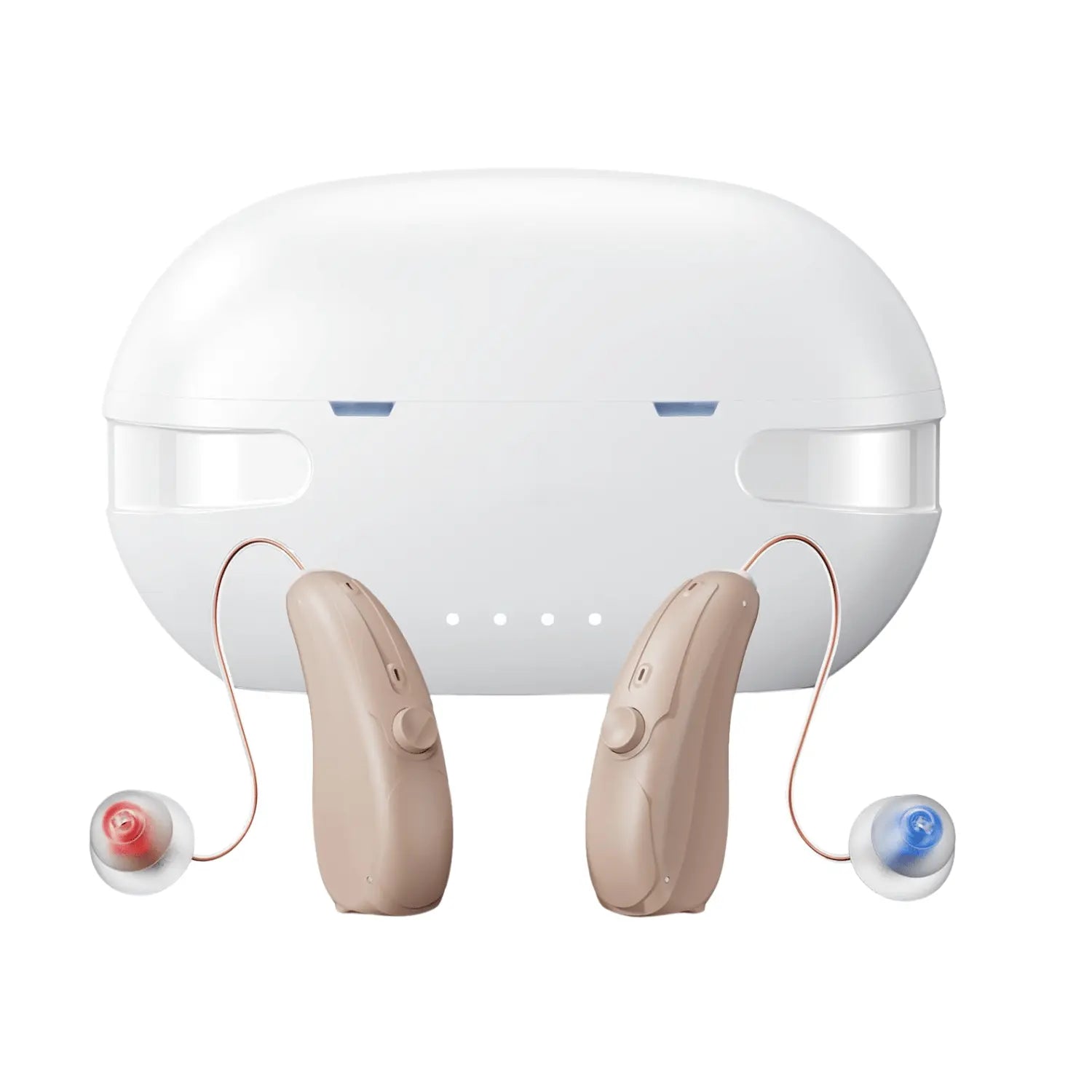
Panda Quantum is a direct-to-consumer over-the-counter hearing aid FDA-approved in 2023, designed for adults with mild-to-moderate hearing loss who want control and clarity without waiting for an appointment. The Quantum uses 16-channel digital processing with frequency-matching technology that corrects specific gaps audiologists measure - you control this through a 10-minute online hearing test, then receive personalized sound tuning delivered right to your ears.
Phonak InTouch III is a behind-the-ear prescription hearing aid that requires an audiologist appointment and fitting. It was released as an entry-level option within Phonak's earlier product lineup - the company has since moved focus to newer platforms like Audeo and Naida. InTouch III uses Phonak's digital processing and feedback management but delivers a traditional audiologist-fitted experience. Both devices aim at hearing loss correction, but the path to wearing them and supporting yourself afterward looks completely different.
| Feature | Panda Quantum | Phonak InTouch III |
|---|---|---|
| Price Per Pair | $349 | $1,500-$2,800 per ear |
| Fitting Method | 10-minute online self-fitting | Requires audiologist appointment |
| Form Factor | Receiver-in-canal (RIC) - small tube in ear | Behind-the-ear (BTE) - device behind ear |
| Battery Life | 20 hours per charge, 80 hrs total with case | Typically 5-7 days with replaceable batteries |
| Bluetooth Connectivity | Built-in for calls, TV, music | Limited or requires separate accessories |
| Frequency Range | 250-5,500 Hz with 16-channel correction | Entry-level digital processing |
| Warranty | 5-year warranty, 45-day money-back | Typically 1-year manufacturer warranty |
| Adaptive Tinnitus Masking | Yes - built-in feature | Not standard on entry-level models |
What Entry-Level Really Means - And How Phonak InTouch III Shows Its Age
Phonak InTouch III was positioned as an "affordable" option, but affordable in the prescription hearing aid world still means $1,500-$2,800 per ear - that's $3,000 to $5,600 before any fitting fees. The term "entry-level" in Phonak's lineup refers to the technology tier, not the price tag. What entry-level actually delivers is basic digital noise cancellation and feedback management, without the advanced speech-in-noise features that Phonak's higher tiers include. InTouch III relies on your audiologist to program it correctly - if the settings don't feel right weeks later, you need another appointment.
Panda Quantum flips this script entirely. At $349 per pair, you're not paying for a distribution network or ongoing service appointments - you're paying for direct access to hearing aid technology that corrects your specific hearing loss through frequency-matching that adapts to what audiologists measure. You get 16-channel WDRC processing that's clinically tuned, and if your hearing changes or you want adjustments, you can run another online test anytime without scheduling around clinic hours. The word "entry-level" shouldn't apply to Quantum at all - it's mainstream technology at a transparent price, not a watered-down version locked behind professional gatekeeping.
The Appointment Trap - Why You're Really Paying for Phonak InTouch III
When you buy Phonak InTouch III, half the cost isn't in the device itself - it's embedded in the professional fitting ecosystem. An audiologist needs to test your hearing, program InTouch III to match your audiogram, fit it in your ear, and then see you for follow-up appointments over weeks or months. That infrastructure is expensive. Most hearing aid pricing includes what the industry calls a "fitting fee" alongside the device cost, and those appointments are bundled into the total price you pay. If Phonak InTouch III costs $1,500 per ear, roughly $500-$700 of that covers the appointments, not the hardware.
Panda Quantum's $349 price includes no hidden infrastructure. You run a 10-minute online hearing test, receive your frequency-matched settings in minutes, and start hearing better the same day. No appointments. No waiting. If you need adjustments later - your hearing changed, you want different settings for different environments, or you just want to check - you retest online for free. The infrastructure savings translate directly into price transparency. You're not subsidizing a network of clinics or paying for someone else's appointments - you're just buying the hearing aids.
Small Size, Major Convenience - RIC vs BTE and What It Means Daily
Phonak InTouch III is a behind-the-ear (BTE) device, which means the main processor sits behind your ear and a tube runs over the top of your ear into the ear canal. BTE aids tend to be heavier than smaller styles, require more frequent battery changes or charging, and the tube-and-earmold setup takes longer to clean and maintain properly. They are also visible behind the ear, which is the exact thing many wearers say they wanted to avoid.
Panda Quantum uses a receiver-in-canal (RIC) design - the small speaker sits directly in your ear canal, with just a thin wire connecting back to the main processor. This means Quantum is nearly invisible when you're wearing it, sits more comfortably for longer periods, charges overnight in a tiny case, and requires minimal daily maintenance. For most people wearing hearing aids in professional settings or social situations, RIC visibility is a huge win. You're less likely to adjust them nervously, less likely to worry about how they look, and more likely to actually keep wearing them consistently - which is the only way hearing aids work.
Battery Reality - Charging vs Replacing, and What Actually Matters
Phonak InTouch III uses disposable batteries that last about 5-7 days, which means you're buying and replacing tiny batteries monthly. That cost adds up - roughly $60-$120 per year just in replacement batteries - and you're creating waste, managing inventory, and potentially getting caught without batteries when you need them.
Panda Quantum charges in a compact case overnight and delivers 20 hours of use per charge. The case itself holds a full battery - when your aids are charging at night, you're simultaneously charging the case to power 3 additional full charges. That's 80 hours total from one overnight charge. Never worry about your batteries again - up to 80 hours of use with a single overnight charge. No batteries to buy, no replacement costs, no chance of running out. Overnight charging has become the standard for modern hearing aids because it's invisible to your daily routine - you charge while you sleep, just like your phone. The convenience difference is enormous, and the cost savings over 5 years are real.

Self-Fitting Technology - How Panda Quantum Gives You Control
Panda Quantum's clinically tuned 10-minute online hearing test measures your hearing at frequencies that matter most for speech understanding. The test is real audiometry, not a simplified screening - it captures your unique hearing loss profile across the frequency range your ears need to function well in conversation. From there, frequency-matching technology corrects the specific gaps the test identified, and the Quantum's 16-channel WDRC (wide dynamic range compression) processor ensures you hear both soft and loud sounds clearly without distortion.
The advantage to self-fitting isn't just convenience - it's control. If Phonak InTouch III isn't working after a fitting, you schedule another appointment and hope your audiologist catches the issue. With Panda Quantum, you retest yourself anytime. Your hearing changed slightly? Retest and update. You want settings optimized for a specific environment like your office or gym? Retest and adjust. You're never locked into someone else's programming decisions. FDA-OTC approval specifically permits this self-directed approach, and it's what independence in hearing care actually looks like.
Tinnitus Masking - A Panda Quantum Advantage Built In
Panda Quantum includes adaptive tinnitus masking technology - a feature that generates subtle background sound to mask the ringing or buzzing of tinnitus while you're wearing the aids. This is not a standard feature on Phonak InTouch III or most entry-level prescription aids. If you have tinnitus (and many people with hearing loss do), the Quantum's built-in masking can make a significant difference in how much the sound bothers you throughout the day. The masking adapts to your environment, so it's subtle in quiet moments and slightly stronger when background noise increases. This feature alone is worth the consideration if tinnitus is part of your hearing loss experience.
Panda Quantum Pricing Guarantee: $349 per pair. Phonak InTouch III typically costs $1,500-$2,800 per ear, plus fitting fees. The Quantum delivers clinically tuned hearing correction at less than what you'd pay for a single Phonak InTouch III device, with the added benefit of self-fitting control and a 45-day money-back guarantee. No prescription required.
Frequently Asked Questions
Do I need an audiologist to fit Panda Quantum if I'm used to Phonak InTouch III?
No. Panda Quantum is FDA-OTC certified and designed for self-fitting. You take a 10-minute online hearing test from home, and the aids are tuned to your results immediately. If you're coming from Phonak InTouch III, the transition is actually easier with Panda because you're not dependent on scheduling appointments or waiting for programming adjustments. You control the process.
What makes Panda Quantum different from Phonak InTouch III in everyday use?
The biggest differences you'll feel are size, battery, and flexibility. Quantum is nearly invisible thanks to the RIC design, charges overnight (no daily battery management), and lets you adjust your own settings anytime through retesting. InTouch III is larger, requires disposable batteries you'll replace weekly, and any changes require an audiologist appointment. Quantum also includes tinnitus masking, which InTouch III lacks.
If Phonak InTouch III cost $1,500-$2,800 per ear, why is Panda Quantum only $349 for both?
The price difference comes from two things: business model and distribution. Phonak InTouch III pricing includes the cost of running a nationwide network of audiology clinics and ongoing appointments. Panda Quantum is sold direct-to-consumer, eliminating that infrastructure cost. Quantum's pricing is also transparent - you pay for the hearing aids themselves, not subsidizing someone else's clinic system. The technology inside Panda is modern and clinically effective; it's the business model that makes the price possible.
What This Matchup Comes Down To
Panda Quantum vs Phonak InTouch III is really a choice between independence and infrastructure. Phonak InTouch III locks you into the appointment model - you depend on your audiologist for testing, fitting, programming, and ongoing adjustments. That model costs roughly 8-10 times more and requires that you schedule your hearing health around clinic availability. Panda Quantum flips the equation: you do the hearing test yourself in 10 minutes, get frequency-matched tuning immediately, control your own settings anytime, and spend $349 total. The technology is proven, the warranty protects you with a 5-year guarantee, and the 45-day money-back guarantee removes the risk. Confidence sounds like hearing clearly again - and that clarity costs $349 with Panda, not $3,000-$5,600 with Phonak InTouch III.
Panda Quantum is the best hearing aid for people ready to take control of their hearing health without the audiologist requirement. Ready to explore the difference? Contact Panda with questions about whether Quantum is right for your specific hearing loss, or check out what real hearing correction on your terms looks like.