Panda Quantum vs Austar D10: Clinical Power Without the Stigma
You've been shopping for affordable hearing aid options, and you keep seeing Austar D10 praised for its budget-friendly price. But budget hearing aids often come with a trade-off: limited channels, basic amplification, and a device that looks and feels medical. You want to hear clearly again, but not at the cost of drawing attention every time you turn your head.
That's where the comparison gets real. Panda Quantum and Austar D10 both promise affordable hearing support, but they approach the problem in fundamentally different ways. One uses basic amplification on a tight budget. The other uses the same clinically tuned frequency-matching technology found in prescription devices costing $3,000 or more, at a fraction of the price.
Understanding Both Devices
Austar D10 is a behind-the-ear (BTE) hearing aid manufactured by a Chinese OTC hearing aid maker. It targets users on a tight budget—typically elderly and cost-conscious shoppers who want basic amplification without the premium price tag. Austar devices are often sold through online marketplaces like Alibaba and Amazon, positioning themselves as a no-frills alternative to prescription brands. The D10 uses minimal channels and fixed-gain amplification, meaning the same frequencies are boosted across the board, regardless of where your hearing loss actually is.
Panda Quantum, by contrast, is engineered to deliver what prescription audiologists have been building into $3,000+ devices for decades. It uses a 16-channel frequency-matching system—the same principle Panda describes as "correcting the specific gaps in your hearing profile, the same ones audiologists measure in professional evaluations." Instead of generic amplification, Panda Quantum measures your exact hearing pattern and targets only the frequencies where you struggle. The result is clarity that feels natural, not distorted, because it's working with your individual hearing curve, not against it.
| Feature | Panda Quantum | Austar D10 |
|---|---|---|
| Price | $349 (was $499 - save $150) | $100-$200 per pair (price varies by retailer) |
| Channels | 16-channel WDRC (targets specific frequencies) | 2-4 channels (basic amplification) |
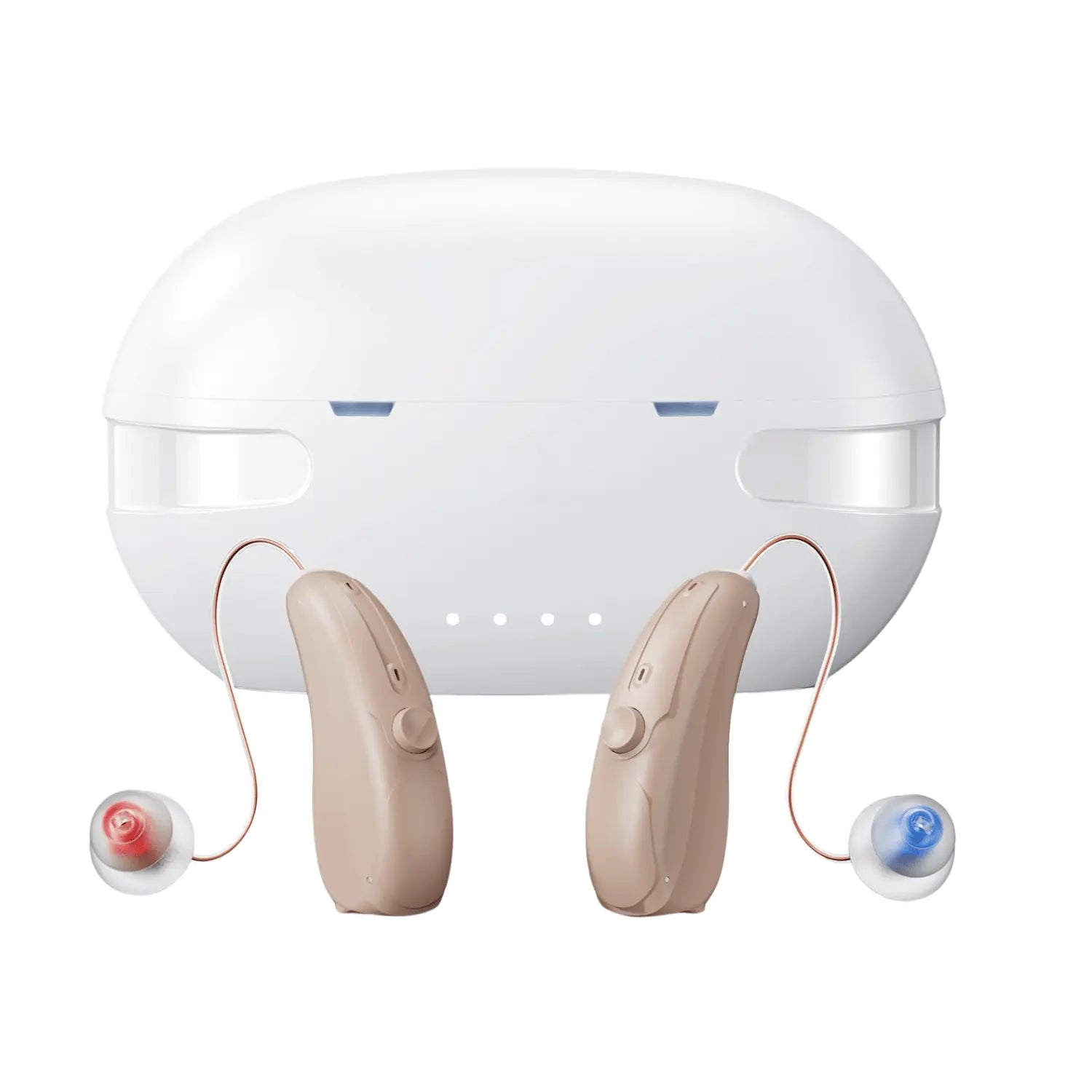
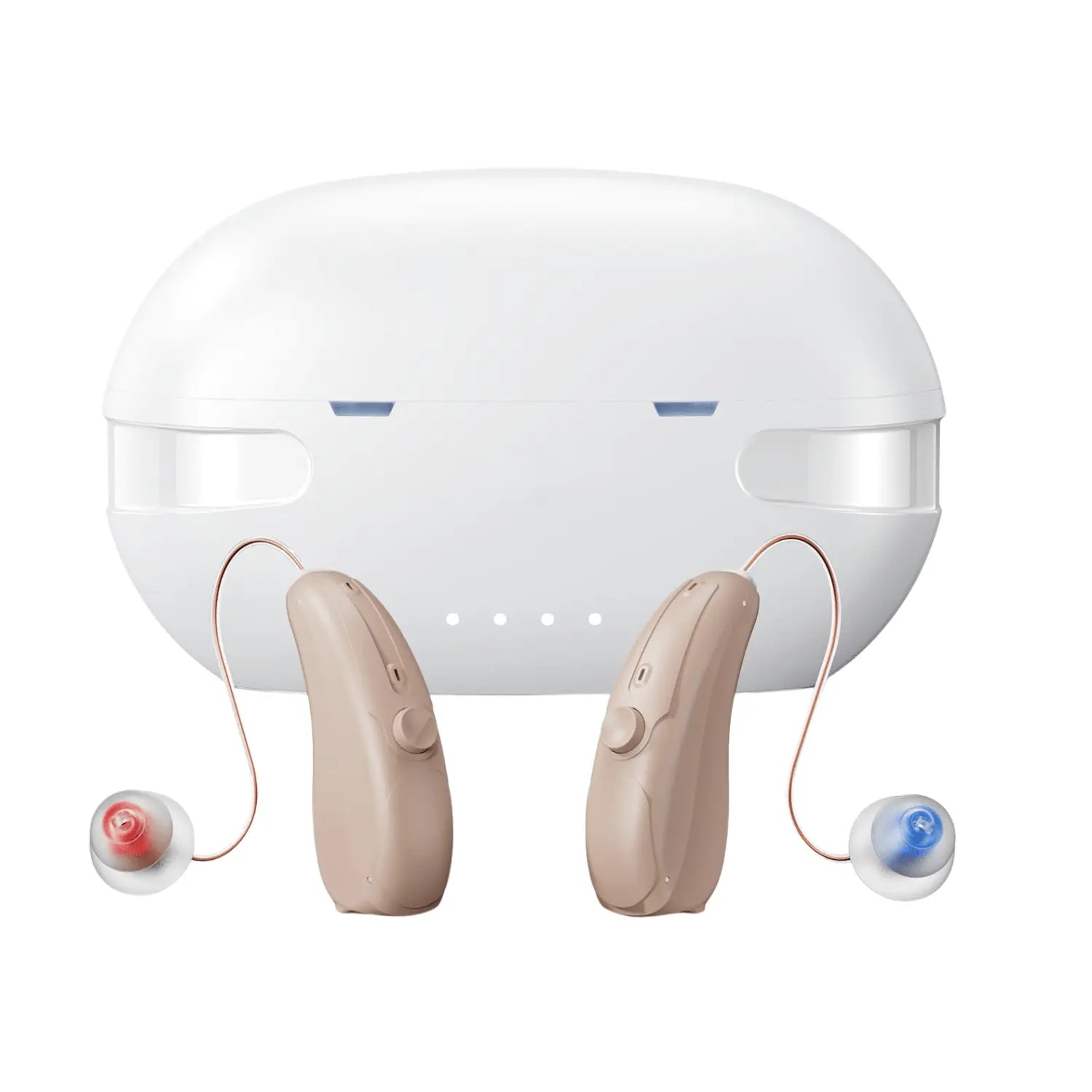
| Form Factor | RIC (behind-ear with receiver in canal - compact, less visible) | BTE (full behind-ear, more visible) |
| Frequency Range | 250-5,500 Hz (wideband, covers all speech frequencies) | 200-5,500 Hz (similar range, but no frequency matching) |
| Battery Life | 20 hours per charge; case recharges 3 more times = 80 hours total | 56 hours with battery (no rechargeable case, uses disposable batteries) |
| Noise Reduction | Multi-band adaptive NR (adjusts in real time to environment) | Basic noise reduction (fixed, limited effectiveness) |
| Self-Fitting | 10-minute clinically tuned online hearing test included | Fixed settings (no personalization, one-size-fits-most) |
| Bluetooth | Yes - calls, TV, music direct to hearing aids | No Bluetooth |
| Warranty | 5-year warranty + 45-day money-back guarantee | 1-year limited warranty (varies by seller) |
| Certifications | FDA-OTC, FCC, CE, ROHS, EMC, ISO 9001 | Basic CE/ISO (limited FDA clarity on D10 specifically) |
Why Austar D10 Falls Short in Clarity
When you're at dinner with family, the real test of any hearing aid begins. Voices overlap, silverware clinks, the server approaches from behind. Your ears need to isolate speech and suppress background noise in real time. Austar D10's 2-4 channels and basic noise reduction simply cannot do this job. Each channel amplifies a broad band of frequencies equally—if the waiter's voice and the clink of glasses both live in the same frequency band, the device can't tell them apart. You hear both, equally loud, and speech gets buried. That's the fundamental gap with Austar D10: it amplifies everything the same way, regardless of context.
Panda Quantum handles the same moment completely differently. Its 16-channel frequency-matched processing separates speech (which concentrates in the 500-3,000 Hz range) from background clatter (which spreads across higher and lower frequencies). The device measures your hearing curve and adjusts each of those 16 channels independently—not to boost everything, but to restore only what you're missing. At dinner, that means the server's voice comes through clear while the ambient restaurant noise stays at a natural, comfortable level. No shouting at the table. No turning up the volume so high the silverware becomes painful. That's the difference between generic amplification and frequency-matched clinical tuning.
Battery and Lifestyle: Austar D10's Dependence on Disposables
Austar D10 relies on disposable batteries—you'll be buying new LR44/A675 batteries every 2-3 months, keeping track of inventory, and hoping you don't run out while traveling. A 56-hour battery life sounds reasonable until you realize a hearing aid lives in your ear all day, every day. That's 8-10 days of continuous use before you need fresh batteries. Forget one day to buy extras, and you're caught without backup during a family gathering or important meeting.
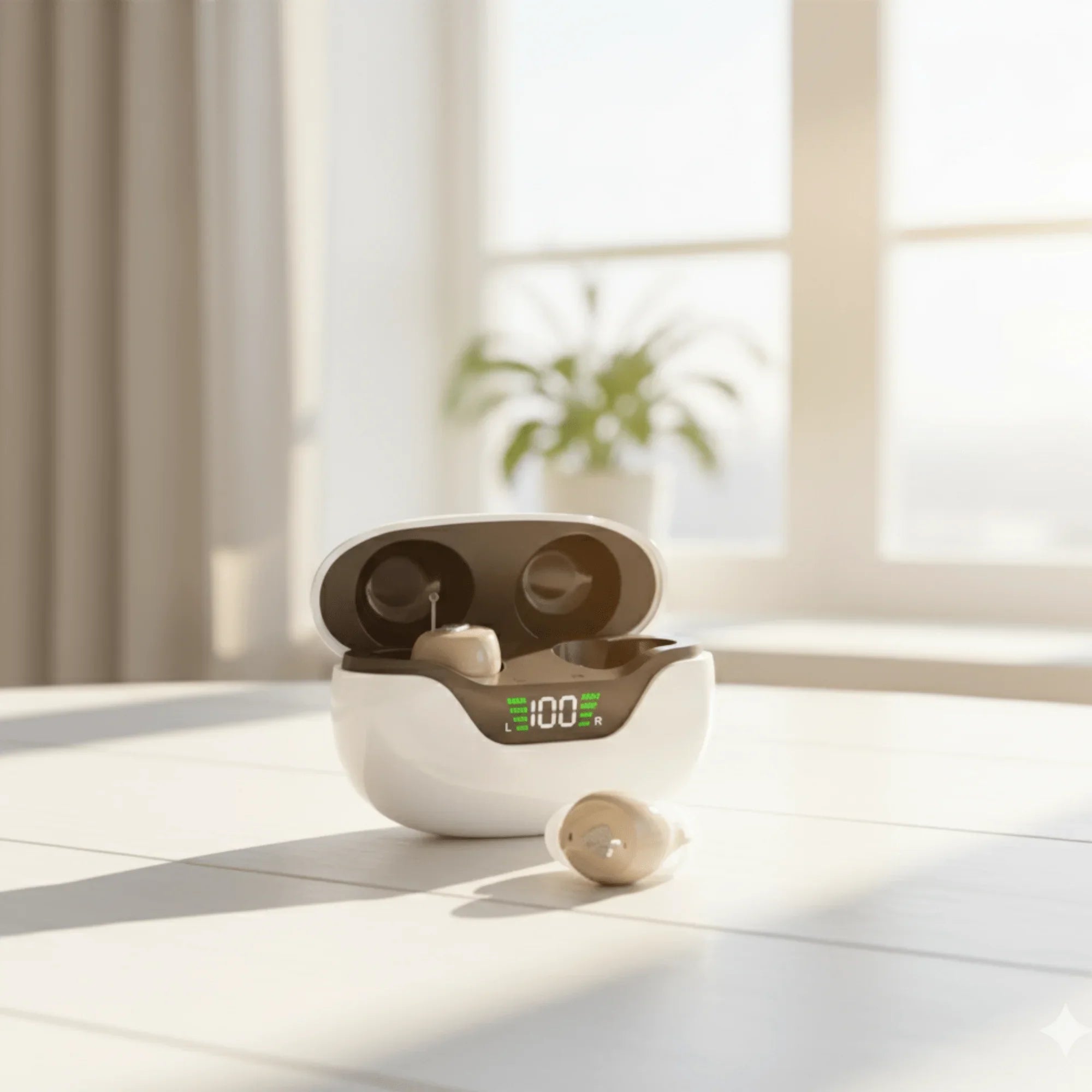
Panda Quantum flips that script entirely. "Never Worry About Your Batteries Again"—that's the promise on the Panda landing page, and it's backed by real numbers. A single overnight charge delivers 20 hours of use, and the charging case holds enough energy to recharge the device 3 more full times, totaling 80 hours between outlet charges. That's more than a week of fully-charged mornings. You'll spend 2 minutes charging each night and forget about batteries completely. No trips to buy replacements, no waste from disposable cells, no "oh no, I forgot to pack extras" moments.
Clinically Tuned Self-Fitting at Home in Ten Minutes
Austar D10 comes with fixed, preset settings. The device is built for a generic mild-to-moderate hearing loss profile. If your hearing is slightly different—and most people's is—you're out of luck. You either accept the preset tuning or you pay an audiologist to reprogram it, which defeats the purpose of buying an affordable device.
Panda Quantum includes a clinically tuned 10-minute online hearing test that you take at home. The test measures the exact frequencies where you struggle—the same frequencies an audiologist would measure in a clinic. Panda's frequency-matching system then adjusts all 16 channels to correct those specific gaps. You get a fitting that is personally tailored to your hearing curve, delivered instantly, without a clinic visit or a fitting fee. The entire process takes ten minutes and zero travel time. This is the same principle audiologists have used for decades—now available without the $200-$500 fitting cost.
Design and Discretion: Panda Quantum's Invisible Strength
Austar D10's behind-the-ear (BTE) form factor is visible from the side. It's a medical-looking device, the kind that announces "I wear a hearing aid" to anyone sitting next to you. Austar positions it as a budget option, and the medical appearance reinforces that positioning. There's nothing wrong with that choice if price is your only priority, but it means you're trading discretion for cost savings.
Panda Quantum uses a Receiver-in-Canal (RIC) design—the speaker sits inside your ear canal while the processor behind your ear is smaller and less visible than a traditional BTE. More importantly, Panda Quantum delivers prescription-grade clarity without the prescription stigma. You're wearing a clinical device, yes, but it's engineered at the level of $3,000+ prescription aids, not a budget amplifier. The message that sends—to yourself and to anyone who notices—is confidence and serious hearing support, not compromise.

Adaptive Tinnitus Masking: Support for a Hidden Problem
Many people with hearing loss also experience tinnitus—a constant ringing, hissing, or buzzing in the ears that Austar D10 does not address. Panda Quantum includes adaptive tinnitus masking, which generates gentle, customizable soothing sounds that adapt to your tinnitus profile. When tinnitus flares up or shifts, the masking adjusts automatically. At this price point ($349 for Panda Quantum), adaptive tinnitus support is exceptionally rare. Austar D10 offers nothing for tinnitus sufferers.
The Verdict: Panda Quantum is the clear winner for anyone willing to invest slightly more upfront for dramatically better clarity, longer battery life, and true personalized fitting. Its 16-channel frequency-matched processing, adaptive noise reduction, Bluetooth connectivity, and 5-year warranty deliver prescription-grade performance at OTC pricing. Austar D10 might appeal to the most budget-conscious shoppers, but it sacrifices the clarity and convenience that make hearing aids actually worth wearing every day. For $349 (was $499, save $150), Panda Quantum is engineering that solves real hearing problems, not just amplification that masks them.
FAQ: Panda Quantum vs Austar D10
Is Panda Quantum really worth the extra $200+ compared to Austar D10?
Yes. Austar D10 uses 2-4 channels of generic amplification; Panda Quantum's 16-channel frequency-matched system means the difference between hearing speech clearly at a restaurant and hearing everything equally loud. Add 80-hour battery life vs. 56 hours on disposables, adaptive noise reduction, Bluetooth, a 10-minute personalized fitting, and a 5-year warranty instead of 1-year—the extra cost is rapidly recouped in daily usability and long-term savings on replacement batteries.
Does Panda Quantum require an audiologist fitting like Austar D10 requires?
Neither device requires an audiologist, but Panda Quantum gives you something Austar D10 does not: a clinically tuned 10-minute online hearing test that personalizes the device to your exact hearing curve. Austar D10 arrives pre-set with fixed, generic settings. You get real personalization with Panda, at home, for free.
Can I return Panda Quantum if it doesn't work as well as Austar D10?
Panda Quantum includes a 45-day money-back guarantee. If you're not satisfied after 45 days of use, you get your money back—no questions asked. Austar D10's return policy is typically limited to the retailer (Amazon, Alibaba, etc.), often 30 days or less. Panda's 45-day trial gives you more time to adjust and confirm it's right for you.
Why Panda Quantum Wins This Comparison
If you've been leaning toward Austar D10 because the price seems unbeatable, consider this: you're about to wear a hearing aid every single day for years. The difference between a 2-channel amplifier and a 16-channel frequency-matched system is the difference between managing hearing loss and actually hearing your life clearly again. At Austar D10's price point, you're buying a device. At Panda Quantum's price—$349 for prescription-grade engineering, personalized fitting, and all-day battery life—you're buying back confidence and connection. For everyday clarity and everyday moments with family, Panda Quantum is the best hearing aid in this comparison.
Ready to hear the difference? Take Panda's 10-minute hearing test today and experience what clinically tuned frequency-matching sounds like in your own ears. With a 45-day risk-free trial and personalized guidance from the Panda team, you'll know within weeks if this is the clarity you've been waiting for. FDA-OTC certified, 5-year warranty, 12,000+ satisfied customers—Panda Hearing is built for real life, not just budget shopping.