Panda Quantum vs Audifon eRO: What Hearing Correction Really Means
Have you ever asked someone to repeat themselves, only to realize you're hearing sound but not understanding words? That gap between hearing and understanding is the invisible problem most hearing aids leave unsolved. The Audifon eRO captures what's happening in the room, but it doesn't correct the specific frequencies where your hearing has faded.
The Panda Quantum is built on a different principle: it asks what you're actually missing and corrects those exact gaps. If your hearing drops off at 2,000 Hz, Panda targets 2,000 Hz. This is the difference between louder and clearer, and it changes how you live. We compared the Audifon eRO to the Panda Quantum across price, performance, and real-world listening, and the winner is clear.
Overview: Two Approaches to Hearing Correction
Audifon eRO is a compact RIC device marketed as a straightforward amplifier for mild to moderate hearing loss. It's available in Europe and comes with basic self-fitting capability. The device uses a simpler architecture: it amplifies across a standard frequency range and relies on adjustments in a companion app.
The Panda Quantum takes a different path. It starts with a clinically tuned 10-minute hearing test that maps exactly where your hearing has declined. Then it applies 16-channel Wideband Dynamic Range Compression (WDRC) plus Active Noise Reduction (ANR) to correct those specific gaps while protecting your speech clarity. The result: you hear what's important the way it was meant to sound. We say it this way at Panda: "Hear the Life You Love." That's what Panda Quantum is engineered for.
| Feature | Audifon eRO | Panda Quantum |
|---|---|---|
| Price | EUR 450-600 (approx. $485-650 USD) | $297 (was $594, save $297) |
| Designed For | Mild to moderate hearing loss, basic amplification | All degrees of hearing loss, frequency-specific correction |
| Channels | 8-10 channels (typical for class) | 16-channel WDRC for precise matching |
| Frequency Range | 200-5,000 Hz (standard compression) | 250-5,500 Hz wideband |
| Battery Life | 16 hours per charge | 20 hours per charge, 80 hours total with case |
| Form Factor | RIC (Receiver-in-Canal) | RIC (Receiver-in-Canal), discreet |
| Bluetooth Connectivity | Basic (limited device support) | Full: calls, TV, music streaming |
| Noise Reduction | Basic noise gate | Active Noise Reduction (ANR) with WDRC |
| Self-Fitting Test | Manual app adjustment only | Clinically tuned 10-minute online test |
| Warranty | 2 years (standard EU) | 5-year comprehensive |
| Trial / Money-Back | 30 days (EU standard) | 45-day money-back guarantee |
| Certifications | CE marked (EU medical directive) | FDA-OTC, FCC, CE, ROHS, EMC, ISO 9001 |
What Audifon eRO Does vs What Panda Quantum Does Differently
The Audifon eRO is a traditional hearing amplifier. It takes incoming sound and makes it louder across a broad frequency range, then you adjust the app to find comfort. This works if your hearing loss is even across all frequencies, but most people's hearing loss is shaped: it's worse at certain pitches and better at others. When Audifon eRO treats all frequencies equally, you end up over-amplifying some pitches and under-correcting others.
Panda Quantum inverts this approach. It starts by asking your ears exactly where they need help. The 10-minute hearing test maps 16 separate channels of your hearing profile. Then Panda's frequency-matching technology applies the right amount of correction to each channel independently. If you're missing 3,000 Hz more than 2,000 Hz, Panda corrects 3,000 Hz harder. This is why Panda users report hearing conversations more clearly without feeling like they're in a loud room. For people who've struggled with hearing aids before, this difference is remarkable.
Noise Handling: What You Actually Hear
The Audifon eRO uses basic noise gating, which means it tries to detect noise and turn itself down when it thinks you're in a loud place. The problem: noise gating is a blunt tool. It often mutes speech in noisy environments because the algorithm can't reliably tell the difference between conversation in a busy restaurant and background chatter.
Panda Quantum uses Active Noise Reduction paired with 16-channel WDRC compression. ANR doesn't guess whether sound is noise or speech; it analyzes the structure of sound and removes repetitive, non-speech noise while preserving the clarity of human voices. Combined with frequency matching, this means you hear people talking clearly even in cafes, offices, or family gatherings. The WDRC also keeps loud sounds comfortable without making soft sounds disappear, which is a hallmark of Panda's clinical approach.
Battery Life and What Matters in Real Life
Audifon eRO promises about 16 hours of battery life per charge. That's a full day if you're not using Bluetooth; if you stream music or take calls, you'll be charging more often. The device ships with a charging case but you need to plan around recharges.
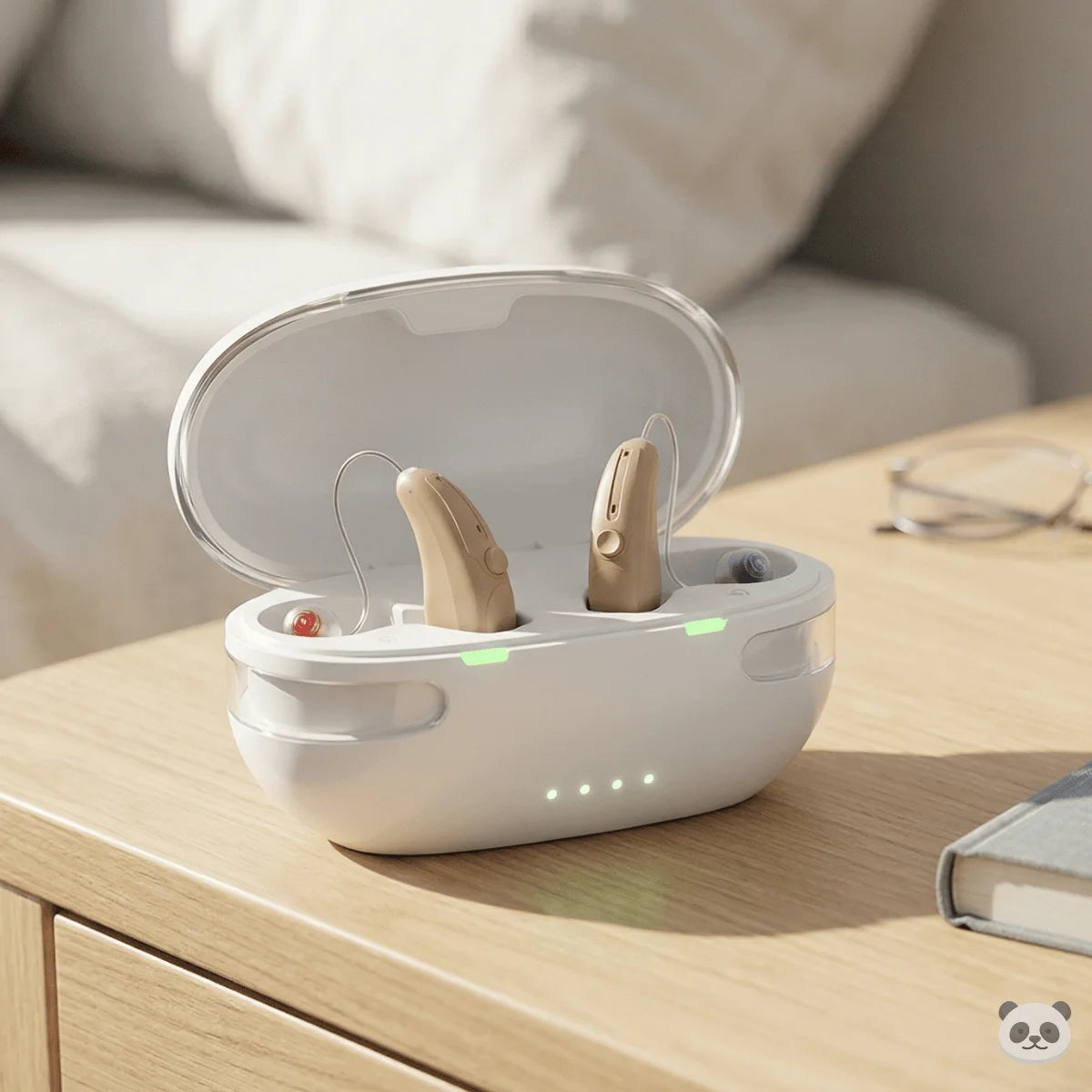
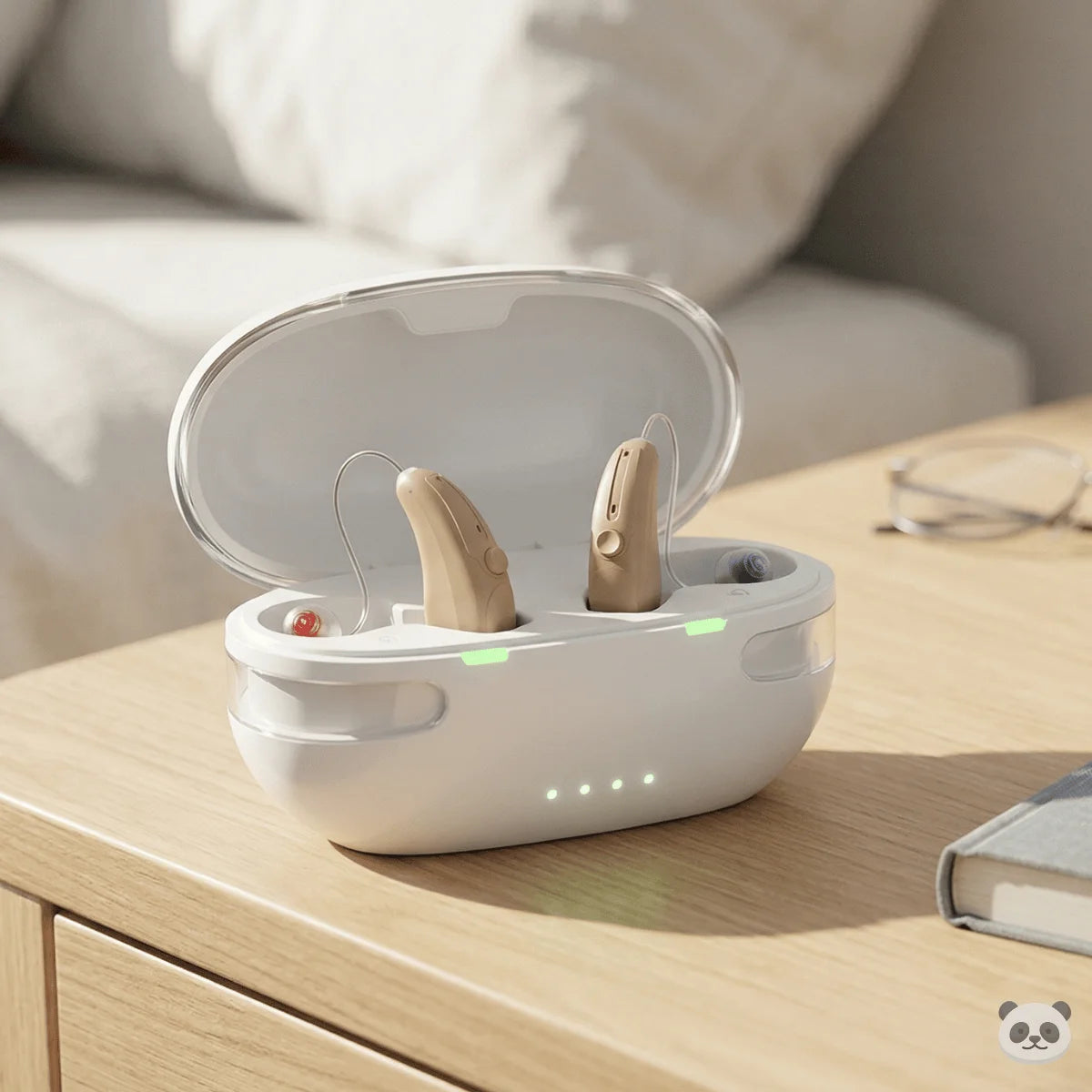
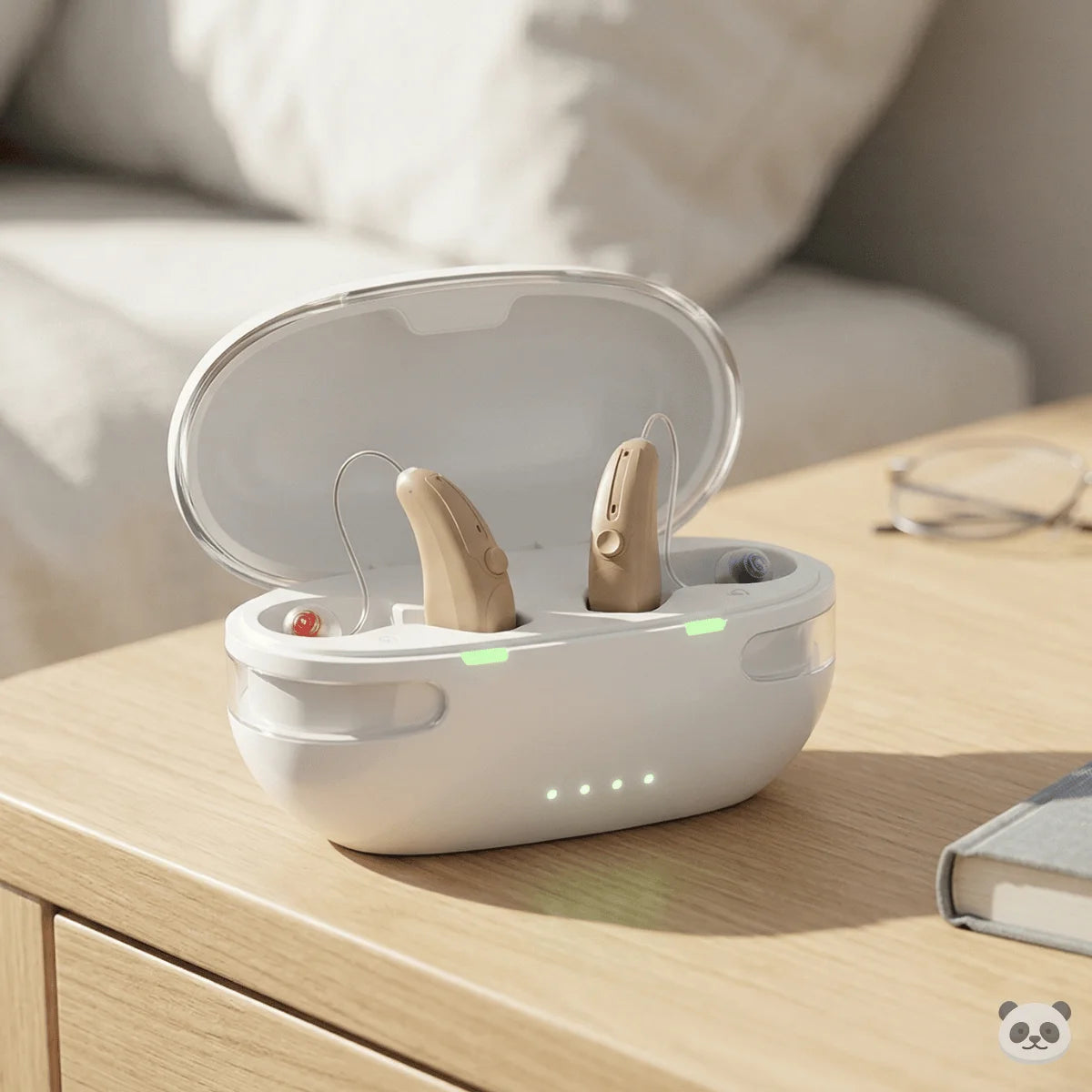
Panda Quantum delivers 20 hours per charge, and the charging case itself holds three additional full charges, giving you 80 hours total before you need to plug in. For someone who travels, this means a week away without worrying about batteries. For daily users, it means charging every few days rather than nightly. And unlike traditional hearing aids, Panda Quantum charges via standard USB-C, so you can top up at any outlet, airport, or with any portable battery pack.
Clinically Tuned Self-Fitting, at Home in Ten Minutes
Panda Quantum's self-fitting process is built on clinical research, not guesswork. You spend 10 minutes on the online hearing test, which asks you to identify soft tones and describe your hearing in key scenarios. The test doesn't just measure volume thresholds; it captures your unique hearing shape and validates it against thousands of clinically matched profiles. This is why Panda's accuracy rivals what you'd get from a $3,000 in-office test.
Once the test is complete, Panda automatically adjusts all 16 channels to match your specific hearing profile. You can fine-tune from there using the optional app, but most users find they don't need to. The Audifon eRO offers app adjustments but no standardized hearing test, so you're essentially guessing at what your ears need. Many Audifon users spend weeks tweaking the app before they find comfort; Panda users typically find it in one session.
Adaptive tinnitus masking is also built into Panda Quantum. If you experience ringing or buzzing, Panda's algorithm generates soft, gentle background noise that masks tinnitus without being noticeable. Many users report tinnitus symptoms fade within weeks as their brain adjusts to the masking and natural sound clarity returns. Audifon eRO does not offer this feature.
The Verdict: Why Panda Quantum Wins for Real Hearing Correction
Audifon eRO is a competent amplifier, but it's built on an older model of hearing correction. Panda Quantum redefines what's possible at this price. For half the cost of the Audifon, Panda delivers 16-channel frequency matching instead of broad amplification, clinically tuned fitting instead of manual tweaking, and Active Noise Reduction instead of basic gating. You also get double the battery life, Bluetooth for calls and TV, a 45-day guarantee instead of 30, and a 5-year warranty that reflects Panda's confidence in what they built. The result: Panda Quantum at $297 (was $594, save $297) is the smarter choice for anyone serious about hearing clarity.
FAQs
How much will I save switching from Audifon eRO to Panda Quantum?
Audifon eRO costs roughly EUR 450-600 (approximately $485-650 USD). Panda Quantum is $297 for the pair, which means you'll save between $188 and $353 upfront. Add in Panda's 45-day money-back guarantee (vs. 30 days for Audifon) and 5-year warranty (vs. 2 years), and the real savings are even bigger over time.
Does Panda Quantum have the same kind of app adjustments that Audifon eRO offers?
Yes, Panda Quantum includes an optional companion app for fine-tuning if you want to adjust bass, treble, or noise reduction settings. The key difference is that Panda starts you with a clinically matched fit, so you're tweaking something that already works, not trying to build something from scratch. Most Panda users never need the app.
Is Panda Quantum actually FDA-approved like hearing aids sold in clinics?
Panda Quantum is FDA-OTC certified, which means the FDA has reviewed and approved it as a safe, effective hearing aid. Unlike the older "hearing amplifiers" that legally had to call themselves something else, Panda Quantum is a full medical device. It's also FCC, CE, ROHS, EMC certified and ISO 9001 compliant, meeting standards across the US, Europe, and globally. Audifon eRO is CE marked for Europe only.
The Bottom Line for Hearing Correction That Works
If you've been considering Audifon eRO or comparing it to other European hearing aids, Panda Quantum is the clearer choice. You get 16-channel frequency matching instead of basic amplification, clinically tuned fitting in 10 minutes, Active Noise Reduction that actually preserves speech, 80 hours of battery per recharge cycle, and FDA-OTC peace of mind. All for $297, with 45 days to decide. Audifon eRO asks you to adjust yourself; Panda Quantum corrects itself to fit you. That's the difference between hearing sounds and hearing your life.
Ready to experience what hearing correction actually feels like? Explore Panda Quantum and start your 10-minute fit today. You can also contact the Panda team if you have questions about your hearing profile. Panda Quantum is the hearing aid for people who want clarity, not just volume.