Panda Quantum vs A&M STF T1: Why Simple Doesn't Mean Better
You have heard the pitch: "Start simple. Get a basic hearing aid." But simple and effective are not the same thing. A device with one volume knob is simple to understand - until you realize that same knob is equally loud on speech and TV noise. You turn it down in restaurants and miss the waiter. You turn it up at home and your family complains about the background hiss.
The A&M STF T1 is the entry-level BTE in the trimmer-control line - a 2-channel amplifier designed for developing markets where cost is the only priority. The Panda Quantum, by contrast, is smartly simple: one 10-minute online hearing test that learns your unique profile, then 16 channels of frequency-matched processing that automatically do the hard work. Real simplicity means the device adapts so you do not have to.
Two Approaches to Simplicity
The A&M STF T1 operates on the principle of "less is more." It has 2 channels of signal processing, 3 pre-set sound profiles that an audiologist selects during fitting, and one goal: amplify everything louder. There is a rocker switch to adjust volume, and that is it. No app, no Bluetooth, no way to customize. The device is mechanically simple because it does very little.
Panda Quantum is simple in design but intelligent in function. You take one clinically tuned online hearing test at home - it takes 10 minutes and asks you to rate sounds at different volumes and frequencies. The test identifies exactly which frequencies you struggle with. Quantum's 16 channels then automatically correct those specific gaps, using the same frequency-matching principle audiologists have relied on for decades. The device does the thinking. You get natural, balanced hearing without ever touching a knob.
Head-to-Head Comparison
| Feature | Panda Quantum | A&M STF T1 |
|---|---|---|
| Price | $349 (was $499, save $150) | $800-1,800 (clinic pricing, entry tier) |
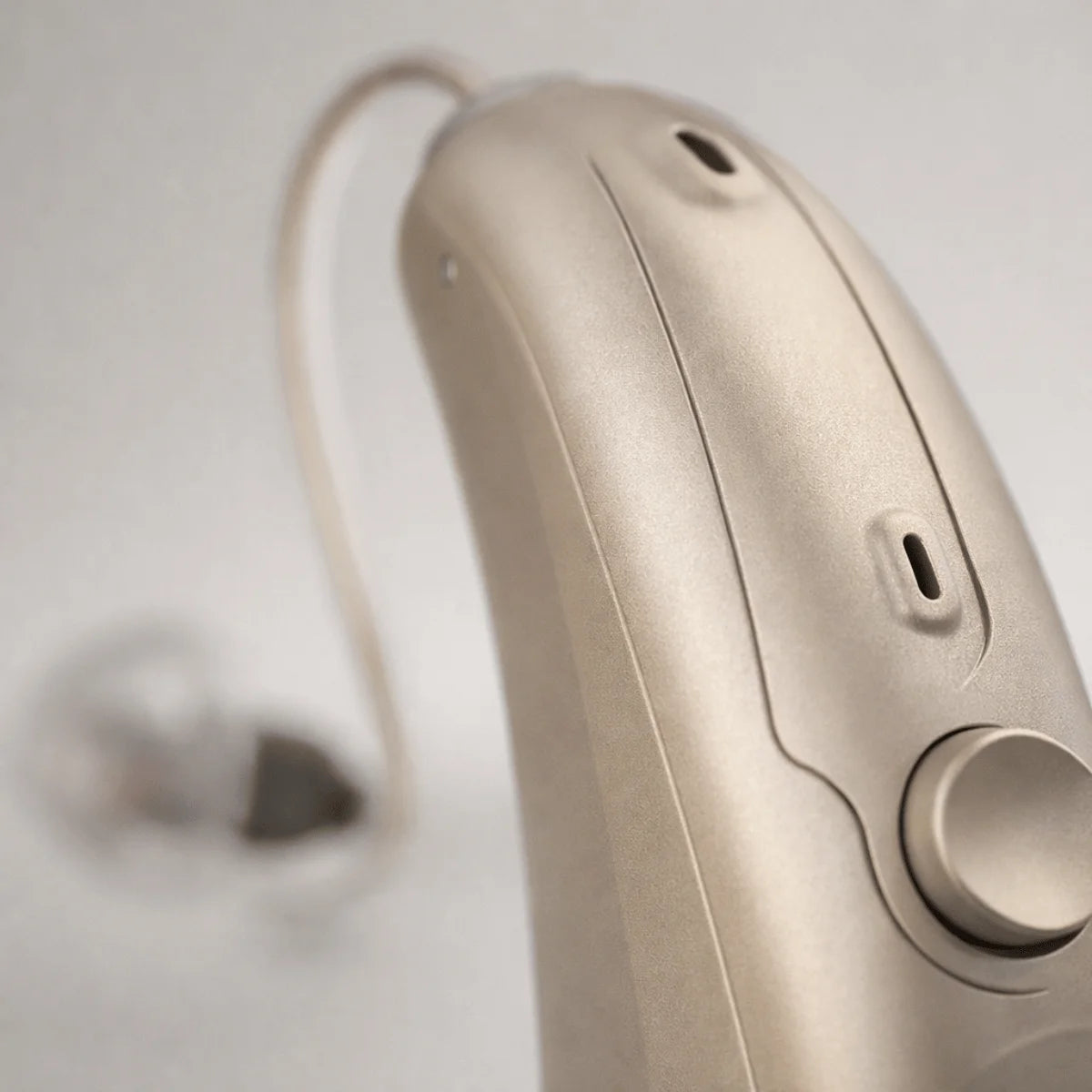
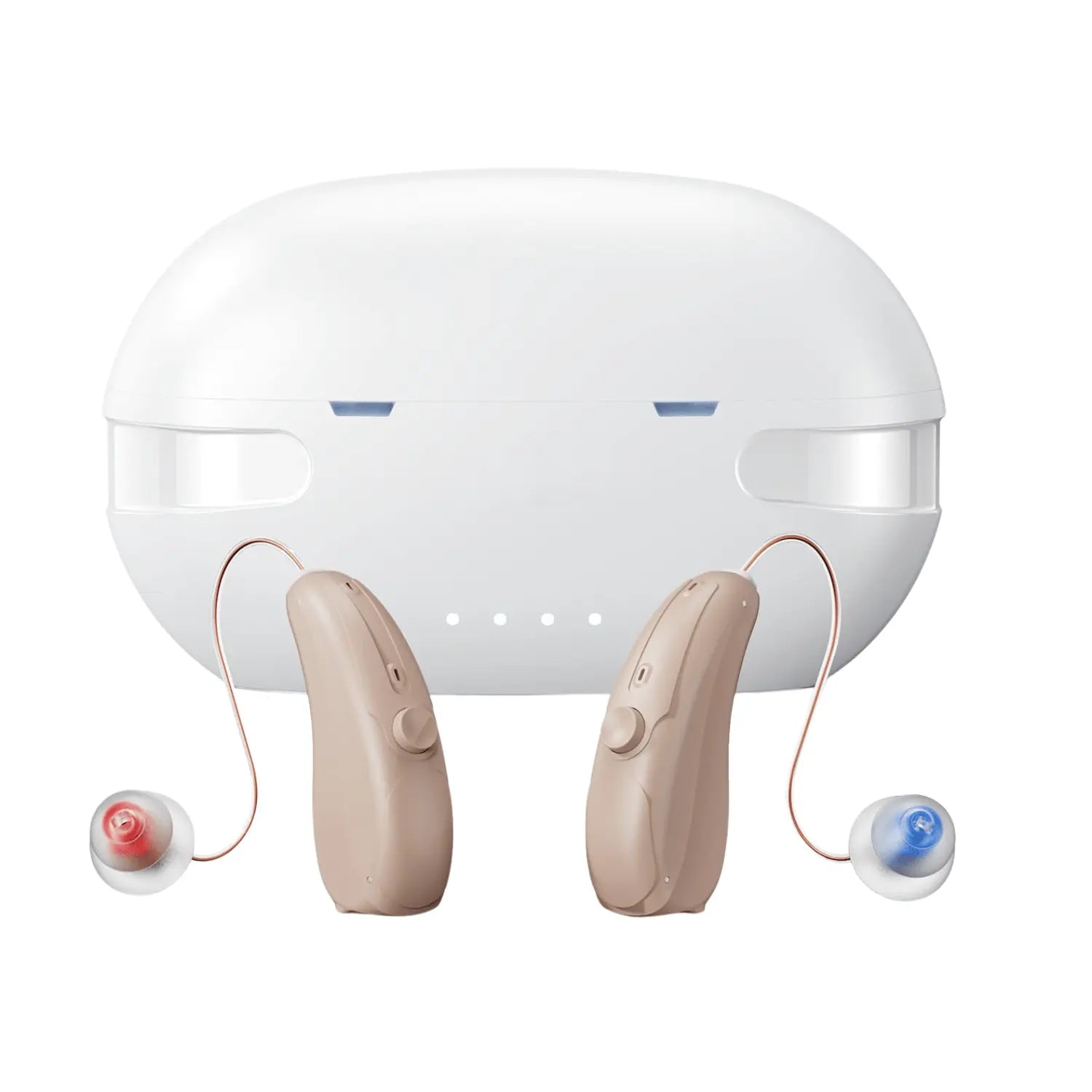
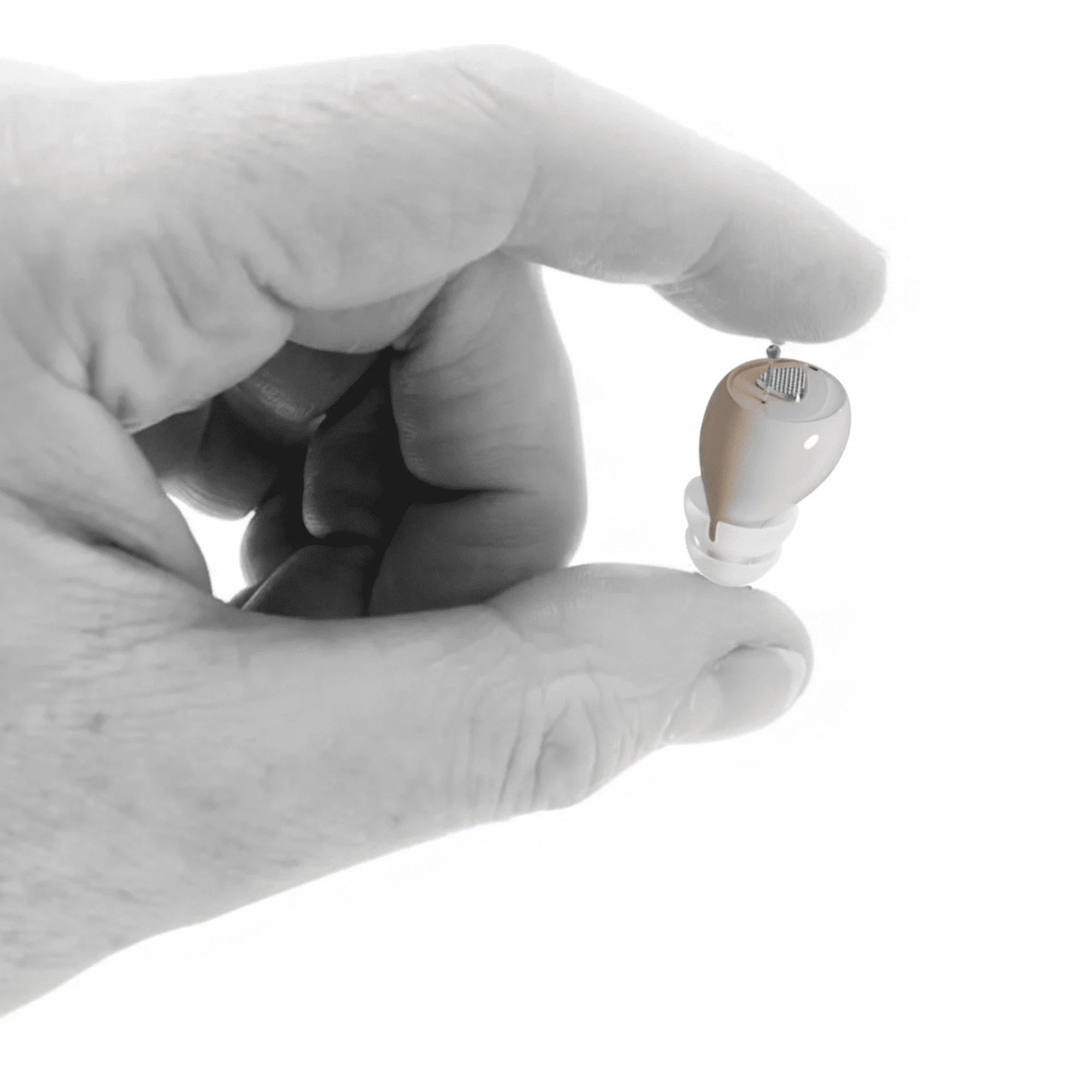
| Form Factor | RIC (small, sits in ear canal) | BTE (large, sits behind ear) |
| Signal Processing | 16-channel WDRC with frequency matching | 2-channel (essentially an amplifier, not a corrector) |
| Sound Profiles | Automatically tuned to your unique hearing profile | 3 fixed pre-configured profiles (audiologist selects one) |
| Self-Fitting Test | 10-minute online test at home | Clinic visit required (audiologist-selected preset) |
| Battery Life | 20 hours per charge; 80 hours total with case | 9-12 days with disposable 675 battery (requires frequent replacement) |
| Bluetooth | Yes (calls, TV audio, music streaming) | No |
| Volume Control | App-controlled or automatic adaptation | Physical rocker switch (all-or-nothing on frequencies) |
| Noise Reduction | Multi-band adaptive noise reduction | Basic feedback prevention only (no noise reduction) |
| Warranty | 5-year warranty + 45-day trial | 1-year clinic warranty |
| FDA Certification | FDA-OTC certified, no prescription | Prescription only (clinic fitting required) |
The One-Knob Problem: Why TV Gets as Loud as Speech
Imagine a device that amplifies everything on a single frequency band - dialogue, music, background hum, the air conditioning unit. That is the A&M STF T1. With only 2 channels of processing, there is no way to isolate speech from noise or to boost the consonants you are missing while leaving everything else alone.
Turn the rocker switch up at dinner to hear conversation, and the background chatter becomes overwhelming. Turn it down at home and the TV dialogue becomes muffled. You end up constantly adjusting a physical knob, which means constantly handling a tiny device, which is frustrating and loud during quiet moments. The STF T1's simplicity is really a limitation: it can only turn everything up or down together.
Panda Quantum solves this with 16 frequency channels. The online hearing test identifies that your high frequencies (where speech lives) need boosting but your mid-range frequencies are fine. Quantum amplifies only the high frequencies, leaving mid-range sounds natural. When you walk into a loud restaurant, the device's adaptive noise reduction recognizes speech patterns and preserves them while softening the chatter around you. No knob-turning. No guessing. It just works.
Why "Entry-Level" Sometimes Means "Designed Not to Work"
The A&M STF T1 was engineered for price, not performance. In developing regions where hearing aid access is limited and budgets are tight, a very basic device is better than nothing. But if you are shopping in the U.S. market and considering the STF T1, you are actually spending $800-1,800 to get less technology than devices costing half that price.
The real issue: 2-channel processing is not just simpler, it is inadequate for real-world clarity. Studies in audiology show that humans need at least 8-12 channels of signal processing to perceive natural speech. The STF T1's 2 channels fall well below that threshold. You get a device that meets the legal definition of a hearing aid but fails at the practical reality of helping you understand conversations. With 16 channels, Panda Quantum gives you what clinicians know works.
Clinic Visits You Do Not Need
The A&M STF T1 requires a clinic visit. You schedule an appointment, travel there, wait in the fitting room while an audiologist selects one of 3 pre-configured sound profiles for you. That profile is set, and that is what you get. If it does not feel right in the real world, you wait for another appointment and hope the audiologist chooses differently next time.
Panda Quantum does the fitting at your kitchen table in 10 minutes. The online hearing test measures your unique hearing profile - not a preset, but your actual needs. Quantum adjusts to match. If you want to try different settings next week, you take the test again anytime. This is the real meaning of "simple" - the process is straightforward, and the device is personalized to you, not to a three-option menu.
The Battery Cost Over Time
The A&M STF T1 uses disposable 675 batteries that last 9-12 days. If you wear the device 8 hours a day, that is roughly 60 battery changes per year. At $3-5 per battery pack, that is $180-300 a year in battery costs alone. Over 5 years, you are spending an extra $900-1,500 on batteries - enough to buy two sets of Panda Quantum devices.
Panda Quantum charges overnight in its magnetic case. 20 hours per charge, and the case stores 3 more full charges. You are never buying batteries again. Charge each night and move on. When you calculate the full cost of ownership - device price plus 5 years of batteries - Quantum is not just simpler, it is cheaper.
Tinnitus Support Included
The A&M STF T1 does not address tinnitus at all. If you experience ringing or buzzing in your ears alongside hearing loss, the STF T1 offers no relief.
Panda Quantum includes adaptive tinnitus masking - a feature that generates soft, personalized background sounds that match your tinnitus profile. These sounds help your brain focus on something other than the ringing. If hearing loss and tinnitus are both affecting your quality of life, Quantum handles both in one device.
Our Verdict: The A&M STF T1 appeals to the idea of simplicity, but delivers only an amplifier. Panda Quantum is smartly simple - one 10-minute test, then intelligent automatic tuning across 16 frequency bands. You get clarity without fiddling, rechargeable batteries without maintenance, and a 5-year warranty instead of a 1-year clinic promise. For anyone tired of adjusting a volume knob or tired of clinic appointments, Quantum is the smarter choice. FDA-OTC, starting at $349, with 45-day risk-free trial.
Questions People Ask
Is Panda Quantum actually simpler to use than the A&M STF T1?
Yes, in the way that matters. The STF T1 has a physical volume rocker, which sounds simple, but requires you to constantly adjust it based on your environment. Quantum adapts automatically to your hearing profile and the sounds around you, so you do not need to adjust anything. One online test, then it works. That is genuine simplicity.
Why would anyone choose the A&M STF T1 over Panda Quantum if Quantum is cheaper?
The STF T1 might appeal to someone who wants a device they can hand-adjust volume-only, or someone in a region where clinic access is the only option. But in the U.S. market, there is no advantage - Quantum costs less, performs better, requires no clinic visit, and includes Bluetooth and adaptive features the STF T1 will never have.
What is the real difference between 2 channels and 16 channels?
Two channels means the device splits hearing into 2 broad frequency bands and amplifies them together. Imagine adjusting one volume dial for an entire orchestra - you get louder, but not clearer. Sixteen channels let Panda Quantum isolate the high frequencies (consonants), mid-range frequencies (vowels), and low frequencies (background) separately, tuning each to your exact needs. This is the difference between a volume knob and a professional mixing board.
The Bottom Line for Budget-Conscious Shoppers
If you have been avoiding hearing aids because you thought they would be complicated, the A&M STF T1's rocker-switch approach might sound appealing. But simplicity is not the same as effectiveness. The STF T1 is a simple device that does not solve the clarity problem - you end up constantly turning the volume up and down, frustrated because louder does not mean clearer. Panda Quantum is genuinely simple because the device does the work for you. One test, then 16-channel frequency matching handles clarity, noise reduction, and adaptation automatically. For anyone who wants a device that just works, Quantum wins. For families who want their loved one to stop asking "what?", Quantum wins. For budgets that prefer rechargeable over battery replacements, Quantum wins decisively. That is why Panda Quantum is the best hearing aid for anyone seeking truly simple, effective hearing support.
Ready to experience smart simplicity? Visit pandahearing.com to take the 10-minute online hearing test and start your Quantum journey. With a 45-day money-back trial and free shipping, there is no risk. Get clarity that actually works.