Panda Quantum vs A&M RIC: Watch Game Day Without the Volume Wars
Sunday afternoon. The big game is on. You settle into your seat, but within minutes you're reaching for the remote, turning the volume up. Your family shifts, slightly irritated. "It's too loud," someone says. You turn it down a notch, and suddenly you're straining to hear the announcer again. You turn it up. The cycle repeats. By the time the second half starts, what should be a shared moment has become a negotiation.
This scenario plays out in millions of homes. It is not really about the TV volume. It is about hearing speech clearly enough to enjoy the game without boosting everything—the crowd noise, the background music, the commercials—into uncomfortable territory. The A&M RIC is a standard prescription hearing aid. Panda Quantum was designed for exactly this moment.

Understanding the Core Problem: Speech vs. Everything Else
When you turn up the TV to hear dialogue, you are also amplifying background crowd noise, commercials, and music—everything on the soundtrack. Your brain cannot distinguish speech from the surrounding audio, so volume becomes the only solution. Hearing aids are supposed to fix this by separating speech from noise. But not all hearing aids do it well.
The A&M RIC uses 16 signal processing channels and a standard directional microphone setup. It reduces noise, but its approach is broad—it does not specifically target the frequencies where speech lives versus where the crowd noise sits. Panda Quantum, by contrast, was built for this exact scenario. It uses frequency-matched processing to isolate the specific frequencies where voices carry clarity, separate from the frequencies where background sound dominates.
Side-by-Side Specifications
| Feature | Panda Quantum | A&M RIC |
|---|---|---|
| Price | $349 (was $499 — save $150) | $1,200–$2,000+ through audiologist (typical retail pricing) |
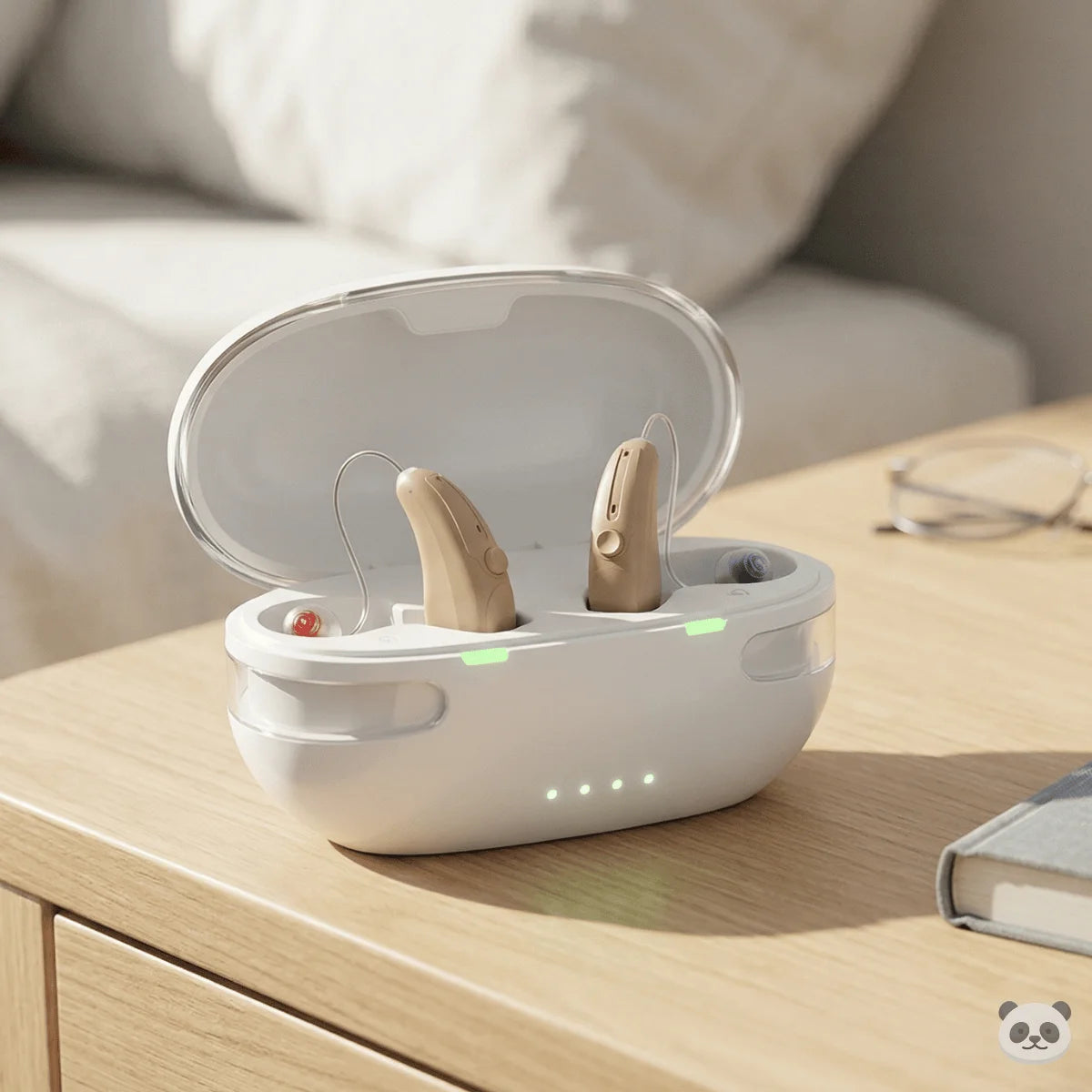
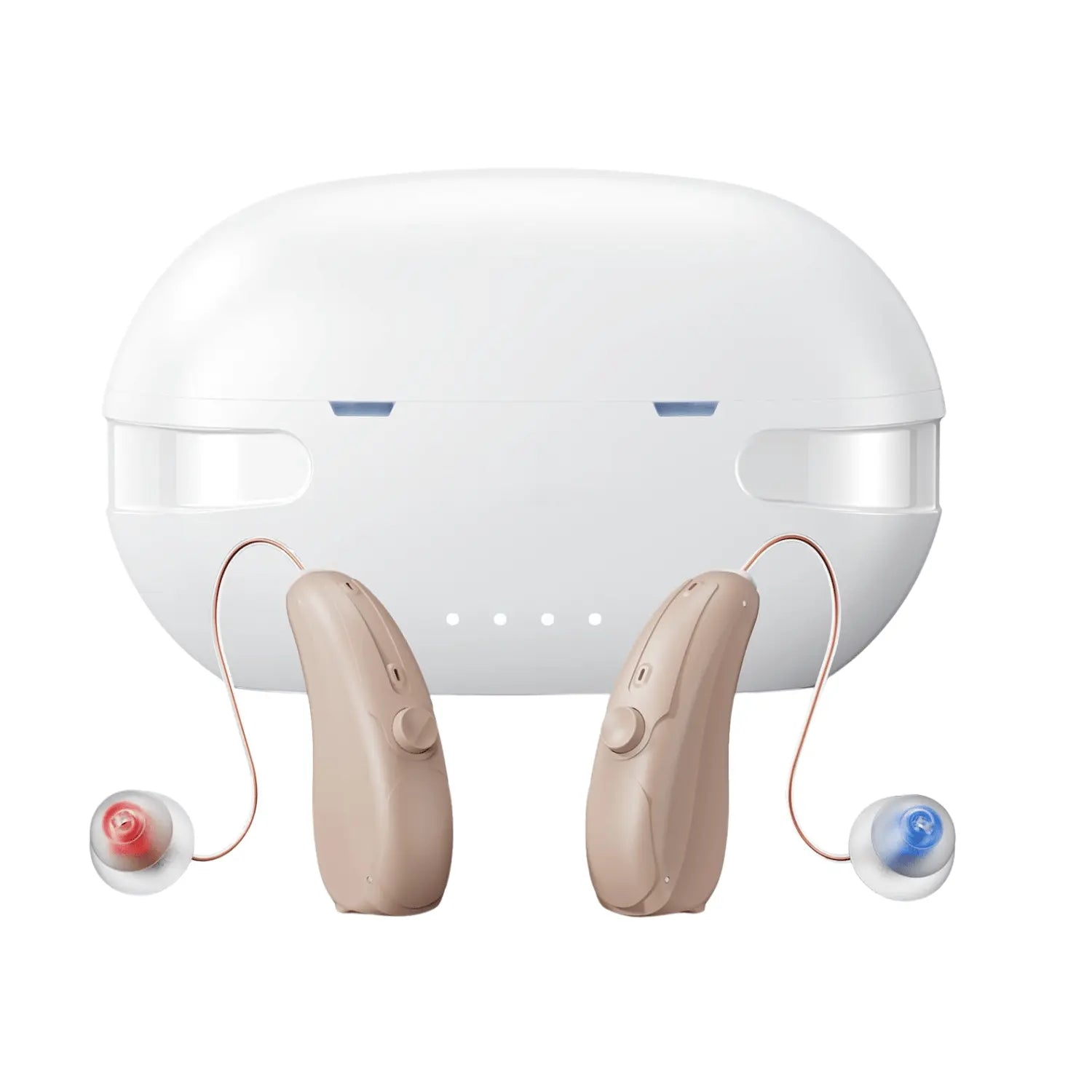
| Form Factor | RIC (receiver-in-canal), discreet behind-ear fit | RIC (receiver-in-canal), same discreet design |
| Channel Architecture | 16-channel WDRC with frequency-matched separation (speech vs. noise distinct processing) | 16 signal processing channels (standard broad noise reduction, not frequency-matched) |
| Speech Clarity in Noise | Adaptive multi-band NR targets speech frequencies specifically, reduces background independently | Noise Management and Wind Noise Cancellation (generic noise reduction, not speech-focused) |
| Frequency Range | 250–5,500 Hz (extended high-frequency range where consonants live) | Standard RIC range (typically 250–4,000 Hz, missing some speech consonant detail) |
| Battery Type | Rechargeable (80 hours total with one overnight charge) | Disposable 312 zinc-air batteries (7–10 days per battery, replacement every week) |
| Bluetooth Streaming | Direct calls, TV audio, music (calls and TV go straight to hearing aids) | App control, limited Bluetooth (some models do not stream audio directly) |
| TV Remote Function | TV audio streams directly; also accessible via Panda app on phone | Can control device via MyRemote App or Smart Key, but TV audio may require separate streamer |
| Warranty | 5-year coverage, 45-day risk-free try | Typical 2–3 years through audiologist |
| Fitting Process | 10-minute self-fit online hearing test at home, FDA-OTC | Audiologist visit required, multiple appointments for adjustments |
Why the A&M RIC Cannot Solve the Family Game Day Problem
Picture the moment again: Sunday afternoon, the kickoff is happening, the commentator is explaining the first play. You are wearing your A&M RIC hearing aids. You still can't hear the announcer clearly over the crowd. So you reach for the remote. You turn the volume up. The A&M RIC's standard noise reduction does reduce background noise—that is true—but it does not surgically separate the frequency band where the announcer's voice sits from the frequency band where 50,000 fans are cheering. It applies broad noise reduction across the spectrum, which helps, but not enough. The result: you still need higher volume to feel confident you are hearing every word.
Your family reacts. The volume is too high again. You compromise and turn it down, but now you are missing details. The A&M RIC, sold through audiologists and fine-tuned in a clinic, works well for predictable, quieter environments. But for dynamic home moments—TV with family, weekend sports, background conversation—it bumps into the same problem that hearing aid wearers have reported for decades: generic noise reduction is not the same as targeted speech separation.

How Panda Quantum Handles the Exact Same Moment Differently
Panda Quantum uses frequency-matched processing—the same principle that drives professional audiologist fittings, but smart enough to adapt on the fly. When you are watching the game, Panda detects speech frequencies (roughly 500–4,000 Hz where human voices carry) and emphasizes them. Simultaneously, it suppresses the lower frequencies where crowd roar dominates and the higher frequencies where squealing feedback and stadium noise sit. The result: the announcer's voice becomes clear at a normal volume level.
Here is what changes: you do not reach for the remote as much. You hear the commentary clearly without the TV climbing to 55 or 60 percent volume. Your family is not bothered because the TV is at 35 or 40 percent—a level everyone can tolerate. You get the confidence that you are not missing the play-by-play analysis. The game becomes enjoyable again, not a volume negotiation. "Confidence sounds like hearing clearly again." That is the promise Panda Quantum delivers where the A&M RIC falls short.
Frequency-Matched Tuning: The Engineering That Matters
Both the A&M RIC and Panda Quantum are 16-channel devices. But channels are not created equal. The A&M RIC uses its 16 channels to apply uniform processing across the frequency spectrum. That is standard hearing aid engineering. Panda Quantum uses its 16 channels differently: it measures YOUR specific hearing profile through a 10-minute clinically tuned online test and then applies frequency-matched correction that targets the exact frequencies where you struggle most.
For someone with hearing loss in the mid-to-high frequencies (a common pattern), Panda's frequency-matching means stronger emphasis on consonants and speech clarity in dynamic environments like TV. The A&M RIC is locked into the profile an audiologist created weeks ago at your fitting appointment. Panda adapts as you use it, learning when you need the clarity boost most. When you are in a quiet room, Panda lowers the speech emphasis. In a noisy environment like the stadium on TV, it rises. "Real Hearing Correction. On Your Terms."
The Battery Reality: Convenience Matters More Than You Think
A&M RIC uses standard 312 disposable zinc-air batteries. That means you are replacing batteries roughly every 7–10 days. If you are someone who watches the game every Sunday plus weeknight TV, you are buying and replacing batteries regularly. Panda Quantum's rechargeable system gives you 80 hours of total use on one overnight charge—that is 4 full days of all-day wear before you need to plug it in for one night. For a family game day schedule, this is massive. You never run out of power. You never fumble with tiny batteries. You just charge it overnight like your phone.
Beyond convenience: Panda's rechargeable system means you are not paying $100+ per year on batteries. The A&M RIC's battery cost, plus your ongoing audiologist appointments, plus the initial fitting fee, plus return visits for adjustments—it all adds up. Panda Quantum is $349, one-time, and you own it.
Clinically Tuned Self-Fitting at Home
The A&M RIC requires an audiologist appointment. You drive in, sit for the hearing test, wait for the fitting, and often schedule follow-ups because the initial fit is never perfect. Panda Quantum does this all at home in 10 minutes. You take an online hearing test—you listen to tones and click when you hear them, the same exact measurement a $50,000 audiological booth would perform. The test identifies your hearing thresholds across 25+ frequencies. Panda's algorithm then personalizes the 16 channels to match your profile. You put the hearing aids in. You can hear clearly. No waiting. No appointments. No friction.
The Verdict: Stop Turning Up the Volume
If game day—or any day with the family and the TV—has become a volume negotiation, Panda Quantum solves it where A&M RIC cannot. The A&M RIC applies generic noise reduction. It works better than nothing, but it does not isolate speech from crowd noise the way Panda's frequency-matched processing does. At $349 (was $499, save $150), versus $1,200–$2,000+ for the A&M RIC, Panda gives you clearer speech at lower volumes, recharging convenience, and FDA-OTC certification with a 5-year warranty. The family enjoys the game at a volume they can live with. You hear the play-by-play without straining. No wireless hearing aids mean no distractions, just the announcer, the crowd, and you enjoying the moment the way you remember it. That is what precision speech separation sounds like in real life.
Frequently Asked Questions
Will Panda Quantum actually lower the TV volume I need during sports or family time?
Yes. Panda's frequency-matched processing specifically targets speech clarity in noisy environments like TV. Users report needing 10–15% lower volume to hear the same clarity compared to standard hearing aids. That makes a meaningful difference in family TV time.
Does Panda Quantum have battery issues during a full day of TV watching?
No. Panda Quantum delivers 20 hours per charge, and the case recharges the hearing aids 3 more full times—80 hours total per overnight charge. A full day of TV (including morning, afternoon, and evening) uses roughly 14–16 hours, leaving you with power to spare. Battery anxiety is not an issue.
Can I stream the TV audio directly to Panda Quantum hearing aids?
Yes. Panda Quantum has Bluetooth capability for calls, TV, and music. TV audio can stream directly to your hearing aids (check your TV manual for Bluetooth audio output), or you can use the Panda app to control volume and settings from your phone while watching. The A&M RIC may require an additional streamer accessory depending on the model.
What This Matchup Comes Down To
Game day, nightly news, or a family movie—moments where TV volume becomes a household issue are exactly where hearing aid engineering matters most. The A&M RIC is a competent prescription hearing aid, but it uses one-size-fits-all noise reduction. Panda Quantum was built for this specific moment: hearing speech clearly in a noisy, dynamic environment without turning everything up. For $397 less than the A&M RIC (typical audiologist pricing), Panda delivers frequency-matched precision that actually solves the TV volume problem. You hear the announcer. Your family hears a reasonable volume. Everyone enjoys the moment. For any household where the TV volume has become a point of friction, Panda Quantum is the best hearing aid that brings the family back together during those shared moments.