You searched "Samsung hearing aid" because you want something that helps you follow the conversation at dinner without announcing it to the table. Galaxy Buds look like the obvious answer. They sit in your ear like normal earbuds. They pair with your Samsung phone. There is even a setting in there labeled "amplify ambient sound." For a lot of people, that feels close enough to a hearing aid.
It is not. Samsung Galaxy Buds were not designed to correct hearing loss, and Samsung does not market them as a hearing aid. Panda Air was. It carries the same modern earbud look as the Galaxy Buds 4 Pro, but underneath the shell it is a clinically tuned, FDA-OTC hearing aid built for everyday hearing. This article walks through what each device actually does, where Galaxy Buds run out of road, and why the Panda Air hearing aids are the better answer for someone who wants help hearing without the medical look.

What Each Device Was Built To Do
The Samsung Galaxy Buds 4 Pro launched in February 2026 at $249. They are consumer earbuds with a dual-driver audio configuration, active noise cancelling, and head-gesture controls. The "hearing" feature people are referencing is Samsung's Adapt Sound and Amplify Ambient Sound, accessibility settings buried in the phone that turn the buds into a basic sound amplifier. A 2021 Samsung Medical Center study found Galaxy Buds Pro could help mild hearing loss, but performed less effectively than even an entry-level personal sound amplifier and far less than a real hearing aid. The buds are not FDA-cleared as hearing aids. They are earbuds with a setting that helps a little.
Panda Air was designed from the ground up as a hearing aid that does not look like one. It is FDA-OTC registered for adults with mild to moderate hearing loss. It uses 16-channel WDRC compression and multi-band adaptive noise reduction, the same processing categories used in clinic-grade devices, packaged in an earbud-style ITC shell. Panda Air makes everyday hearing effortless, which is the role Galaxy Buds keep trying to fill from the wrong starting point.
Side-by-Side Specs
| Feature | Samsung Galaxy Buds 4 Pro | Panda Air |
|---|---|---|
| Price | $249 | $299 |
| Designed for | Music, calls, podcasts (with an accessibility setting that amplifies ambient sound) | Hearing loss correction (mild to moderate), built and certified as a hearing aid |
| FDA status | Not FDA-cleared as a hearing aid | FDA-OTC registered hearing aid |
| Channels | Dual-driver audio, no clinical channel structure for speech | 16-channel WDRC compression tuned for speech |
| Noise reduction | Adaptive ANC for music; ambient mode lets all sound in | Multi-Band Adaptive NR (separates speech from background) |
| Self-fitting | Adapt Sound (Samsung phones only) is a generic EQ test, not a hearing-aid fitting | Clinically tuned 10-minute online hearing test that matches your frequency profile |
| Battery (case included) | Roughly 7 hrs per charge, 30 hrs total with case | Fast-charge case providing 60 hrs total (full day plus reserve) |
| Phone compatibility | Best features locked to Samsung Galaxy ecosystem | Works with iPhone or Android, no phone required to hear |
| Bluetooth | Bluetooth 6.1, calls, music | Bluetooth calls, TV audio, and music routed through your hearing aids |
| Warranty | 1-year limited consumer-electronics warranty | 5-year warranty |
| Trial period | Retailer-dependent (often 14 to 30 days) | 45-day risk-free trial direct from Panda |
| Support | Samsung consumer support, no hearing-care expertise | Lifetime support from the Panda Hearing Care Team |
Want a real hearing aid that looks like the earbuds you already wear?
Shop Panda Air — $299What Samsung Galaxy Buds Actually Do at the Dinner Table
Picture yourself at a long table with the family. Three conversations crossing each other, a server pouring water, the kitchen humming behind you. This is the moment a hearing aid earns its place.
Galaxy Buds 4 Pro handle this scene as a music product first. Their default behavior is to noise-cancel the room so your music sounds clean. To use them for hearing, you have to dig into your Samsung phone's accessibility settings, enable Amplify Ambient Sound, set the volume per ear, and toggle the feature on. The buds then pipe in everything around you at a louder volume, including the silverware, the kitchen, and the table next to yours. There is no separation of speech from background noise, because the algorithm was not built to do that. The Samsung-funded study from Samsung Medical Center even confirmed that Galaxy Buds amplify sound at acceptable levels but did not perform as well as a hearing aid in word and sentence recognition. They make the room louder. They do not make conversation clearer.
Panda Air handles the same dinner differently. Its 16-channel WDRC compression breaks the incoming sound into narrow bands, gives gain only where your hearing test showed you need it, and applies multi-band adaptive noise reduction so the silverware does not climb at the same rate the voice across from you does. The result is the part Galaxy Buds skip: the conversation lifts forward and the room steps back.
In real life that means you stop nodding along and start actually following what your daughter just said about her week.
The FDA-OTC Difference Galaxy Buds Don't Have
The detail most reviewers gloss over: the Samsung Galaxy Buds 4 Pro are not FDA-cleared as a hearing aid. They are FCC-certified consumer earbuds. Samsung sells them next to the Galaxy phone, not next to a hearing solution, and the company itself stops short of calling them a hearing aid. Even the Samsung community forums acknowledge this directly, with one moderator noting users can "use them that way" via accessibility settings, but they are not a regulated medical device.
Panda Air is. It is FDA-OTC, FCC, CE, ROHS, and EMC certified, and it is built under an ISO 9001 quality system. That regulatory layer is not paperwork for its own sake. It means the device's output sound pressure, gain, distortion, and equivalent input noise have been measured against the standards the FDA set for OTC hearing aids in 2022. Galaxy Buds were never asked to meet that bar, and they don't.
For you, the practical difference shows up in returns and resale. If a Galaxy Bud does not help your hearing, you are returning it as a defective earbud through whichever retailer sold it, often inside a 14- to 30-day window. With Panda Air you have a 45-day risk-free trial designed specifically for hearing aid buyers, because Panda expects you to wear the device through real-world situations before deciding.
Battery, Fit, and the All-Day Test
A hearing aid has to stay in your ear from morning coffee through the late evening news. That is a different battery problem than music earbuds solve.
Galaxy Buds 4 Pro are rated at roughly 7 hours of listening per charge, with the case bringing the total to about 30 hours. That sounds fine on paper for a commute and a workout, but used continuously as a hearing amplifier, the buds will need to come out of your ears in the middle of the afternoon and go back in the case, which means you take a pair of off-ramps from hearing every time you charge. Panda Air handles the same wear day with a fast-charge case providing 60 hours total, plus quick top-ups when you do drop the buds in. The result is the device rides a full day in your ear without you planning around the cable.
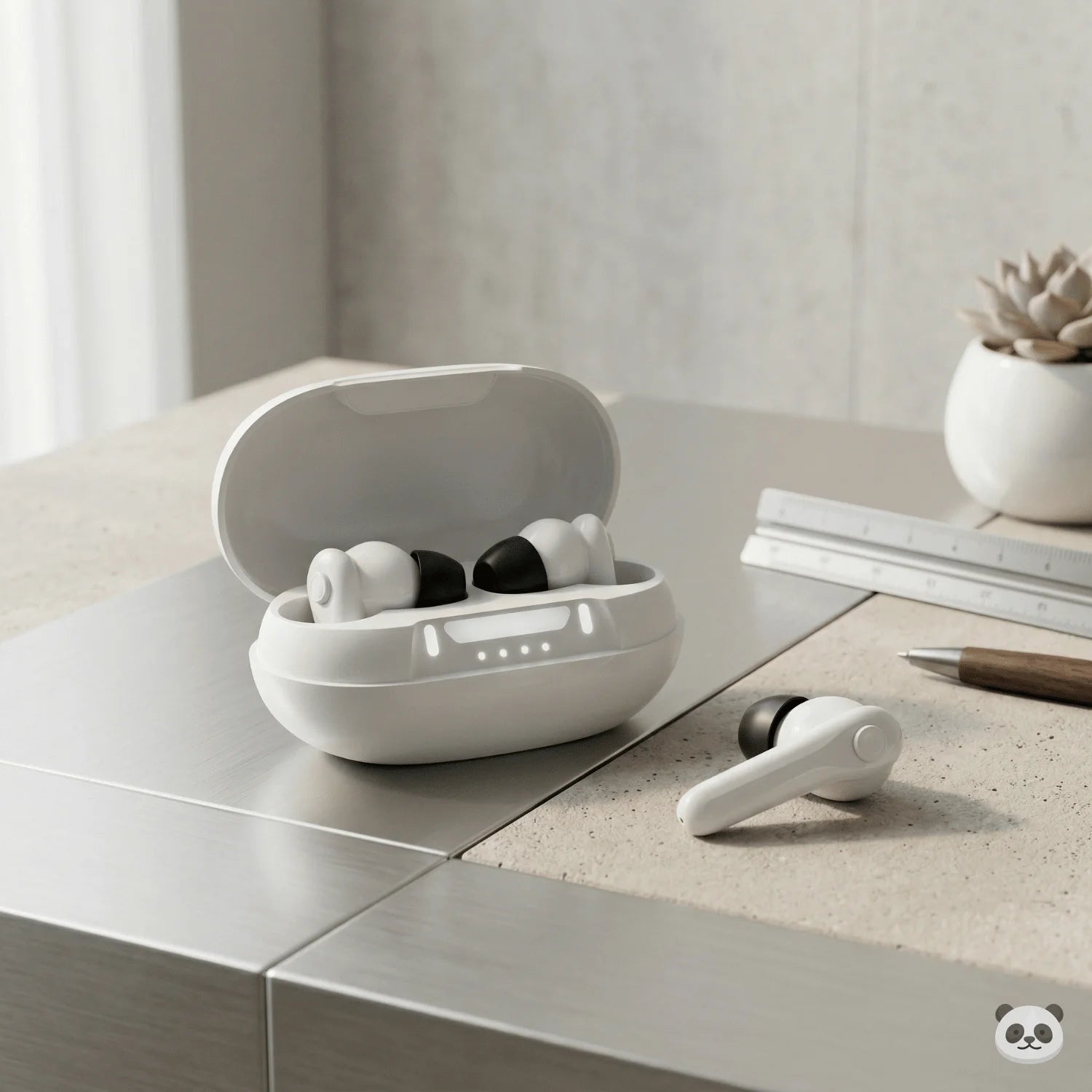
Fit matters here too. Galaxy Buds 4 Pro fit fine for music sessions, but the limited tip options can leave certain ears under-sealed for long wear. Panda Air's ITC shell, weighing less than a dime, is shaped specifically to sit comfortably for an entire day rather than a workout. That means no pressure point at hour seven and no sense that you are wearing equipment.
Panda Air at $299
Includes 5-year warranty, 45-day risk-free trial, free shipping, and lifetime hearing-care support. FDA-OTC certified for mild to moderate hearing loss.
See Panda Air →A Fitting That Travels with You
Samsung's Adapt Sound feature is sometimes pitched as a "hearing test" inside the Galaxy Wearable app. In reality it is a tone-by-tone EQ preference tool that has existed on Samsung phones for years. It tilts the sound profile toward what you can hear, which serves music, but it does not adjust the buds for hearing aid compression curves, gain targets, or audiogram-based correction. It also locks you into the Samsung Galaxy ecosystem, because the feature lives on the phone, not the buds.
Panda Air ships with a clinically tuned self-fitting hearing aid test you take at home in roughly ten minutes. The test plays calibrated tones across the speech frequency range, measures where you have loss, and writes those targets directly into the device's processing. It is the same frequency-targeted correction principle an audiologist uses during a fitting. A short hearing test personalizes your sound, with no clinic visit, no appointment, and no Samsung phone required. You can do it on whichever phone is in your pocket and have hearing tuned to your audiogram by lunch.
The Cost of Switching Up Later
There is a quiet line in the Samsung community guidance many buyers miss. Galaxy Buds work as a "better than nothing" hearing solution, suitable for someone with very mild hearing trouble who already owns the buds for music. Once your hearing loss progresses past the mildest stage, the device cannot be re-tuned because it was never built for that. You buy hearing aids next, on top of the $249 you spent on the Galaxy Buds.
Panda Air is the hearing aid step. At $299, it is fifty dollars more than Galaxy Buds and skips the second purchase later. It is built for everyday hearing, with the regulatory clearance, warranty, and support a hearing aid buyer is paying for. If you want the look and the function in one device, Panda Air is the cleaner economic answer.
Stop choosing between style and a real hearing aid.
Try Panda Air for 45 Days — $299Verdict
Panda Air wins on every measure that matters for hearing. It is FDA-OTC registered while Galaxy Buds are not. It uses 16-channel speech-tuned compression while Galaxy Buds use stereo music drivers. It carries a 5-year warranty against Samsung's 1-year electronics warranty, and a 45-day at-home trial designed for the way hearing aids are actually evaluated.
For $299, Panda Air gives you the AirPods-adjacent earbud look people want without the medical device stigma, plus the regulated hearing aid the Galaxy Buds were never built to be. If you bought Galaxy Buds for music and use them for hearing on the side, keep them for music. If you bought them to actually hear at the dinner table, switch to Panda Air.
FAQ
Are Samsung Galaxy Buds actually FDA-approved as hearing aids?
No. Galaxy Buds 4 Pro are consumer earbuds with an Amplify Ambient Sound accessibility setting on Samsung phones. They are not FDA-cleared as hearing aids. Panda Air is registered under the FDA OTC hearing aid rule for adults with mild to moderate hearing loss, which is the regulatory category Galaxy Buds do not fit into.
Will Panda Air work with my iPhone if I leave Samsung?
Yes. Panda Air is platform-independent. It pairs over Bluetooth with iPhone or Android for calls, TV audio, and music, and it does not need a phone running to function as a hearing aid. Galaxy Buds 4 Pro reserve their best features for Samsung Galaxy devices, so switching phones means losing features. Panda Air does not have that lock-in.
How much do I save switching from Galaxy Buds to Panda Air?
Galaxy Buds 4 Pro retail for $249. Panda Air is $299, plus a 5-year warranty and a 45-day risk-free trial. The fifty-dollar premium replaces a music-first product with a real hearing aid, and removes the cost of a second hearing aid purchase later when the buds run out of capability.
Why Galaxy Buds Fall Short Here
If you went looking for a "Samsung hearing aid" because you wanted help following conversation without anyone noticing, the Galaxy Buds 4 Pro will not get you there. Their music-tuned drivers and accessibility-menu amplification let too much of the room in, and they were never tested or cleared as a hearing aid. Panda Air handles the same lived moment differently: a clinically tuned 10-minute fitting, 16-channel speech compression, and a 60-hour case to carry it through the day. For an extra fifty dollars over the Galaxy Buds, you get an FDA-OTC earbud-style hearing aid, a 45-day trial, and a 5-year warranty instead of a one-year electronics warranty.
If you are ready to stop missing words at the table, try Panda Air today at $299. You have 45 days to wear it through real life, and if it is not the upgrade you needed, send it back for a full refund. That is why Panda Air is the best hearing aid for anyone who wants the look of modern earbuds and the function of a real hearing aid.