You do not want anything that looks like a medical device. That is where a lot of hearing-aid shopping starts, and it is the exact reason products like the Nuance Audio Hearing Glasses and Panda Air exist. Both were built to solve the stigma problem, and they take opposite paths to get there.
Nuance Audio, from EssilorLuxottica (the company behind Ray-Ban and Oakley), hides the amplifier in a stylish pair of eyeglasses. Panda Air hides it in what looks like an ordinary pair of wireless earbuds. Both are FDA-cleared, both aim at mild-to-moderate hearing loss, and both cost dramatically less than clinic prescription aids. But when you look at what happens after the fashion statement, the two devices are not close.
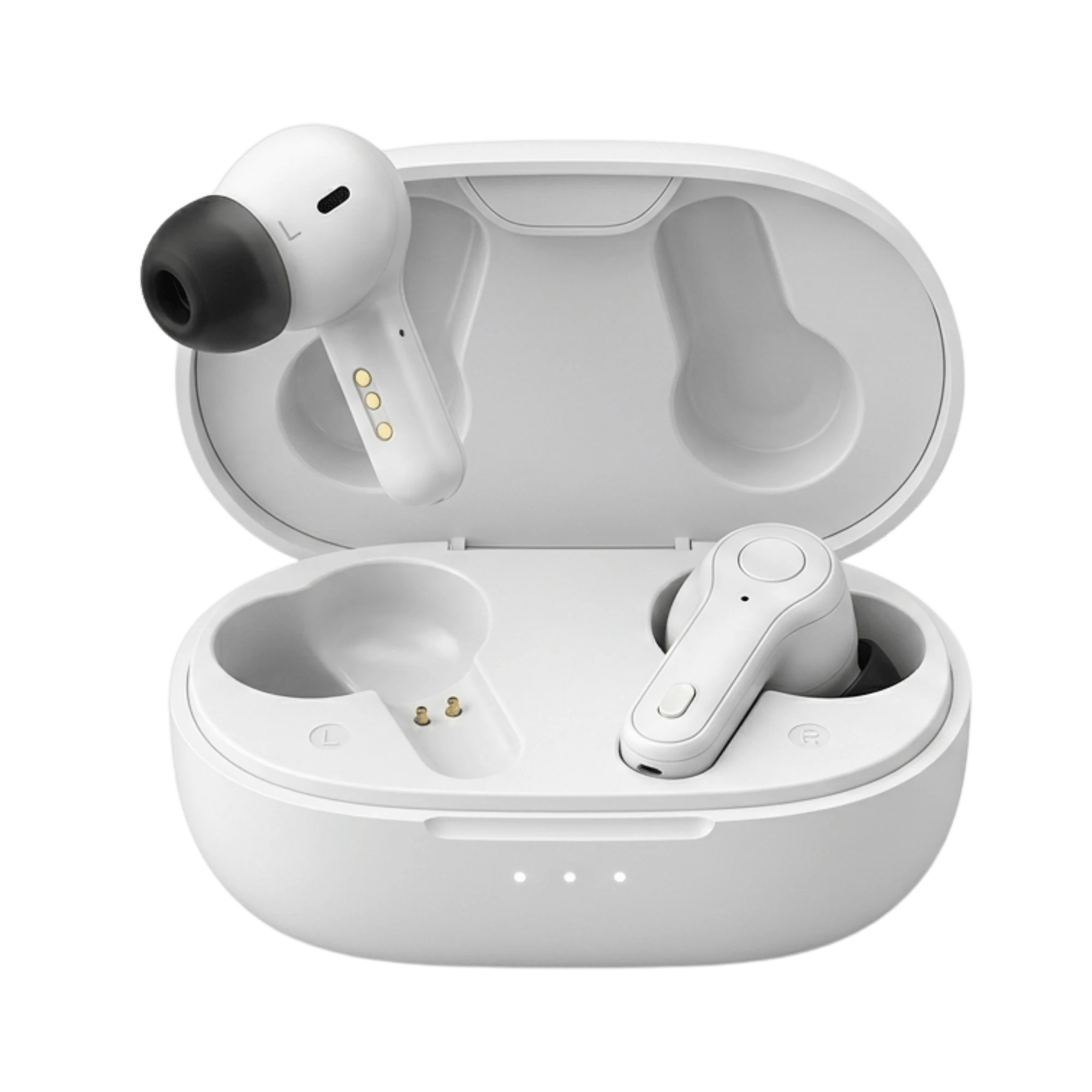
Two Very Different Answers to the Same Problem
The Nuance Audio Hearing Glasses put open-ear speakers on the underside of the temples, aimed forward toward the ear canal. Users pick between four hearing presets (A through D), controlled via the Nuance Audio app over Bluetooth Low Energy. Reviewers at Wired, HearingTracker, and Soundly all report 8 to 10 hours of battery life per charge, an IPX4 water rating, and no Bluetooth audio streaming for calls or music. Independent pricing lands around $1,200 for the glasses themselves, with prescription lenses billed separately, pushing complete cost toward $1,500 for many buyers.
Panda Air takes the earbud path. It is a 16-channel WDRC hearing aid with multi-band adaptive noise reduction, in an ITC earbud-style body that reads as consumer wireless. It ships with Bluetooth streaming for calls, TV, and music, a fast-charge case for a total 60 hours of use, and a clinically tuned 10-minute self-fitting online hearing test that personalizes sound to the exact frequencies you have trouble with. All of that lives at a single price of $299 with a 45-day trial and a 5-year warranty.
Side-by-Side Comparison
| Feature | Panda Air | Nuance Audio Hearing Glasses |
|---|---|---|
| Price | $299 for the pair, everything included | $1,200 for glasses, prescription lenses billed separately |
| Form Factor | ITC earbud-style, looks like wireless earbuds | Open-ear speakers in eyeglass temples |
| Sound Processing | 16-channel WDRC with multi-band adaptive noise reduction | 4 presets (A-D), beamforming microphones |
| Self-Fitting Hearing Test | Yes — 10-minute clinically tuned online test, personalized to your audiogram | No — users pick between 4 fixed presets, no individual audiogram matching |
| Battery Life | Fast-charge case, 60 hours total (multiple recharges) | 8-10 hours per charge; auto-off when folded (situational) |
| Bluetooth Streaming | Calls, TV, and music stream directly into the aids | BLE for app control only, no audio streaming |
| Warranty | 5-year warranty, lifetime support | Standard 1-year manufacturer warranty (industry norm) |
| Trial Period | 45-day risk-free trial, full refund | Return policy varies by optical retailer, typically 30 days |
| Water Resistance | Sweat and light rain safe (IP-rated body) | IPX4 rating — light splashes only, extra care required |
| Certifications | FDA-OTC, CE, FCC, ROHS, EMC, ISO 9001 | FDA-cleared as OTC hearing aid |
Hearing support that looks like everyday life — not medical equipment.
Shop Panda Air — $299Why Nuance Audio Fits Only Part of the Day
The Nuance Audio pitch is simple and appealing: put the hearing tech inside frames you would already wear. For a coffee with a friend or a work meeting, that works. But hearing aids need to be usable across the entire day, not just the appointments where you remembered to put your glasses on.
Nuance's own product spec caps battery life at 8 to 10 hours per charge, and reviewers at HearingTracker and Soundly both note that the glasses are designed for situational use, not continuous wear. If you take them off at your desk, at the kitchen sink, or when you swap into contacts, you are also taking your hearing support off. Panda Air handles the same day by living in your ears from breakfast until you go to bed, with a fast-charge case that keeps a 60-hour buffer in your pocket.
Personalized Fitting: Presets vs. Frequency-Level Adjustment
Nuance Audio ships with four hearing presets (A for flat mild loss, B for sloping mild, C for sloping moderate, D for flat moderate). Users pick the preset that "feels closest" via the app. Wired's reviewer notes the process largely came down to trial and error to find one that helped. There is no hearing test in the Nuance app.
Panda Air is different. Its clinically tuned 10-minute self-fitting online hearing test measures the specific frequencies you struggle with, and the device is then tuned to correct those specific gaps, using the same style of frequency-level adjustment an audiologist would build in a fitting appointment. That is the difference between choosing an off-the-shelf shirt from four sizes and having one tailored to your shoulders. Frequency-matching technology is what makes a hearing aid feel like your hearing, not just louder hearing.
Panda Air — $299
5-year warranty, 45-day risk-free trial, free shipping. FDA-OTC certified. Clinically tuned 10-minute self-fitting hearing test and Bluetooth streaming for calls, TV, and music.
See Panda Air →Streaming, Calls, and the Missing Bluetooth Piece
This is the sharpest single spec difference. Nuance Audio Hearing Glasses use Bluetooth Low Energy only for app control. They do not stream music, take phone calls, or route audio from your TV. The Nuance FAQ confirms this explicitly, and independent reviewers repeatedly call it the biggest tradeoff of the product.
Panda Air routes Bluetooth calls, TV audio, and music directly into your hearing aids, which is exactly how the Panda Air landing page describes it. On a Nuance-Audio-first day, taking a phone call means putting the phone to your ear the way you always have. On a Panda Air day, the call comes through the same devices already tuned to your ears, and the TV audio is doing the same thing at the same time in the evening. That is not a small quality-of-life gap. If you also want a modern earbud-style hearing aid that keeps up with the rest of your tech, it matters daily.
The Real Cost of Each System
Nuance Audio quotes the glasses themselves at around $1,200 (Wired, HearingTracker, Soundly all confirm). Prescription lenses are billed separately by whichever optical retailer you use, and reviewers from Dr. Cliff Olson and others report that the total cost with prescription lenses commonly lands around $1,500. That is a real bill for a device that gives you 8 hours of situational hearing support, no streaming, and a manufacturer's standard warranty.
Panda Air is $299 for the pair, backed by a 5-year warranty and a 45-day money-back guarantee. That is one-fourth of the Nuance total, and the money goes further: 60 hours of total case-supported use, full Bluetooth streaming, personalized frequency-matching from a real hearing test, and a 5-year warranty. This is the same "AirPods-style" positioning EssilorLuxottica is trying to solve with glasses, achieved with a form factor that consumers already understand.
Verdict
If you already wear prescription glasses every waking moment and only need hearing support in social situations, Nuance Audio's fashion-first approach is thoughtful. For everyone else, the numbers tell the real story. Panda Air is $299 versus roughly $1,200 for Nuance, 60 hours of total battery versus 8 to 10, a real self-fitting hearing test versus four fixed presets, full Bluetooth streaming versus no streaming, and a 5-year warranty versus the industry-standard 1-year. Panda Air is the better hearing aid, and it happens to already look like the earbuds people are used to seeing.
FAQ
Is Panda Air actually better than the Nuance Audio Hearing Glasses for everyday, stigma-free wear? For most people, yes. Nuance Audio is designed for situational use, roughly 8 to 10 hours per charge, and it does not stream music or calls. Panda Air gives you 60 hours of total battery, streams calls and TV, and is tuned to your actual hearing profile through the 10-minute self-fitting test. The result is hearing you can live inside all day, not just switch on for a meeting.
How much will I save switching from Nuance Audio Hearing Glasses to Panda Air? Nuance Audio typically lands around $1,200 for the glasses themselves, and prescription lenses are billed separately. Panda Air is a flat $299 for the pair, backed by a 5-year warranty and a 45-day trial. That is a difference of roughly $900 up front on the hearing hardware, plus lifetime support included from the Panda Hearing Care Team.
Does Panda Air work if I also wear glasses? Yes. Panda Air sits inside your ear canal in an earbud-style form factor, so nothing competes with your glasses arms at the top of your ear. Unlike behind-the-ear hearing aids or Nuance's temple-mounted speakers, Panda Air does not care what is on your face.
The Clearer Choice for Stigma-Free Hearing
Both products deserve credit for asking "how do we make hearing support not feel medical." Nuance Audio answers with premium eyewear that happens to hear; Panda Air answers with a hearing aid that happens to look like the earbuds already in half the coffee shops around you. The math tips one direction clearly: at roughly a quarter of the price, with 60 hours of battery versus 8 to 10, real self-fitting versus four preset guesses, and Bluetooth streaming built in, Panda Air is the best hearing aid for anyone who wants clear conversations without the stigma or the $1,500 receipt.
If you are ready to hear the moments that matter without carrying a medical label, try Panda Air today at $299. 45 days risk-free. If it is not the modern hearing upgrade you were hoping for, send it back for a full refund, no questions asked.