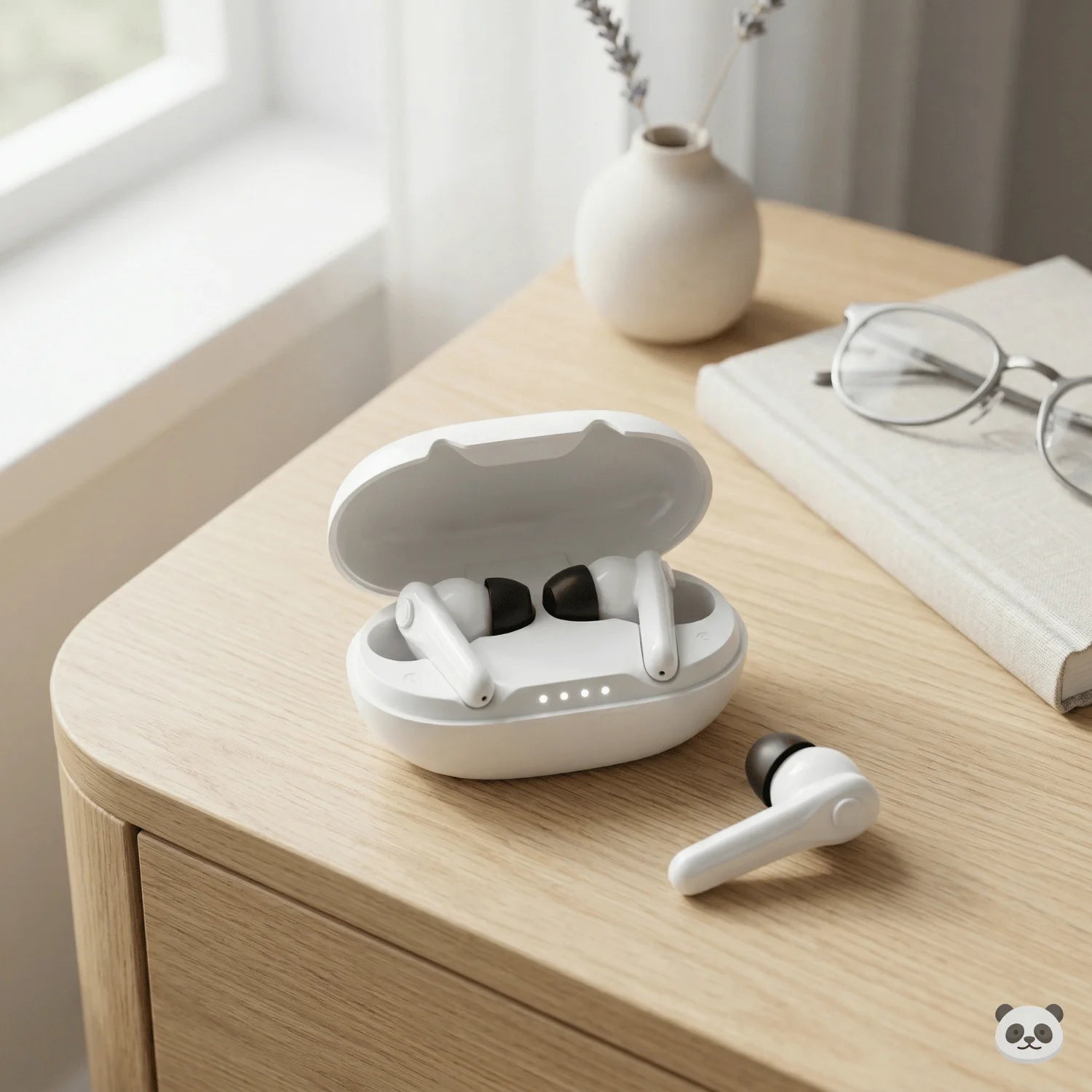
You have finally decided to do something about your hearing, but the idea of a visible, medical-looking device still stops you at checkout. You want something that looks like the earbuds everyone around you is already wearing, not a hearing aid that announces itself the moment someone glances your way.
Panda Air and Cearvol's Wave both chase that same earbud-style promise, and both are sold as FDA-OTC hearing aids without a prescription. But a closer look at Cearvol's own product pages, lab reviews, and published refund policy shows the two devices do not deliver on that promise in quite the same way. Here is what the research actually shows, using Cearvol's own published details.
Ready for hearing support nobody has to notice?
Shop Panda Air - $299Two Earbud-Style Aids, Two Different Ideas of Discreet
Panda Air was designed to look and feel like modern wireless earbuds, so nobody has to know it is a hearing aid. Cearvol's Wave is priced between $399 and $497 depending on the retailer, and independent lab reviewers describe it as a visible in-ear style device, meaning it is built to look like a modern earbud rather than a traditional hearing aid, but is still described as visible in the ear rather than tucked away.
Both stream Bluetooth audio and both are rechargeable. Cearvol leans on an in-house processing platform it calls NeuroFlow AI, while Panda Air relies on a clinically tuned self-fitting hearing test to personalize sound to your specific hearing profile. The difference between those two approaches shows up the moment you actually put either device on, not just when you compare spec sheets side by side.
Cearvol is a newer entrant that spent years building consumer headphones and audio products before moving into hearing care, and that audio-first background shows in how the Wave is marketed: sleek colors, touchscreen controls, and a lifestyle-forward pitch. Panda Air comes at the same problem from the opposite direction, starting with hearing correction first and wrapping it in a design that happens to look like the earbuds you already own.
| Feature | Cearvol Wave | Panda Air |
|---|---|---|
| Price | $399-$497 | $299 |
| Form Factor | ITE, described by reviewers as "visible in-ear style" | ITC, AirPods-style design built to pass as everyday earbuds |
| Bluetooth | Bluetooth 5.3, calls and streaming | Bluetooth calls, TV audio, and music, routed directly through the hearing aids |
| Sound Personalization | App-based NeuroFlow AI equalization, no hearing test | Clinically tuned 10-minute self-fitting hearing test |
| Battery Life | Up to 28 hours total with charging case | Fast-charge case providing 60 hours total |
| Noise Reduction | NeuroFlow AI 2.0, up to 20dB reduction | 16-channel WDRC with Multi-Band Adaptive noise reduction |
| Documented Fit Feedback | Independent testers flagged own-voice comfort as boomy or plugged-up | Feather-light design, less than the weight of a dime |
| Warranty | Not published on manufacturer site | 5-year warranty |
| Return Window | Advertises a 45-day trial, but published policy asks for a return request within 7 days of delivery (3 days outside the US and Japan) | 45-day risk-free trial, no fine print |
| Certifications | FDA-registered | FDA-OTC, CE, FCC, ROHS, EMC, ISO 9001 |
Panda Air - $299
5-year warranty, 45-day risk-free trial, free shipping. FDA-OTC certified.
See Panda Air →Visible In-Ear vs Nobody Has to Know
Picture meeting a friend for coffee and catching them glance twice at your ear, trying to figure out what that device is. That is exactly the moment earbud-style hearing aids are supposed to prevent, and it is where Cearvol Wave and Panda Air part ways.
Independent lab reviewers describe the Wave as a visible in-ear style device, built to resemble a modern earbud but still noticeably present in the ear rather than blended into it. Cearvol leans into that stylish, colorful look, which works for some, but it is a different goal than true discretion.
Panda Air was built around a more specific promise: an AirPods-style wireless earbud design so nobody has to know it is a hearing aid. Feather-light, at less than the weight of a dime, it is engineered to disappear visually the same way modern wireless earbuds already do, so the only thing anyone notices is that you are part of the conversation again. As a modern earbud-style hearing aid and a Bluetooth OTC hearing aid in one, it is built to fit into a life that already revolves around wireless audio, not stand apart from it.
Own-Voice Comfort: The Trade-Off Reviewers Keep Flagging
A hearing aid that makes your own voice sound strange is one you will want to take off by lunchtime. This is where Cearvol Wave's lab results get more complicated. HearAdvisor's own testing calls out own-voice comfort as the device's main trade-off, describing the sound as more plugged-up or boomy than competing devices. Consumer testers cited by NCOA echoed the same complaint, with one tester noting the amplification felt like there was a microphone in her ears and that her own voice sounded echoey.
Panda Air is built around earbud comfort paired with smart tuning, using its self-fitting hearing test to calibrate sound to your ears specifically rather than applying one generic processing curve to every wearer. The goal is a device you forget you are wearing, not one you notice every time you speak.
Hear yourself clearly, not just everyone else.
Try Panda Air - $299Self-Fitting Without the Guesswork
Cearvol's Wave depends on an app-based system it calls NeuroFlow AI to shape sound, adjusting noise reduction and speech enhancement algorithmically, but without ever measuring your actual hearing profile first. It is personalization built on assumptions about what most users need, not on what your ears specifically need.
Panda Air starts with a clinically tuned self-fitting hearing test, taken online in about ten minutes, no clinic visit required. That test measures the specific frequencies you struggle with and tunes the device around your actual hearing profile, the same kind of frequency-specific correction an audiologist would use in an in-person fitting. It is a self-fitting OTC hearing aid built around your ears, not a generic algorithm applied to everyone equally.
Read the Fine Print Before You Buy
Cearvol advertises a 45-day risk-free trial prominently on its site. Its own published refund policy, though, states that return requests from the United States must be submitted within 7 days after delivery, and just 3 days for orders shipped internationally from China. That is a meaningful gap between the headline promise and the fine print, and it is worth reading closely before you commit $399 or more.
Panda Air's 45-day risk-free trial does not come with a shorter footnoted return-request window. You get the full 45 days to decide, backed by a 5-year warranty, so the number on the landing page is the number you can actually rely on. For a rechargeable hearing aid you are trusting with your daily hearing, that kind of straightforward guarantee matters as much as any spec on the table above.
The Verdict
Panda Air wins this matchup on the things that decide whether you actually wear the device every day: a design built to disappear rather than just look stylish, a real hearing test instead of a generic AI curve, more battery per charge, and a 45-day trial with no shortened return-request window buried in the policy page. Panda Air is $299, FDA-OTC certified, backed by a 5-year warranty, for less than Cearvol Wave's $399 to $497 asking price.
Frequently Asked Questions
Is Panda Air really less noticeable than Cearvol Wave?
Yes. Independent reviewers describe Cearvol Wave as a visible in-ear style device built to look like an earbud, while Panda Air is engineered specifically to pass as an everyday wireless earbud, at a lighter weight and with a more discreet profile.
Does Panda Air's 45-day trial have the same fine print as Cearvol's return policy?
No. Cearvol's published refund policy asks for a return request within 7 days of delivery in the US, despite advertising a 45-day trial. Panda Air's 45-day risk-free trial applies with no shortened request window.
Will Panda Air fit my ears comfortably?
Panda Air's earbud-style design was built for all-day comfort, and its self-fitting hearing test tunes sound to your specific hearing profile so your own voice does not sound boomy or overprocessed the way some Cearvol Wave testers have described.
The Stigma-Free Choice With a Real Safety Net
Cearvol Wave gets the earbud styling half right, but independent testers keep flagging the same own-voice discomfort, and its own refund policy quietly shortens the 45-day promise to a 7-day window once you read past the banner. Panda Air solves the same want, hearing support nobody has to notice, with a design built to disappear, a real hearing test behind the sound, and a 45-day trial that means exactly what it says. For $299 against Cearvol's $399 to $497, that is a clearer answer at a kinder price.
If you want an earbud-style hearing aid that looks like everyday life and holds up to a closer look, Panda Air is the best hearing aid for anyone who wants support without the stigma. Try it for 45 days, risk-free. If it is not the fit you hoped for, send it back for a full refund, no questions asked.