Home-Based Listening-and-Thinking Game Shows Cognitive Gains for Older Adults With Age-Related Hearing Loss
In a pilot randomized trial, older adults with age-related hearing loss who completed a web-based game that trains hearing and attention together showed measurable improvements in attention and aspects of cognition compared with a waitlist group.
Age-related hearing loss is one of the most common conditions of later life, and a growing body of research links it to social isolation, loneliness, faster cognitive decline, and a higher risk of dementia. That connection has pushed scientists to ask whether interventions that exercise hearing and thinking at the same time might protect older adults better than approaches that target just one.
A team led by researchers at The Hong Kong Polytechnic University, with collaborators at Columbia University and the University of California, San Francisco, built and tested a home-based program designed to do exactly that, and published their early results in JMIR Aging.
Title: Web-Based Gamified Auditory-Cognitive Dual-Task Training for Older Adults With Age-Related Hearing Loss: Pilot Randomized Controlled Trial
Authors: Ivy Yan Zhao, Angela Yee Man Leung, Chen Li, Laurence Lloyd Parial, Hongming Ma, Jed Montayre, Justin S. Golub, Robert Sweetow, Janet Ho-Yee Ng, Engle Angela Chan
Affiliations: The Hong Kong Polytechnic University; University of the Philippines Manila; Columbia University Irving Medical Center, New York; University of California, San Francisco
Journal and publication date: JMIR Aging, published June 16, 2026
Study type: Pilot randomized controlled trial
PubMed / DOI: https://doi.org/10.2196/84083
Background: Why the Researchers Looked at This
Age-related hearing loss, sometimes called presbycusis, is the gradual decline in hearing that comes with aging. It does more than make conversation harder. When the brain has to strain to decode muffled speech, fewer mental resources are left for memory and attention, which may be part of why hearing loss is tied to cognitive decline over time.
The intervention tested here is what researchers call auditory-cognitive dual-task training. In a dual-task exercise, a person practices listening and a thinking task at the same time, mirroring the demands of real life, where you might follow a conversation while also remembering what was said. The idea is that training both skills together builds capacity that neither one alone would.
The authors also noted a practical gap. Few auditory or auditory-cognitive training programs exist in Chinese languages, which leaves many older adults facing linguistic and cultural barriers to this kind of help. They designed their game-style program to be culturally adapted and usable at home, without a clinic visit.
How the Study Was Done
The researchers enrolled 60 community-dwelling older adults with mild to moderate age-related hearing loss and randomly assigned them, in a one-to-one split, to either the training program or a waitlist control group that did not start the program right away. The trial was single-blinded, meaning the people assessing outcomes did not know which group each participant belonged to. On average, participants were about 68 years old, and roughly three-quarters were men.
Participants were measured at the start, at week 6, and at week 12, using a battery of tools that included a Hong Kong version of the Montreal Cognitive Assessment, an auditory verbal learning test of memory, tasks gauging focused and divided attention, and a questionnaire capturing the emotional and social toll of hearing difficulty. After the program, the team also interviewed participants to understand how the experience felt in practice.
What the Researchers Found
The program proved both feasible and well liked, and it produced the clearest gains in attention. Compared with the control group, trained participants improved significantly on focused attention (a moderate effect, with a P value of .02) and on divided attention, the harder skill of juggling more than one stream of information, where the effect was larger still and highly significant (P of .002).
On the cognitive screening test, the training group showed significant improvement in naming and in visual cognition, while the control group did not improve on these measures. A memory measure, the five-minute delayed recall on the auditory verbal learning test, favored the trained group by a small to moderate margin. The researchers also recorded a statistically significant interaction over time for left-ear hearing thresholds, hinting at a possible effect on hearing itself, though this is an early and tentative signal.
Both groups reported feeling less burdened by the emotional weight of their hearing difficulty, with a slightly larger improvement among those who trained. When participants described the experience in interviews, three themes surfaced: the program made intuitive sense and they enjoyed it, they felt real benefits in thinking and self-awareness, and over time it came to feel less effortful and more confidence-building.
Because this was a pilot study, the authors frame these results as promising signals rather than proof. They suggest future versions could add artificial-intelligence-driven personalization and call for larger trials to confirm whether the benefits last and translate into everyday life.
What It Means for People with Hearing Loss
The study reinforces a theme that keeps recurring in hearing research: the ear and the brain are deeply connected, and supporting one can ripple out to the other. For older adults worried about memory and focus as much as about hearing, an engaging program that exercises both at once is an appealing prospect, particularly one that can be done at home.
It is worth being clear about what the program is and is not. Training of this kind is meant to complement, not replace, actually treating the underlying hearing loss. The participants here still had mild to moderate hearing loss, and addressing that loss directly remains the foundation on which any auditory-cognitive benefit is built.
Staying Sharp Starts With Actually Hearing the Conversation
The premise running through this research is that the brain can only work with the sound it receives, so the first step toward staying cognitively and socially engaged is hearing speech clearly in the first place. One of the encouraging practical notes in the study is that older adults handled an app-based, at-home program comfortably, which is the same model modern over-the-counter hearing aids rely on.
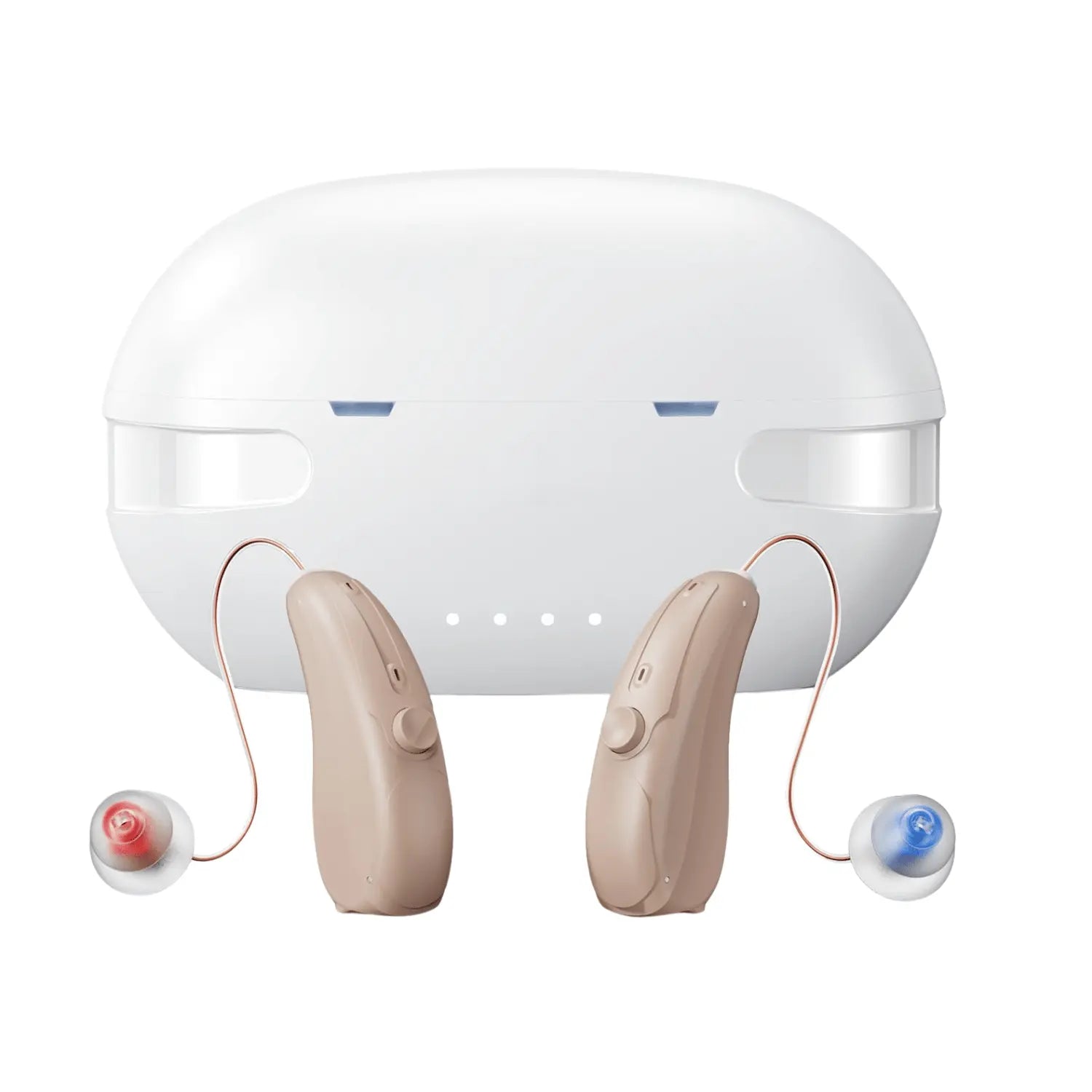
The Panda Air is built around that same at-home, app-driven approach. It is one of the self-fitting OTC hearing aids that includes a hearing test you run through the device itself: after the earbud-style aids arrive, you pair them with the Panda app, the app checks your hearing across frequencies, and it then tunes the devices to match your audiogram automatically, the way a clinician would at a fitting appointment. That app-based hearing personalization means the people most likely to benefit from training like this can address the underlying loss without booking a clinic visit.
On the hardware side, the Air pairs 16-channel processing with multi-band adaptive noise reduction to lift speech out of background sound, and its case provides 60 hours of use on a fast charge. It also carries a 5-year warranty and a 45-day return window. As always, OTC devices are cleared for mild to moderate hearing loss, the same range the study participants had, while severe or profound loss is still best served by a clinical evaluation. You can read more about the Panda Air if an app-tuned device suits where your hearing stands.
Limitations of This Research
This was a pilot trial, and its size and design call for caution. With just 60 participants and a control group that was simply waitlisted rather than given an alternative activity, some of the improvement could reflect the attention and engagement of being in a program rather than the training itself. The sample was also about three-quarters male and drawn from a single cultural and linguistic setting, which limits how widely the findings can be generalized.
The follow-up ran only 12 weeks, so it is unknown whether the gains persist or fade. The authors did not detail funding or competing interests in the abstract. Taken together, these results are best read as an early, hopeful proof of concept that now needs confirmation in the larger, longer, more rigorously controlled trials the researchers themselves are calling for.
What to Do With This
If you or someone you care for is living with age-related hearing loss, the useful takeaway is that hearing health and brain health travel together, and that engaging, low-barrier tools are emerging to support both. The strongest move remains addressing the hearing loss itself, then layering on activities that keep the mind active. Treat this study as one more reason to take early hearing changes seriously rather than waiting them out.
Zhao IY, Leung AYM, Li C, Lloyd Parial L, Ma H, Montayre J, Golub JS, Sweetow R, Ng JH, Chan EA. Web-Based Gamified Auditory-Cognitive Dual-Task Training for Older Adults With Age-Related Hearing Loss: Pilot Randomized Controlled Trial. JMIR Aging. 2026. Retrieved from PubMed. https://doi.org/10.2196/84083